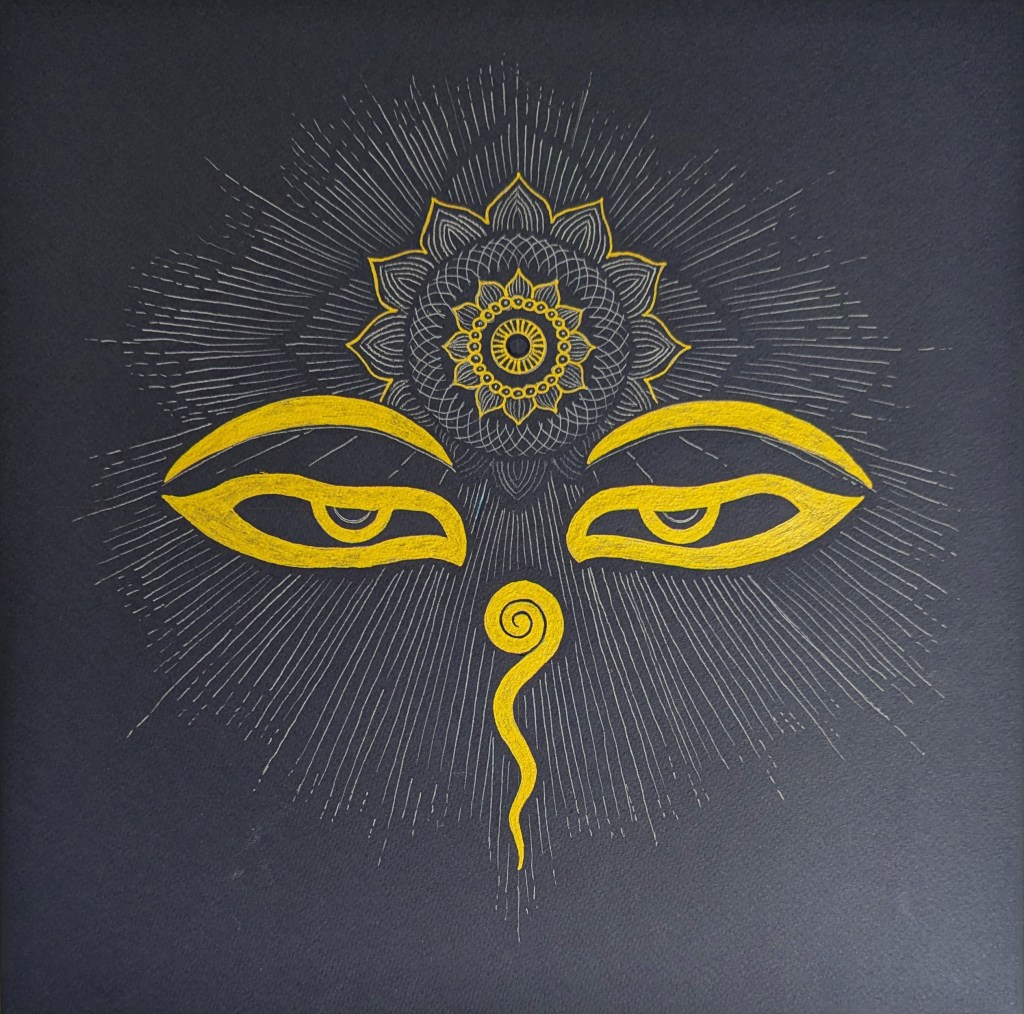
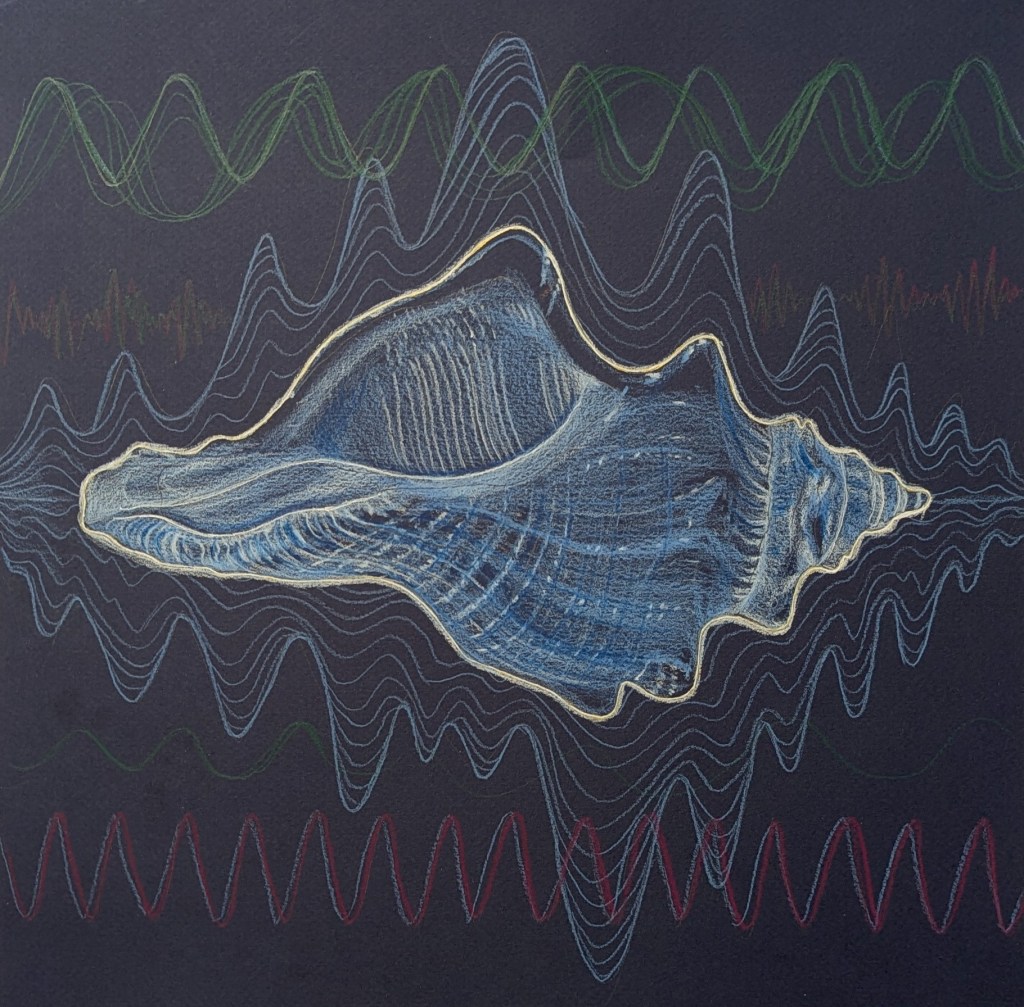
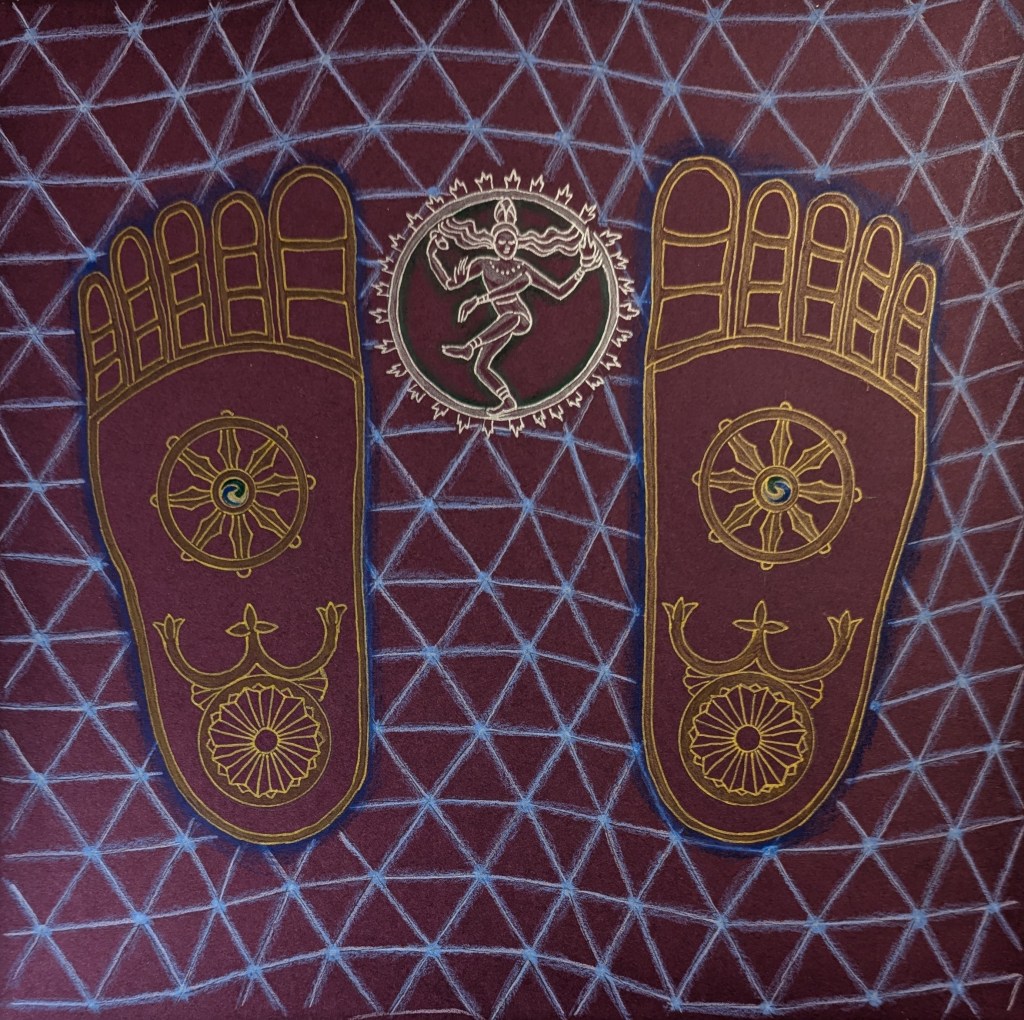
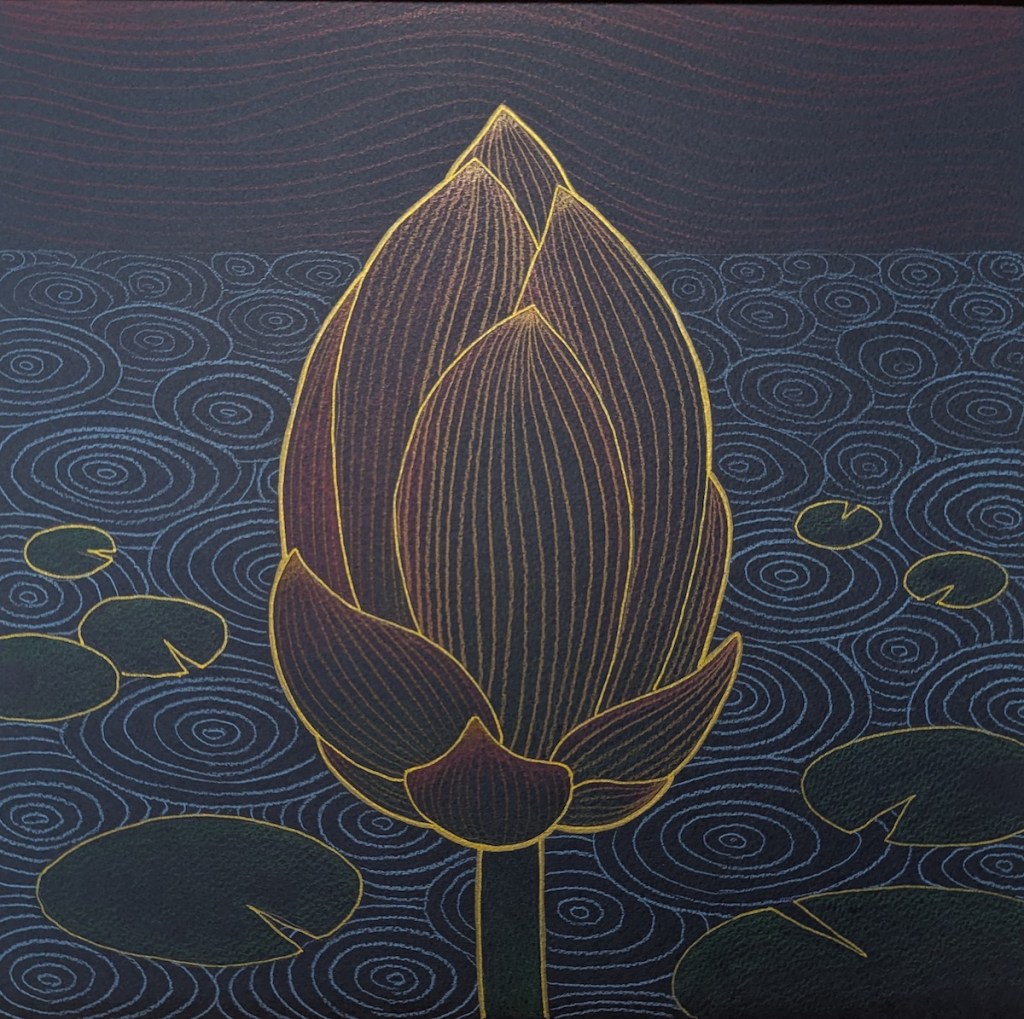
Eyes of the Buddha. Gold ink and color pencil on blue paper, 12″ x 12″.Samyak Vac (conch with sound waves). Color pencil on paper, 12″ x 12″.Footprints of the Buddha. Gold ink and color pencil on red paper, 12″ x 12″.Samyak Sankalpa (lotus bud). Gold ink and color pencil on blue paper, 12″ x 12″.
For my essay series “Turning the Eight-Limbed Wheel” on earthwitness.online, I’ve been making a small drawing for each limb. I’m halfway through now, with four pieces of eight completed. It’s been a lot of fun working at a small scale with simple subjects, as opposed to the large, involved compositions of my last show. Maybe next year these will appear in another show.
If it’s seemed quiet on this site lately, it’s because I’ve been focusing my efforts on a new project: Earth Witness Online, a combined newsletter and podcast that collects my reflections on Buddha Dharma, somatic practice and connection with the living world.
I first began practicing Zen when I was quite young, just 21 years old. Early on I had the opportunity to live and work with Robert Aitken Roshi at his home in Hawaii, and his work and presence continue to be a lasting inspiration. This was also my first entry in serving the Dharma in a professional capacity.
I also trained for many years at the Zen Center of Denver (where I continue to practice today), under first Danan Henry Roshi and then Karin Kempe Roshi. I also served the ZCD for seven years as office manager and resident caretaker, and I was deeply involved with the planning, design and fundraising for the ZCD’s new temple on Columbine Street.
More recently, I spent three years as resident manager and chef for Rocky Mountain Ecodharma Retreat Center, north of Boulder under the Indian Peaks. While the position offered many challenges (namely running a busy retreat center and maintaining a rustic lodge while cooking three meals a day for our guests), it also afforded me numerous opportunities to connect with both the land and with dozens of Dharma teachers. These included teachers such as David Loy, whose work on ecodharma connects Buddhist practice with ecological sustainability and social and political activism, which will be a persistent theme in the podcast.
Friends will know I’ve also had a decades-long interest in yoga, and recently I’ve been digging into Buddhism’s yogic roots, examining the Noble Eightfold Path as an embodied and energetic practice. I have thus embarked on a series of talks titled “Turning the Eight-Limbed Wheel: The Somatic Practice of Buddha Dharma.”
Finally, I will also be periodically posting vegan, vegetarian and gluten-free recipes, both for retreats and at home. While the Dharma posts will be completely open access, the recipes will be available to subscribers only (although they’ll still be free).
This is all at the outset, and the continued development of Earth Witness will depend in some measure on the response. In the meantime, I’ll be offering new posts weekly (more or less) at earthwitness.online. If you’d like to receive the newsletter in your inbox, just click subscribe. You can also follow the podcast on Apple Podcasts or Spotify (links below).
First, thanks to everyone who braved the snow to make it out to the show opening on First Friday at Core. It was such a joy to share these pieces and engage in so many meaningful conversations with friends, acquaintances and strangers alike. Putting on the show has already been a profoundly awarding experience, allowing me to further develop my artistic style and create not just individual pieces but a body of work, a longstanding life goal. Of course part of me is always thinking of the pieces I didn’t have time to create, but to be real, these are ambitious and highly detailed pieces and they simply take me a long time.
In any case, if you missed the opening, I’ll also be hosting a closing reception this Saturday, March 21, from 1-3 p.m. at Core Art Space, with a talk around 1:30 p.m. The talk will focus on the symbolism of the Dharma Wheel as it relates to the Four Noble Truths and the Noble Eightfold Path, and then we’ll have a question and answer period. I’d love to see you there!
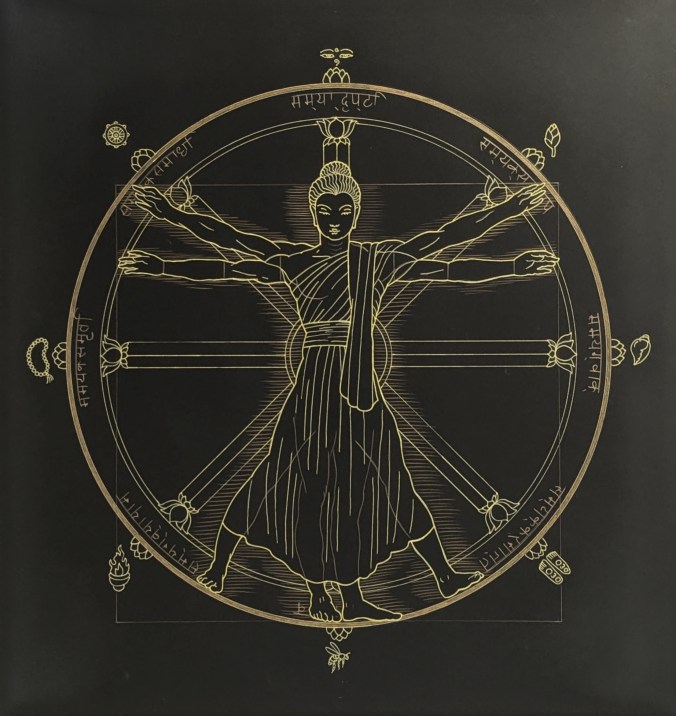
THE EIGHT-LIMBED WHEEL (VITRUVIAN BUDDHA). Color pencil and gold ink on black paper. Buddhism is called the Noble Eightfold Path, Arya Ashtanga Marga in Sanskrit. Interestingly, the term ashtanga is usually translated as “eightfold,” which is perfectly correct, but it can also translate as “eight-limbed.” Yoga practitioners will know the term in another context, as Ashtanga Yoga–“eight-limbed yoga”–a style popularized by K. Pattabhi Jois in Mysore, India, at least nominally based on the Yoga Sutra of Patanjali.
Drawing on (literally) Da Vinci’s Vitruvian Man, here the Buddha is superimposed upon the eight-spoked Dharma wheel. Each spoke features both the Sanskrit text for the particular limb, along with a Buddhist symbol intended as a mnemonic. The eight limbs thus include:
Samyag drishti, Wise Vision, represented by the Eyes of the Buddha;
Samyak sankalpa, Wise Intention, a lotus bud;
Samyak vach, Wise Voice, a conch;
Samyak karmanta, Wise Action, the Buddha’s footprints;
Samyak ajiva, Wise Sustenance, a bee gathering pollen;
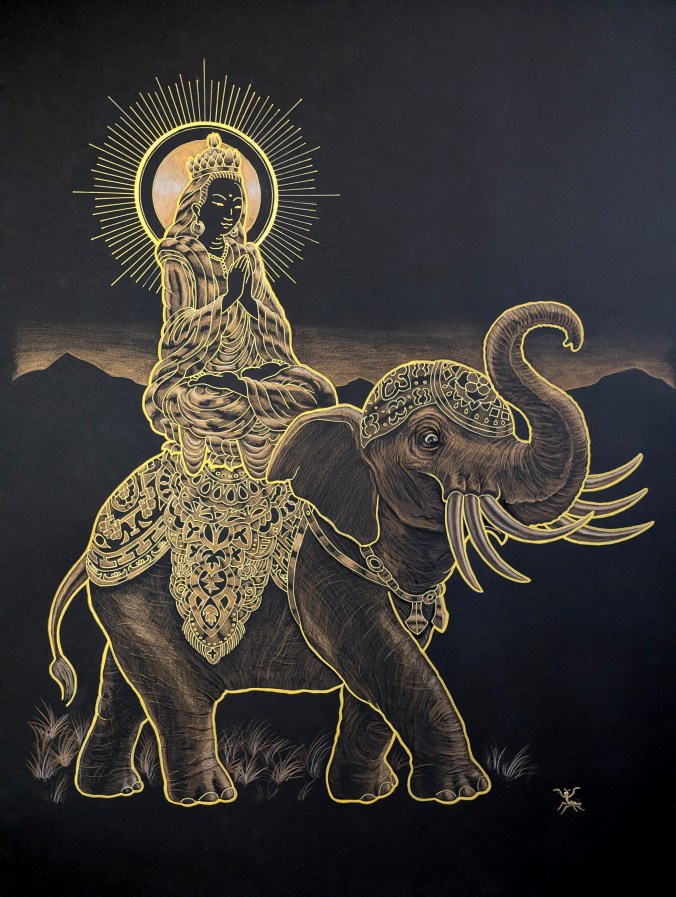
SAMANTABHADRA GREETS THE MANTIS. Color pencil and gold ink on black paper, 22″x30″. Samantabhadra is the bodhisattva of great action, whose gentle persistence is represented as an unstoppable elephant. This piece is inspired by a line from Yung-chia’s “Song of Enlightenment”:
“The elephant-drawn carriage moves like a mountain; how can the mantis block the road?”
The “elephant-drawn carriage,” in this instance, is Mahayana Buddhism, while the mantis represents lesser doctrines. Yet when we encounter delusive thoughts and beliefs, we need not rage or seek to destroy them, but can rather raise our hands palm-to-palm in greeting, recognizing these errors as old friends, like the foibles of a beloved brother or sister. Presenting no true obstacle, they are no threat to us, and so our minds and hearts move freely, unencumbered by any hindrance.
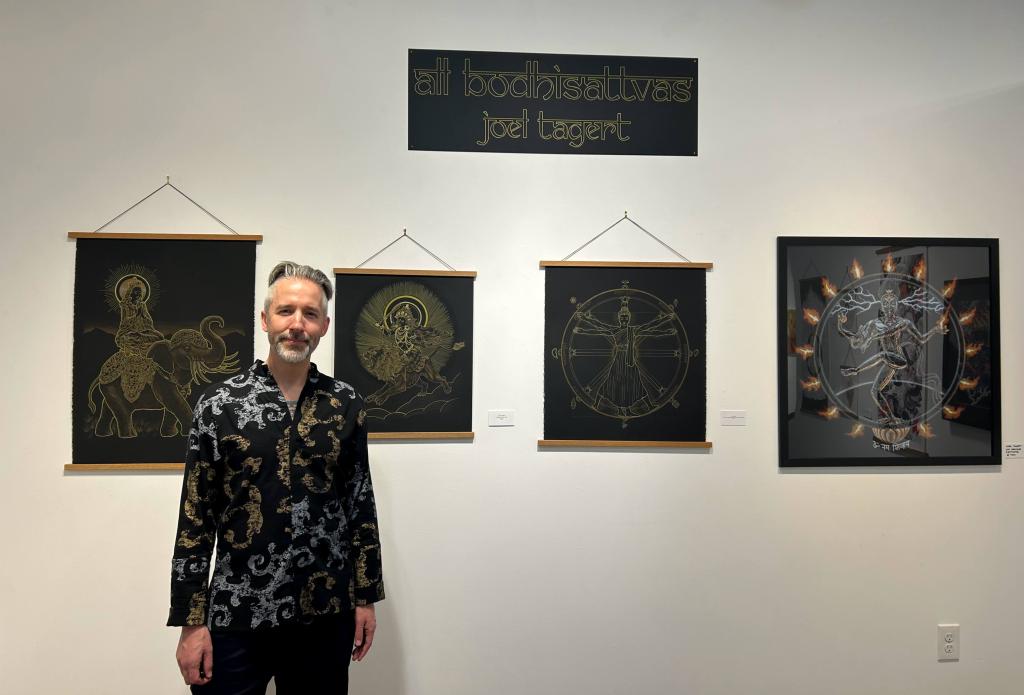
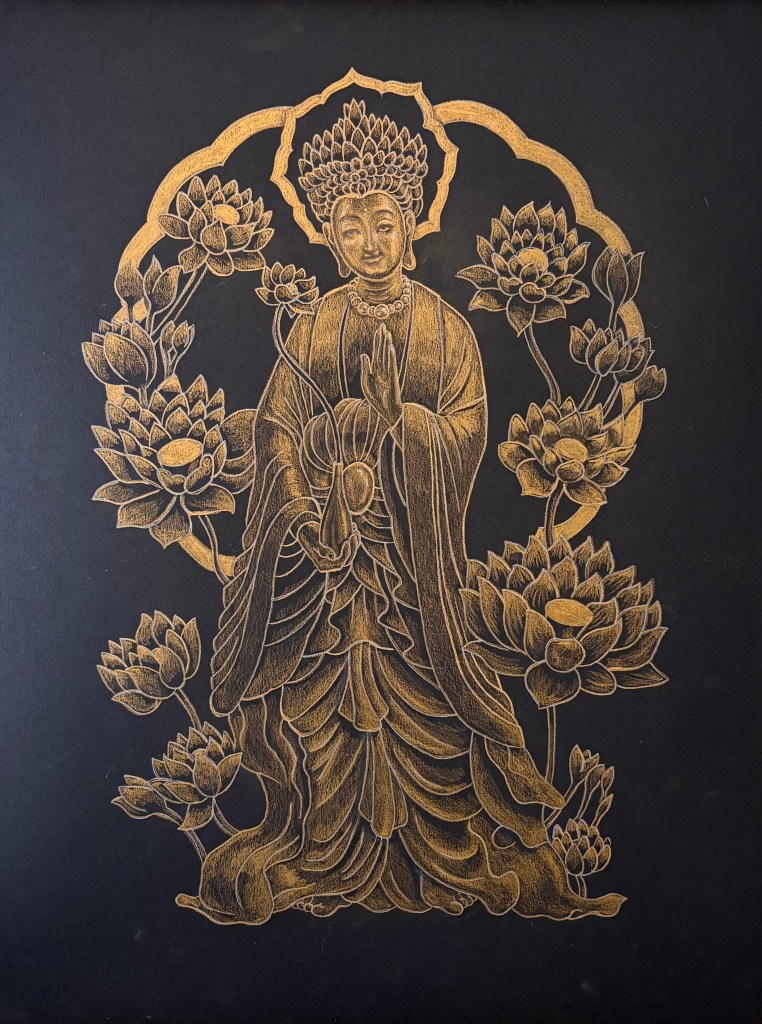
“All Bodhisattvas throughout space and time,” chant countless Buddhists around the world, invoking a multitude of awakened beings in past, present and future to help ease the suffering of the world and liberate all beings from delusive ignorance. In my upcoming show “All Bodhisattvas” at Core Art Space March 6 – 22, I draw on millennia of Mahayana Buddhist tradition to present these powerful archetypes with renewed vigor, grace and poise.
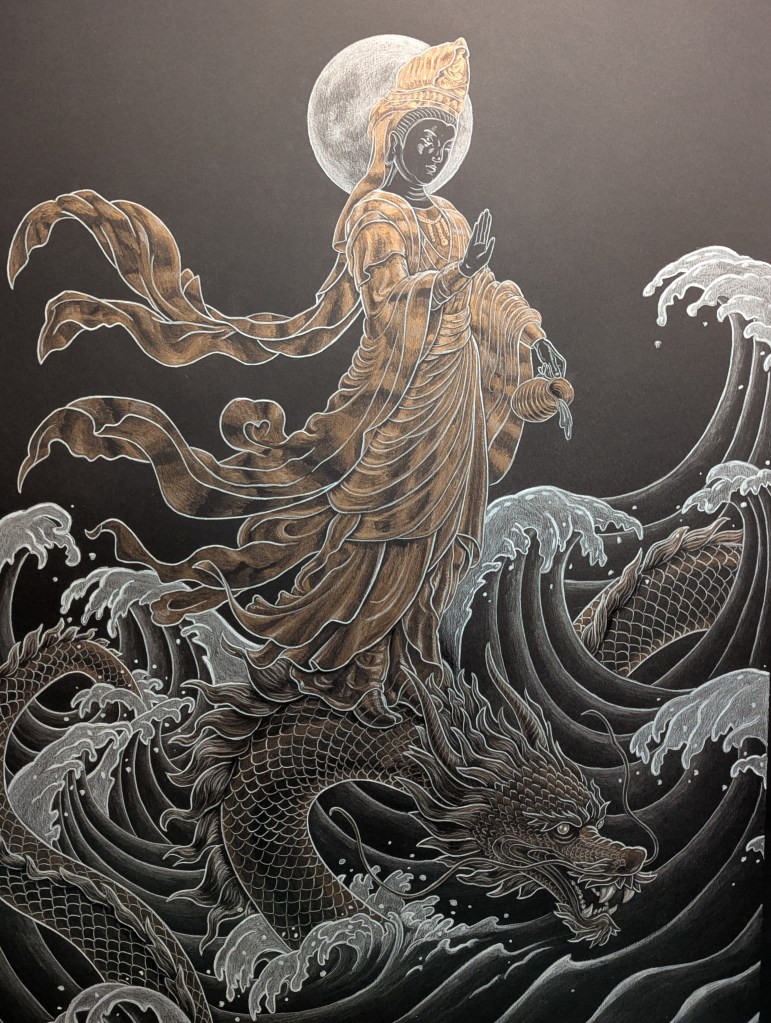
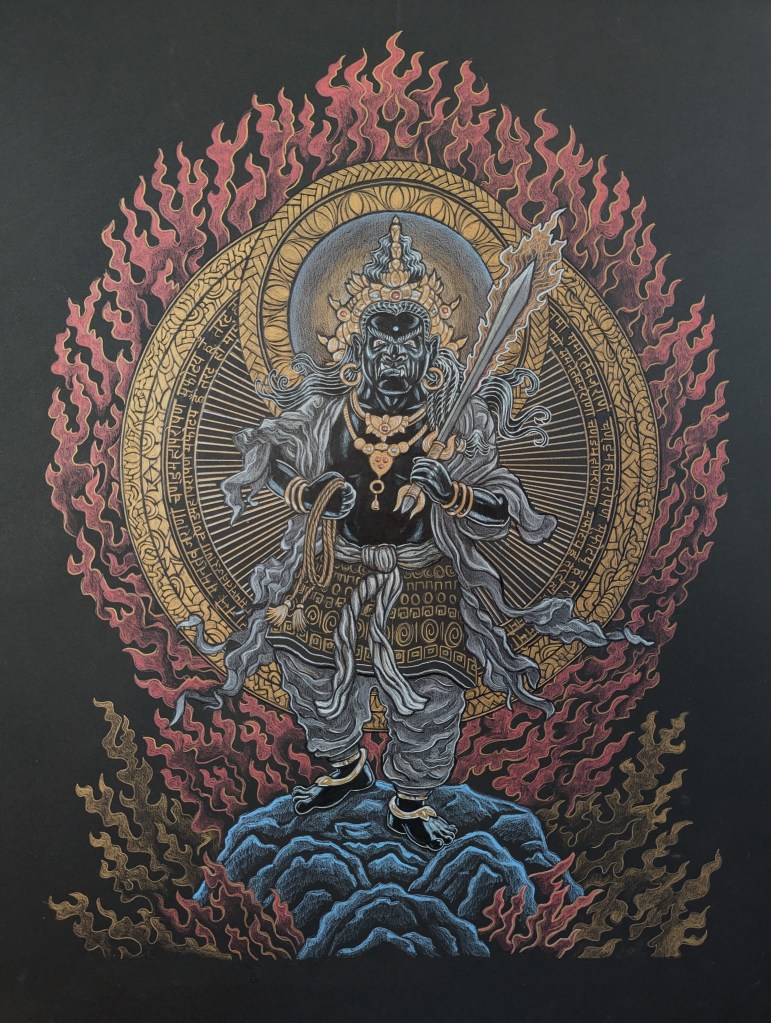
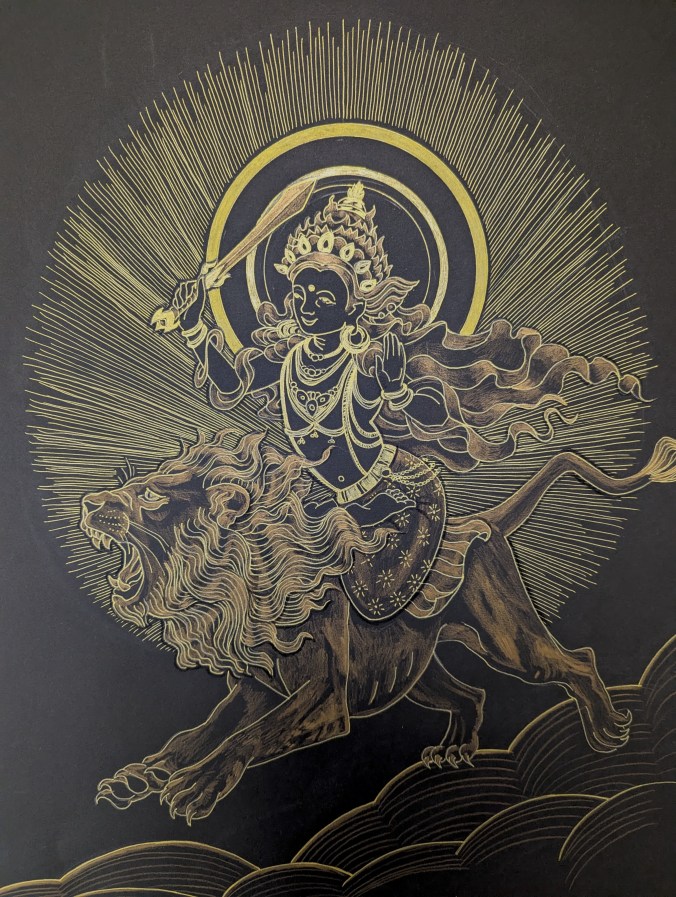
My drawings are particularly inspired by Himalayan and Japanese traditions of painting on black backgrounds, making special use of metallic gold pen and pencil on black paper for strikingly rich palettes and contrasts. The figures’ compositions likewise owe much to these traditions, along with nods to Buddhist lineages in Thailand, China and India, the flowing lines of Art Nouveau and the body-punch of Japanese tattoo design. At once lifelike and highly stylized, these figures glare and glide, leap and laugh. Fudo Myoo brandishes his sword and bugs his eyes in challenge; Manjusri bursts from the underbrush on a lion; Kannon surfs serene through the ocean tumult. Together they cry, “Wake up! Wake up! Wake up!”
“All Bodhisattvas” opens in the Annex at Core Art Space Friday, March 6, with an opening reception from 6-9 p.m.
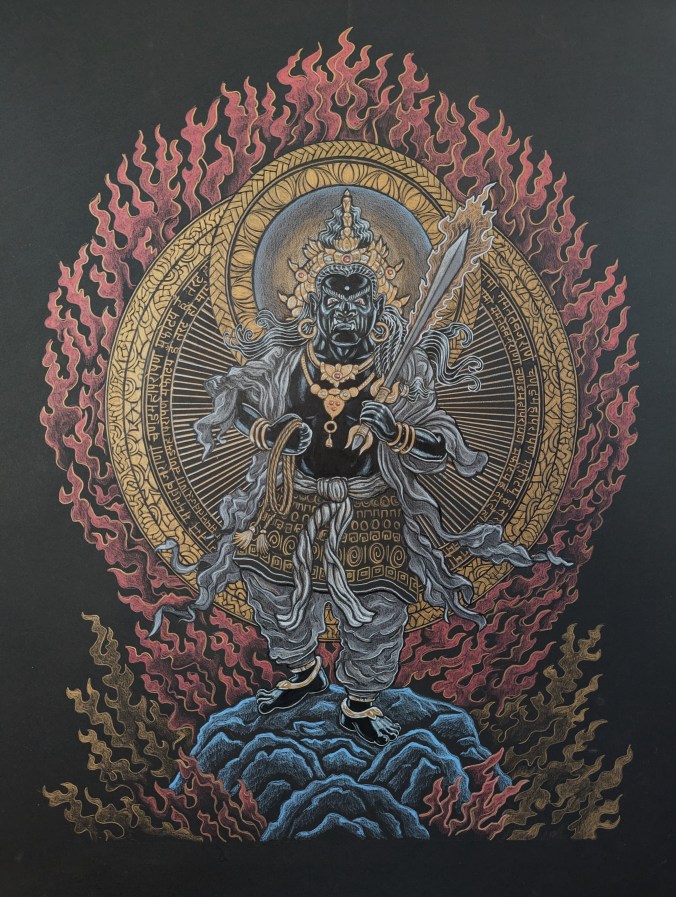
Fudo Myoo, Immovable Wisdom King. Color pencil on black paper, 22″x30″. As usual sharing these images online is a cruel insult, since the camera never comes close to showing the scale, the depth of hue and the play of light on the metallic gold pencil, which is used extensively here.
However, I’ll be showing this piece and more at Core Art Space at a small solo show opening March 6, so come out if you’d like to meet Fudo in person. Announcement to follow.
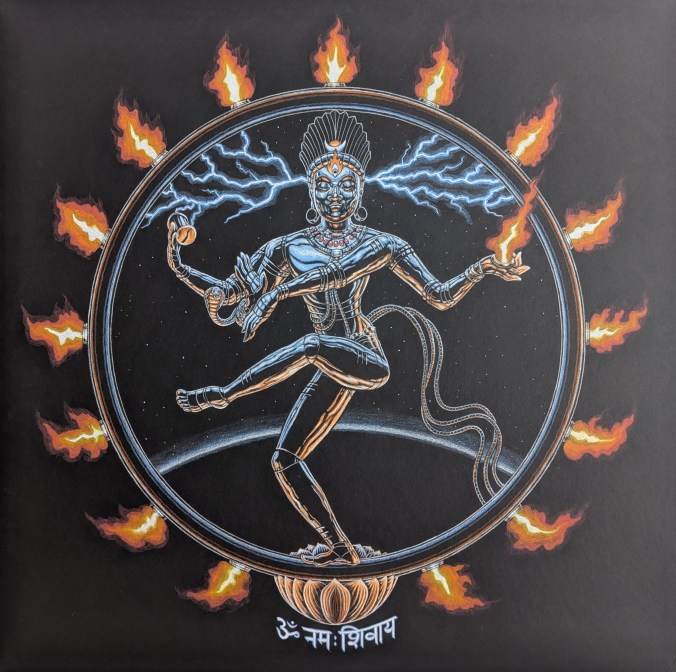
Color pencil on black illustration board, 32″ x 32″. Om Namah Shivaya translates as “I bow to Shiva,” though it can also be interpreted with each of the five syllables (na mah shi va ya) corresponding to the five elements (earth, air, fire, water, space), Shiva having dominion over them.