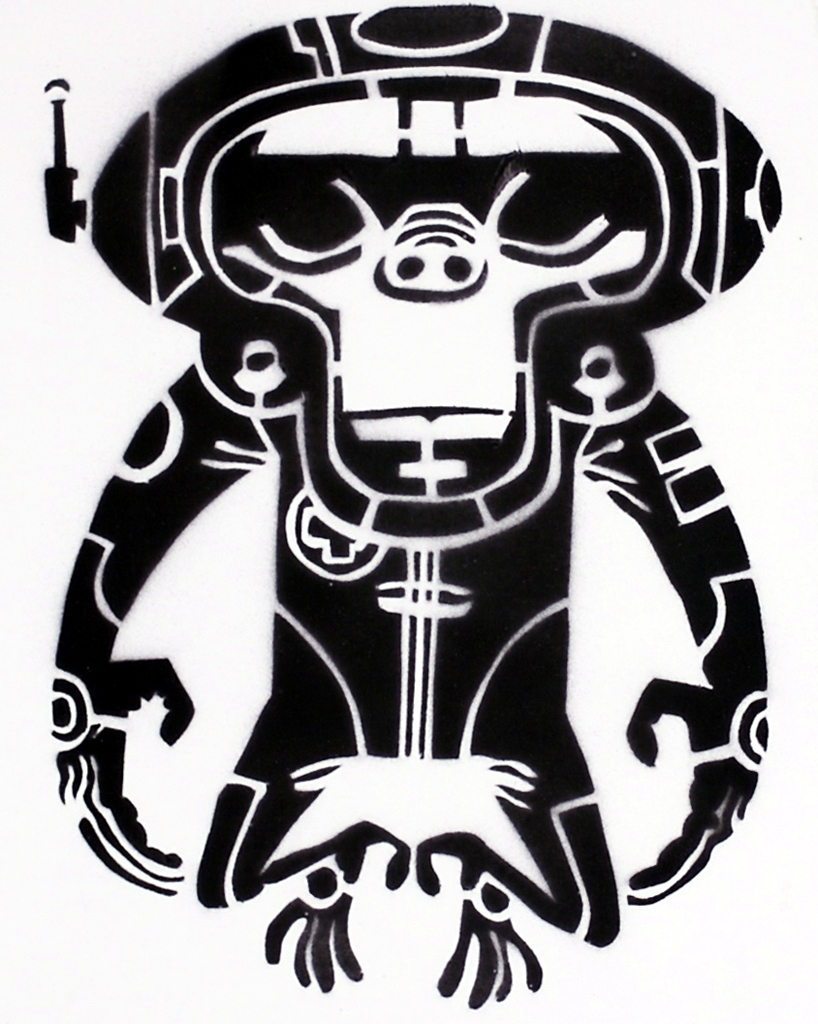
Jack in the Box

The doctor finally brought it over in what looked like a very sophisticated cat carrier. Of course, at first Lew had no idea what was in the grayish box with its LCD screen and blinking lights, and just stood frowning blearily at this unexpected morning visitor in his doorway. You’ve got the wrong apartment, he almost said, belatedly recognizing Dr. Velez from the accident. “How did you get in here?” he came out with instead.
“Your neighbor let me in,” she said, sounding almost apologetic. “I thought about buzzing up, but I knew it might just go to your phone again, and you never seem to answer that.”

“Sorry,” he muttered. He glanced down the hall as though he might find that easygoing neighbor there to accuse. “So what’s up?”

“Can I come in?”

He sighed, like he was in the middle of something, instead of sitting in front of his TV at ten in the morning. He looked briefly at the hallway behind him, and finally shook his head and stood aside.

It was then that he noticed the cat carrier, as she bent slightly at the knees to pick it up and pushed past him in the hall with the box balanced against her hips. It seemed, from her effort, to weigh a fair bit. “What the hell is that?”

“It’s why I’m here.”

No one but him had ever been inside the apartment, and with her entry he was forced to see it from her perspective. Kind of a shithole, or rather, a decent apartment occupied by a shitheel. A shitheel shithole. Flattened boxes behind the door in the hall, left from when he’d moved in six weeks ago. He kept meaning to take them out, but who gave a shit, right? More boxes, unpacked, in the living room. Bare beige walls. The steamer trunk that served as a coffee table overrun with dishes, beer cans, stacks of mail, including some of the preposterous medical bills for which Velez herself was partially responsible. Hopefully she wouldn’t look in the kitchen.

“New apartment?” she asked.

“Something like that.” He gestured toward the couch half-heartedly. Carefully she set down the carrier on the floor by the coffee table, turned and sat on the edge of the cushions.

“How’ve you been?”

Fucking awesome. Living that bachelor life. Now that my wife and son are dead, I party all night, sleep all day. Sometimes in between I dare myself to cut my wrists, but so far the beer’s keeping that in check. 

“Fine,” he said.

“Depressed?”

“What gave you that idea?” He went to the armchair that faced the couch, threw the dirty clothes off of it and onto the floor, and slumped down into its yellow embrace.

“Female intuition?”

“No, I’m not depressed. Everything’s fucking grand.” It was the worst year of his life, and not just the worst year so far. There would never be a worse year.

“Are you working?”

“Some.”

“You’re a … graphic designer, is that right?”

“Yep. My office, right there.” He waved at the computer on the desk.

“How’s business?”

“Keeps me going.” He rose. “You want a beer? I got Bud Light or Bud Light.”

She extended a hand to stop him on his way to the fridge. “Wait, please. Before you start drinking … there’s something you need to see.”

“Whatever’s in the cat carrier, I guess?” He frowned at the box by his feet. “What is in that thing? Is it actually a cat? Is that the idea here, like, get Lew something to take care of so he doesn’t off himself?” He nudged it with his toe. There were readouts on its screen, wave forms zigzagging in green light. “Is the cat sick or something?”

“It’s not a cat. Please, sit down and I’ll explain.” She gestured at the couch beside her. Inexplicably perturbed, Lew sat.

Velez began clearing space on the steamer trunk, transferring magazines to the floor, stacking dishes, pushing cans aside. Impatiently, Lew said, “Here,” and began helping her, taking the dishes to the kitchen, putting the cans in the recycling. Then he sat back down. She’d succeeded to that degree, he reflected. She’d made him clean up his living room.

“There. We good?”

“Can we turn off the TV, please?”

“All right, but you’re going to make me miss the second quarter of the Chick-fil-A Peach Bowl Semifinal game. It’s on your head.”

In the ensuing silence he could hear someone talking on their phone in the parking lot and the hum of the swamp cooler in the hall. “I’m here to talk to you about your son. Jack.”

“I’m not looking for a counselor,” he said brusquely.

“Maybe you should be. But that’s not why I’m here.”

“What then? What is it, some kind of permission you need for his organs again? You need me to sign so you can sell off his heart or lungs or his little fucking toes?” Angry tears were in his eyes. “And what’s in the fucking box?”

Just an accident. One of thousands. A car gets a flat on the interstate, spins out of control. The cars around it try to avoid it, and they too collide. You wake up to your wife and son dead beside you, half the car crushed in the press. He squeezed his eyes shut tight, wishing he could shut his memory off the same way. Leila had died instantly of brain trauma, Jack on the way to the hospital.

“During the accident, Jack’s body was catastrophically injured.” God, what a phrase. “His rib cage was crushed, his limbs … irretrievably injured.”

“Why are you telling me this?” he groaned.

“With your permission, he was taken to surgery for organ donation.”

Velez herself would barely meet his eye, instead fixing her gaze on a readout on the carrier. “Here’s where it gets a bit complicated. The surgeon working on Jack was – is – something of a pioneer in cryogenics. He had been looking for a patient like Jack for some time. A infant, very newly deceased, with a specific grouping of injuries. He believed, on the basis of his research, that certain properties of an infant’s cells and brain would allow resuscitation of the brain, where it had failed on more mature specimens.”

Lew’s own brain seemed to be frozen. He just kept staring at her incredulously. “You’re saying … he’s not dead?”

Finally she met his eye. She looked frightened, and why? But then she nodded, once. “That’s correct.” When this met with a shocked silence, she went on, “Dr. Bettencourt was able to electrically restart Jack’s brain. He then placed him in a life-support system and nutrient bath, thereby keeping him alive. He is alive, Lew.”

“Where?” he whispered. “Where is he?”

Her eyes slid uneasily to the carrier on the table. He looked at it in confusion. “What are you saying? He’s inside this thing?”

She nodded. There was a sheen of sweat on her forehead, though it was cool in the apartment. “I came here to show him to you. I wasn’t positive you would come to the hospital, and I felt strongly you needed to see him for yourself. Dr. Bettencourt took some persuading, but he had this unit available for Jack’s life support, and finally –”

“Why would I not want to see him?” Lew exclaimed. “And how in the fuck did you not tell me before? He’s alive?! He’s been alive this whole time? That’s sick, that’s –”

“Sit down, please. Please, Lew.” Her hand was extended like a shield. “You don’t understand. He was catastrophically injured.”

“Show him to me,” he commanded. “Show him to me.”

She nodded, biting her lip. She turned the carrier slightly toward him and tapped some commands on the LCD screen. It flashed. The front of the box opened, each side sliding back from the center line smoothly and mechanically.

His first thought: It’s a doll’s head.

His second: Why is it upside down?

His third, repeating: It’s not a doll’s head, it’s not a doll’s head, it’s not a doll’s head…

No, it was not a doll’s head. It was Jack’s head, cradled upside-down in the box’s softly lit heart by a score of foam-padded struts, silvery screws and glinting needles. His little neck was mercifully encircled by a two-inch-wide silver collar, above which extended a wrist-thick chock of vined and multicolored tubes, wires and conduits. Utterly horrified, not thinking at all, Lew sank to his knees, until he could look at that darling, serene face in its monstrous container.

God, it was, it was him. Those big pink baby cheeks, that pouty mouth hanging open, his golden hair. His eyes were closed, but between his so-fine brows Lew could see that Jack had a bit of a rash, the skin raised pink against the pale. Lew watched closely, realized with numb horror that his son’s nostrils were flaring slightly with each breath.

“You may be wondering why he’s upside-down,” Velez was saying. “Basically it’s to relieve downward pressure on all the, uh, connectors, the veins, arteries, nerves and whatnot. You can understand, this is extremely fine work. In fact most of the connectors are designed by AIs and created at a nanomolecular scale, it has to be that precise…”

“What did you do?” he interrupted hoarsely, finally tearing his gaze from that hideous, adored visage hanging in its box like the world’s most perverse diorama. Slowly he stood up, hands at his sides.

Velez saw the look on his face. “Listen, Lew. Listen to me. He doesn’t know what’s happened to him. Bettencourt has created a direct interface with Jack’s spinal cord that simulates all the sensations of having a body, modeled after other infants. He thinks he’s in a cradle, wiggling his arms and legs around, getting stronger. As he grows – and he will grow, every nutrient and hormone he needs is provided for – those sensations will become more complex. Eventually, he can either be transplanted to a suitable body, when and if one becomes available, or outfitted with an android body for movement in the real world. Or he can continue living virtually, remaining in his cradle and experiencing the world virtually.

“But the point is, he is alive. He thinks and feels, and he’s going to need real human relationships. He’s going to need a father. He –”

“What did you do?!” he shouted. His rage exploded from him, white hot and blinding, uncontrollable. “You fucking monster! Jesus Christ, what did you do, I should cut off your head, you sadistic fuck, then burn your goddamn laboratory to the ground, I swear to God, I’ll –”

He stopped mid-sentence, hearing the thin wail just below him. He knew that cry, and it twisted around his heart like a thorny vine.

“You woke him,” Velez said quietly, reproachfully, coming around the couch to place a hand into the carrier. “Shhh, baby, it’s okay, it’s okay.”

Slowly, knowing he was defeated, he knelt again on the carpet. Jack was crying, tears streaming downward from his eyes across his forehead and into his hair. Velez was trying to offer him a pacifier, but he wasn’t taking it.

“Here. You try.”

Numbly Lew took the pacifier. After a moment he reached out with it and held it lightly at his son’s lips. “Jack,” he said. Jack looked at him, stopped screaming, and took the pacifier.

Did Jack recognize him? Lew thought he did. Gently he reached out a finger and touched his son’s cheek. It was as soft as the day he was born.

New Year’s Resolutions

Often when I ask someone about their New Year’s resolutions, I get a negative response. “Why should New Year’s be special?” they say. “I feel like everyone makes resolutions on New Year’s and then forgets them a month later.”

On the one hand, the date is arbitrary, and of course you might fail to stick with your resolution. On the other hand, it’s an opportunity to gather up your gumption, your energy and will, which is to say, your resolve, and embark on an endeavor you may well have been dreaming about your whole life. If you fail, so what? There’s always next year – until there isn’t. As Goethe wrote, “Whatever you do or dream you can, begin it. Boldness has genius, power and magic in it.”

My 2016 resolutions are the same resolutions I’ve made for years now: Write another novel. Exercise regularly. Do more zazen. Listen carefully. Be less arrogant and more receptive. Support my community however I can. Love those close to me and far away. Stoke the fire of attention until every moment burns incandescent.

Calling Sheroy Brown

“Watch out for spiders,” Harry told him before he went out.

“Ha, ha,” Devin hefted his toolkit.

“I’m serious. Knew a guy one time, spider was hanging out on top of this old digger…”

“Tell you what, I’ll watch out for a fuel pump for a ’53 Nissan, since that’s what I’m looking for. But don’t worry, I’ll make sure it doesn’t bite.”

Actually there were eight items on his list. Hopefully it wouldn’t take him too long, because it was cold as fuck all outside. He let the door to the trailer slam shut and stepped out into the junkyard pulling on some insulated work gloves and putting up the leather-and-wool hood of his Carhartt jacket. Cheyenne winters were no joke.

He whistled for Sheroy Brown, but the damn dog didn’t come. Whistled again, waited. Nothing. Where was she? Devin stomped around to the dog house, wind nipping at his ass, the skies clouded. He ducked his head down, needlessly, because he could see that the German shepherd wasn’t in there. Well, where the hell was the bitch? She couldn’t have spent the night outside, and you would think with the weather she’d want to stay in her house, where it was warm.

So instead of heading out toward the north corner of the yard, where he knew there were a couple Nissans, he turned toward the fence and started walking the perimeter, calling and whistling. Jeez, he should have let her into the trailer at night. It was criminal to keep her out like this, even if they had run a vent right out to her house from the trailer. Only reason she didn’t sleep in the trailer was because of fucking Harry. Fat sonofabitch said she got hair over everything, made the office look bad for customers. As if anyone gave a flying fuck at a rat’s ass what a junkyard office looked like. After today he’d tell his uncle that Sheroy was sleeping in the trailer, and if Harry was still being a dick about it, she could just come home with Devin and stay in his apartment. Fuck what the landlord said.

On the eastern side the snow was drifted right up against the vehicles there. Chain link and barbed wire might keep out thieves, but it didn’t do shit for snow. His workboots were laced up tight, but even so by the time he got through it he could feel snow melting on his shins.

He’d made almost a complete circuit of the perimeter when he saw it: a spot where the chain link had been pulled out of the ground and pressed upward, leaving just enough room for a dog to wiggle through. Well, there was the answer. He was surprised Sheroy would try it, but apparently there’d been something out in the wide world she wanted to chase. He looked out at the hills, the irregular snow half-covering the blanched grasses, hearing the trucks dopplering past on the highway and the wind making static in his ears. “Fuck.”

Hopefully she would come home. Hopefully she wasn’t dead on the highway. He considered taking the Ford to go look for her, but… hell, she could still be in the junkyard somewhere.

So he went and looked over the Nissans, found what he wanted in a ’54 and worked at pulling it out. Then a left door from a Ford truck, and a side mirror from a Chevy sedan that he removed with just the Gerber multitool he always carried in his jeans pocket.

By now he really was freezing, but he thought he should get halfway through his list before going back in for lunch. Number four was a steering wheel from Toyota minivan. There was only one in the yard, and it hard probably been sitting there untouched for ten years now, but he thought the steering wheel was probably still in it.

Christ, they hadn’t made it easy to get to, though. Cars piled on all sides. Half of this stuff was just scrap, should have been cleared out of here ages ago. Not just cars, either – there were pallets of old generators, broken solar panels, a bunch of antique office computers. Sometimes Uncle Harry went to auctions and bid on lots, ended up with stuff like this. Then it sat there for twenty years. They should call the yard a museum and start selling tickets to come in and look.

You couldn’t even get to the van. Cars were piled right up against it, so you couldn’t open the doors. But one of the rear doors, maybe… He clambered right over the roof of a 2042 Ford Long Haul, a fucking antique, and finally hopped down from the hood onto honest ground again.  More litter scattered in the gravel and weeds, a soda can, a black power cord from who knows what.

Of course the rear doors were locked. He got out his jimmy bar, slid it down the window until he found the latch. Devin was a motherfucking expert at opening cars. He’d be a killer car thief, if he ever wanted to be. Instead you’re just a junkyard dealer. Not even that. Junkyard dealer’s assistant. But shit, he was young. Twenty-four was still young, right? So what if he’d never finished high school. He knew cars, and that was something. And he still got girls, or would, if he wasn’t with Lora. Lately she’d been talking about kids, which made Devin’s skin crawl. Maybe it was time to break it off with her, even if she didn’t mind blowing him when he asked. Things got stale, otherwise.

The lock gave with a gratifying click, and he stuffed the bar in his back pocket and hurried to put his gloves back on. His fingers were turning white. He opened the door, stuck his head inside, and froze.

The van wasn’t empty. Stretched out on the floor was a teenaged boy, shirtless and barefoot, bare white skin exposed to the cold, and Devin’s first thought was shit there’s a dead kid in here. He needed to call someone. Harry first, or the cops? Harry, get him out here. His gloved hand scrabbled for the phone in his pocket. Kid must have been the one to pull up the fence like that. Some runaway, looking for a place to chill for a bit. To chill, ha ha.

He pulled off a glove with his teeth, let it drop to the ground, thumbing the menu. Kept looking at the body. It occupied only a narrow space in the van. The rest of the interior was filled with… he didn’t even know, looked like weird electronics, wires everywhere, computer parts, pinned to the walls, extending right into the cab, and was it just him, or was it actually humming, kind of loudly, actually, this stuff was on.

The wires. The power cords. It wasn’t just scrap. It was plugged into the grid, or maybe to those old solar panels he’d seen.

What was worse, some wires didn’t go to the machinery. They went to the kid. They went right into his arms, like IVs.

And squinting into the darkness, he saw another body with wires running into it, lying there in the cab: his poor dog, Sheroy Brown. She hadn’t run away. She’d been caught.

His uncle’s voice squawked on the phone. “You need something, Devin?” Devin looked down at it, and that was when he felt something drop onto his neck from above.

He yelped and jerked backwards, hands flailing. He grabbed at his neck with his right, felt plastic and metal and tried to tear it away, but the thing had already wrapped four wire-strong limbs around his neck. He felt a pinch at the back of his head where the skull met the spine, realized the thing was trying to hit him with its stinger, but the leather hood of the Carhartt was preventing it.
Spider spider holy fuck it’s a spider!

He kept trying to pull it off, but it only tightened its grip around his throat. He couldn’t breathe. Fuck, he couldn’t breathe, in a second he’d pass out, and the spider would pull down his hood and stick its stinger in his spine and then he’d join the kid in the van.

Suddenly he remembered the Gerber multitool in his pocket. The multitool with wire cutters on it. He got it out, fumbled it open while his throat convulsed. With difficulty he slipped it under one of the spider’s legs, scraped his neck, while stars lit in his vision. With both hands, he clenched the grips together. And again.

The leg parted, its loose end flapped against his hood. One more. He had to dig the multitool right into the flesh of his neck to do it, he might hit a fucking artery, but it was that or be a slave to this bastard freak machine, so he jammed it up there and clenched for all he was worth.

In an instant the spider fell away, wire limbs flailing at the ground, trying to flee under the van, now that it was wounded, but with half its legs cut it was too slow, and Devin stomped on its body with his workboots with a triumphant curse. He kept stomping until it was just little pieces of metal crushed in the gravel.

Who knew what twisted fuck had designed the things, but someone had, a couple decades ago. They’d become a minor danger in junkyards and cities, anywhere with a lot of electronic and mechanical trash. The spiders gathered parts until they could replicate, and if they could, they’d punch into a human, using the body as a trash-gathering agent that wouldn’t be challenged by other humans, and the brain as a biological supercomputer.

Here he’d discovered a nest. There would be at least one spider on the unlucky boy, and another on Sheroy, but with luck and good medical attention they’d both be okay. He picked up the phone, got his uncle on the line again. “Call an ambulance. And a vet. And an exterminator.” He paused. “And from now on, Sheroy’s sleeping inside.”

The Ant Farm

When Haden had been missing for three days Anna’s mother said Anna had to go find him and bring him back. “It’s not good for him to be alone so long,” she said. Anna didn’t bother to point out that Haden would never be alone so long as he was on the ship, or anywhere within a thousand miles of another Node. Even now, if she focused, she could sense his troubled thoughts, not far away.  “I’ll find him,” she promised.

Of course, knowing he was there and pinpointing his physical location were two different things. First she tried asking him, broadcasting her silent appeal through the aether in the way her own mother would never be capable of: Haden come home people are worried.

There was no verbal reply, which didn’t surprise her, just a sullen resentment backed by a slow-burning rage. She caught an image of a insect trapped in the wrong hive, trying to escape only to find the hive was held inside a glass box. Then even that withdrew, as Haden quieted his thoughts.

She would have to do it the hard way. That was fine. Haden was right: they were bound in glass. But that also meant there were only so many places he could go, and Anna was good at empathy, at imagining the feelings of others, human and nonhuman alike.

She might have started at the Sarasohn’s house, over on Ash Street, but Teresa Sarasohn, Haden’s mother, was the one wailing about his absence so vociferously, and Teresa had long ago crossed that twilight border into insanity. In any case it seemed unlikely Haden was just holed up in a closet there for three days.

Where would he go? If Anna were to hide somewhere, she would go to the public library. There were only occasionally people there – Miss Tangier, the librarian, had moved to the other side of town to be with Henry Reeve, and only came in once a week to tidy things up a bit – and there was a little back room with a door that would lock, where Anna liked to go to read.

But that was Anna, not Haden. She wasn’t sure Haden had ever even learned to read. What was the point? She could imagine his thought-stream: primitive scratches like claw-marks of predator on tree marking territory if one wants knowledge just dive into the hive memory-mind.

Diving made her think of swimming. Haden did like to swim. Maybe he was at the rec center. So she made up a PB-and-J sandwich and put it and a water bottle into her backpack and set off on her bicycle.

A number of people were out. Mr. Selwood was mowing his lawn, which was silly since everyone knew the town grass wouldn’t grow higher than four inches anyway, but it provided him with a sense of ritual. He raised a hand in greeting as she passed, and it made her think that this must be how it felt on Earth. The (false) sun was shining and the (reengineered) grass particles glittered in the air around the old man (who would die onboard). Harv Michelsen sat drinking on his porch, watching her with dull eyes. Lucy and Ian were playing in their yard, doing two-person acrobatics, and she sent them a flash image: monkeys swinging through trees. Not that she’d ever seen a real monkey. Together the twins laughed and dropped from their handstands to scratch their armpits and make primate noises.

When she reached the rec center she set the bike outside the door and went in. When Haden was three he’d made himself a breather-mask and a weight-belt, and with them he spent hours submerged at the bottom of the rec center’s swimming pool.

He wasn’t there now. Nor was he hiding in the change rooms, or broom closets, or the sound booth above the roller skating rink.

She went back outside, thinking as she rode. Haden had always been troubled. Of all the town’s progeny, he was the one who seemed closest to the Hive. Nearly all of them had the full-black eyes of their creators, but the other features varied. Some were smaller than usual (like Demitri, who would never grow taller than three feet), some were taller (she thought the near-Earth gravity on the ship couldn’t possibly be good for Ellen’s long, spindly limbs), some had visible luminophores on their faces and bodies. Haden didn’t look as nonhuman as some of the others, but his mind was more Hive than human.

Thinking of the Hive made her think of small, comfortable arrangements, which made her think of the Marron Apartments. Lots of little boxes, most of them unoccupied, now. Maybe he was there.

The apartments were a little spooky, even in the day. The hallways were dirty, unvacuumed. She knocked on each door before entering. Number 404 was locked, but she didn’t try to go in. Matty Klein lived there, and she didn’t care for visitors much.

When she reached the last unit, 408, she paused, chewing a little on her lip. She hadn’t had a glimmer of Haden in the building, but she thought she was getting closer. She saw the staircase to the roof and went up it.

The Marron was one of the tallest buildings in town, situated near its eastern edge. She padded across the tarpaper roof, looking in each direction. The town had four hundred and fifteen residents, one hundred and two of them eight-year-old children. It was about one thousand nine hundred meters in radius, with a generous boundary of Wyoming grassland and cottonwood trees along the river. Early on several people had reasoned that there must be a gap in the wall to let the river run through, but of course the Hive had expected that, and the divers were repelled as though they’d reached a brick wall.

That river boundary wasn’t far from here. Anna looked and saw the trees, some of them right against the wall. A hive in glass, she thought. Alisha Giardano had one like that, though its inhabitants were long dead: an ant farm, she called it.

There was a path along the river, of packed dirt, with a bench along the way. After a while she had to dismount from her bike and walk it, because of the tree roots. There were sparrows in the trees, and she heard a crow cawing, some of the few animals allowed in the Habitat.

She found Haden right at the Habitat boundary, where a big cottonwood pressed against the wall, its branches curved and twisted by its limits. He had built a little platform up there out of scrap wood and nails, nestled in a high branch, not against the trunk but out a little ways. Haden? she sent.

Go away, came the thought, not in English but in the nonverbal communication of the Hive.

I’m coming up.

She clambered up, panting. When she reached the branch of the tree house, she could see Haden sitting with his back turned. The platform was barely three feet on a side, and she only hoped it would hold them both. The last few steps were tricky, too, since you had to go right out on the branch. She gathered her courage and stepped forward in a half-crouch, dropped to her knees as soon as she reached the platform, frightened. What would Haden even do, if she fell?

Nothing, came the answer. But don’t worry, the Hive won’t let you die by accident.

Of course not: there was too much invested in them. Decades of subjective time, a century of planetside years, vast resources, all dedicated to the project of bringing humanity into the Hive. And central to that project were the hybrid children, living bridges between species.

Your mother is worried, Anna sent.

Is she really my mother? Haden replied, still not looking at her. She doesn’t feel like it.

She gave birth to you.

The Hive gave birth to me.

She cares for you.

She hates me. She thinks I’m a monster. Maybe I am, to her. Maybe I am, to all humans.

Now he turned to her. Look. Look at me like a human would look.

She tried. At first she saw only Haden, but she tried to divorce herself from his thought, tried to think like a human would think. His eyes, like hers, were black, but they were very large, and looking close you could see tiny internal facets within them, like an insect’s. He never blinked, because he didn’t need to. He was completely hairless, his nose tiny, his mouth and lips small, and he had not teeth but only two bony plates, top and bottom, the color of black ivory. All across his cheeks and forehead were the tiny silver patterns of luminophores, that even in the sunlight sparkled and flared with meaning.

I’ll never be human. They hate me and I hate them.

He reached out a long-fingered hand past the edge of the platform, and touched the wall of the Habitat. It looked like nothing, like the horizon, but that was just an illusion. Around the whole two-kilometer circle of the town was a dome as hard and impenetrable as diamond, which projected a holographic image of the world around it.

But outside that wall, Anna knew, wasn’t grassland or the highway to Casper, but the almost incomprehensibly vast bulk of the ship, upon whose surface the town, the Habitat, was an enormous bubble. And outside that bubble was the limitless expanse of interstellar space.

Someday soon the ship would reach its destination. Until then, they had to be children, and try to understand. Humans can love at the same time as they hate, she told him. They’re different from the Hive that way. You must look for that love. 

She could tell that he didn’t understand. She reached out and touched his arm and said it again. When they touched, their inhumanly complex nervous systems joined and fused and they felt each other’s bodies and thoughts as one. For just that moment, he believed her. “Come back,” she said.

“Okay,” he answered aloud, in English. Slowly, carefully, they descended the tree.

Tara Mahoney and the Galactic Space Monkeys

At the end of her shift Tara Mahoney went into Sauce Boss’s tiny office to tell her GM she was clocking out. “Hold on, I want to talk to you,” Micky said, and shut the door.

Tara raised a pierced eyebrow. “Well, this is going to be some bullshit. Unless you’re giving me a raise.”

“Yeah, no. Sit down.”

“Rather not.”

“See, this is exactly what I wanted to talk to you about. I’ve noticed you seem to have a problem with authority.”

She rolled her eyes. “You say authority, I say meaningless and unnecessary hierarchy. You say tomato, I say stop using your tomato to oppress the poor.”

Micky sighed, looking discouraged. His problem was, he thought he actually needed his shitty job. And that’s why you should never have children, Tara reminded herself. “How am I even supposed to respond to that?” he said.

“You could say, ‘Thanks for the great work today, Tara, see you tomorrow! You’re awesome at your job! Bye!’ That would work.”

He leaned back and looked up at the ceiling. He was defeated and he knew it. “How do you talk to your manager like this?”

“Easy. I’m your best cook, I’m easily your fastest cook, and I show up more or less on time every day. Fire me, and you’ll probably end up with someone who sucks, and I’ll have a new job by the end of the week. Called job security, son.”

“Okay, fine. But look, when a server tells you they need a refire, please stop arguing with them. It’s not really them asking. It’s the customer.”

“Customers are idiots.”

“It doesn’t matter. Customers pay our bills. And when you argue with servers, it just slows everything down. They need a refire, just make it. Okay?”

“Fine.” She wasn’t about to say it aloud, but she knew inside the justice of his complaint. Why hadn’t he just opened with that? “I got a show to go to. See you tomorrow.”

Her friend Nick’s band, the Groans, were playing at the Lion’s Lair. They were pretty awesome, or at least really fucking loud, which was nearly the same thing. About thirty people showed up to watch, and about fifteen of them formed a loose, swirling pit, including Tara. It seemed like a lot of the guys in the pit kept avoiding her a little, though, presumably because she was a girl, which kind of pissed her off. What was the point of a pit if no one ran into you?

She’d slammed a couple of PBRs and followed it up with a couple shots, but the activity seemed to sweat it out of her and she wasn’t even that tipsy by the time the band finished. When she faded toward the door, she was stopped by someone she recognized. “Tara! What’s up?”

Big purple mohawk, glasses with an athletic band, big smile with missing teeth. Couldn’t forget that face. “T-Bone! Wow. What’s up?”

She’d worked with him a year or two back. He was what you’d call a professional dishwasher, which you could also call a lifelong weirdo. He’d once confided in her that he’d been to outer space. Said there were dozens of species, faster than light travel, all that jazz. In his defense, they’d both been high as shit at the time.

He asked about her and she told him about Sauce Boss, including her recent minor tiff with Micky. “You want a new job?” he asked, to her surprise.

“Where at?”

“Cruise ship.” She looked at him skeptically and he laughed. “I’m serious. I’ve been on a ship the last three months. Doing dishes like always, but now I get paid good to do it, and there’s nowhere to spend it anyway. What do you say?”

“Where’s it go?”

He gestured broadly and said vaguely, “Faraway lands, distant seas, glorious vistas. You should apply.”

“Sure, maybe I will.”

He gave her a number and that was that. Or so she thought, until the spaceship abducted her half an hour later over on 28th Avenue.

***

She woke up feeling like something had torn her whole body apart molecule by molecule and put her back together in only roughly similar order, which wasn’t surprising, because that’s exactly what happened. She didn’t know that, though. She assumed she had just had too much to drink at the Lion’s Lair. Her memories were all fucked.

And gods, whose place was this? Obviously she’d crashed here. Felt like she’d literally crashed. She felt light-headed, woozy, her limbs nearly floating. And was she in a hammock right now?

She struggled out of the netting and that’s when she knew something was seriously wrong. Normally, such a clumsy escape from a hammock would have dumped her on the floor. This time, even more unfortunately, she just floated there, slowly drifting down and out.

“Oh, fuck.” She shut her eyes. Maybe she had taken something. That would explain it. She opened them. Still floating. Her heart started racing, light and fast, and then she threw up.

Most of the vomit splashed against the far wall, which, she noted, had a Ramones poster on it, while some of it formed irregular greenish bubbles that floated around her. She wasn’t paying too much attention to them, though, because she was busy throwing up some more. This could go on a while, she knew, and if it did, this room was going to get really messy.

“Oh for fuck’s sake,” someone cried nearby. She opened up her eyes and saw a large monkey flying in through a round portal. She gasped and flailed away, managing to touch one toe to the floor, or what she was still thinking of as the floor, though the room was actually hexagonal and made of some whitish-yellow plasticky stuff.

In any case the monkey looked pissed. “You fucking punks,” it yelled angrily, using its tail to anchor itself on a handle in the wall, opening a storage unit there. “You ever think, maybe I just shouldn’t have that eighth drink? Like, maybe seven PBRs is enough? Here.” It reached out one long arm and shoved something in her face. It had a black circular opening attached to and some pliable material that looked like intestine. When her gorge rose and she instinctively put her face to it, she realized it was, in fact, a barf bag.

Meanwhile the monkey had let loose a a dozen large yellow moths in the room. They floated over to the vomit and wrapped their wings around it, forming little yellow balls, and layered themselves on puke on the wall, wings touching. “You owe me for that poster,” the monkey said. “Like, who even knows when we’ll be coming back to Earth again?”

“What–?” she began, and stopped. “Where–?” Try again. “Who–?”

The monkey sighed. Wiping the puke-tears from her eyes, she saw that it was odd-looking even for a monkey. No fur, for one thing. Nasty gray skin, curious pot belly, long arms with four-fingered hands and long thumbs, a skinny pointed tail like a rat’s. Its ears were big as a fox’s, its nose was black, its teeth were small and pointed, and its eyes were a vile bloodshot yellow. Its privates were hidden by a pair of green cargo shorts, which is all it wore.

“Okay,” it said. “I know we haven’t met. Sorry. No one likes waking up to the sound of someone puking all over their apartment. I’m Farxis, T-Bone’s roommate. Welcome. Can I get you anything? Some water, some painkillers?”

“Yes,” she said.

“Will do.”

By the time he came back, she was back by the alcove with the hammock, doing her best to curl into a fetal position. “Where am I?”

Farxis raised a brow. “I told you. You’re in my and T-Bone’s place. Fuck, how much did you guys drink last night?”

“I mean, WHY AM I FLOATING?!” She hadn’t meant to scream it, but once she started it was hard to stop. “AND WHY ARE YOU A DEFORMED FUCKING MONKEY? AND WHERE IS FUCKING T-BONE!

Understanding bloomed on Farxis’ face, with pissiness close on its heels. “Oh, I get it now. I fucking get it. Goddamn T-bone, that asshole. And then he leaves me to do the explaining. What are you, like a short order cook or something?”

“Yes,” she allowed, puzzled.

He sighed in exasperation. “He tell you he worked on a cruise ship, asked if you wanted a job? And you kinda sorta agreed?”

“Kinda sorta…”

“Okay. Here’s the deal. You are on a cruise ship, sort of. You’re floating because you’re in space and there’s obviously no gravity here. I –” – he jerked a long thumb at his chest – “– am in no way deformed, thank you very much for that insult, but am a perfectly handsome Trathian, so you can leave your prejudices at the door, please. Any other questions?”

“One more,” she said, forcing herself to calmness. “Why am I here?”

“You mean like, existentially?”

No!

“Oh. Well, I assume to work in the kitchen.” He saw her contorted expression of outrage and added, “In his defense, it is really hard to find good cooks these days.”

Eft

Quinn had nir first and only crush when ne was eighteen, in nir freshman year of college. Quinn’s sib Charlie, who was two years older and had decided to stay newt, said it was just a phase that every eft went through. “If you’re smart, you’ll just make friends with him and leave it at that,” ne said. “But I doubt you’re that smart, so go ahead, get your heart broken.”

The boy’s name was Kendal. He was in Quinn’s judo class, and he fascinated nir.  He was just so immensely physical, like a boulder or a baseball bat, something whose existence and purpose was beyond question, especially by himself. He was tall, light of skin but dark of hair, and if he didn’t shave for a day or two the dark stubble stood out on his chin. When he thought something, he didn’t hesitate to say it even if it might be perceived as critical of someone, like when he told Quinn that nir stance wasn’t right, that ne was leaning forward when ne should be leaning back.

When they practiced together, ne could feel his strength. Kendal held back a bit out of consideration for nir, although Quinn was the closest to a match he had in class. One Thursday Quinn almost got him in a lock, and thought of how ne would like it to continue, pressing nir body against his, nir arms around his neck, Quinn’s smooth cheek brushing against his soft bristles. This must be what sex is like, ne thought. Somewhere between wrestling and dancing.

After class, in the changing rooms, Quinn gathered up nir nerve and asked him if he wanted to get something to eat.

It was near lunchtime, and there was no requirement at their school that they stay there. “Sure, I guess. How about a burrito?”

They went to a place on the mall, and talked about school, and their teachers, how their judo teacher, Mr. Akers, had written a fantasy book called Dragondance and how terrible it was. “I tried to read it,” Quinn laughed. “It was like, half martial arts manual and half bad video-game narrative. He seriously could barely write a sentence. Like, did he just ignore all the red lines his computer was putting under everything?”

“In his defense, he’s basically a P.E. teacher,” said Kendall, also laughing. “I mean, no expects an English teacher to be good at track and field, right? At least he’s trying to broaden his horizons.”

After that, they went out most Thursdays for lunch. Soon Kendall invited Quinn out on weekends with some of his friends, who weren’t a bad bunch, even if Quinn was the only eft among them. Ne didn’t think ne had ever spent so much time with cissies. But that’s what college was for, ne thought. To broaden your horizons.

Kendal wanted to do something grand with his life. He was studying environmental engineering with a focus on geothermal energy. “All this energy’s already there,” he’d say excitedly. “It’s just buried, waiting in the earth. We just have to tap into it.”

They drank often and thoroughly, smoked weed sometimes. Quinn lived in the dorms, but Kendal shared an apartment with three other cis males. One Saturday night late in the semester they were over there getting drunk, until one by one all the others went home or went to bed. Finally just Quinn and Kendal were left.

“Ready for the belt test on Monday?” Quinn asked.

Quinn was sitting more or less upright on the couch, but Kendal was draped loosely on a filthy gold armchair. “Hm. Not really. I don’t quite get this side-control hold we’re supposed to know. They showed it in that class I missed a couple weeks ago.”

“It’s easy. Here, get up, I’ll show you.” Quinn stood up.

Kendal looked at nir skeptically. “Seriously? It’s… almost three in the morning.”

“Might be your only chance.”

“Fair enough. Though I’m so drunk, I probably won’t even remember it.” But he set down his beer and stood up too.

Quinn moved the coffee table. Their Ikea carpet was littered with dirt, food particles, a gum wrapper, but oh well, they were wearing clothes. For now, came the unbidden thought, and Quinn’s pulse quickened.

“I’ll show you first,” Quinn said. “Then we’ll switch. Here, lie down on the ground. So first I take your arm, pin it by my side, and hook your shoulder here. Then I let you pull away, but push forward and turn, so it’s pinned against your chest. Then I take my left, wrap it around your neck, and squeeze.”

As they moved ne could feel Kendal beneath nir, lying passive but still strong, sensing the tightness of his abdomen and shoulders through the thin indigo T-shirt he wore. The side control ended with their faces close together, in this one-sided embrace. Quinn’s cheeks were flushed.

“Got it?” ne said.

“I think so. Let me try.”

But before he could move, Quinn tilted nir head and kissed him on the lips. Gloriously, for just a few seconds, he responded. It was like ne had been invited into a special world.

Then he pulled away, shaking his head. “Look. This isn’t going to work.”

“Why not?” Quinn asked, still in close.

“Come on, let me up.” Ne did and they sat facing each other on the carpet. “You’re an eft.” It was not really a question.

As was increasingly common, Quinn’s parents had elected to have nir be born an eft, a genetically neuter child. Nir had a urethra, internal gonads, and the small sensitive protusion that could be a penis or clitoris. The postponement of sexual development, it was felt, allowed for the greatest range of choice for the child in nir self-expression.

As they aged, efts could choose to receive genetic and hormonal treatments to become male, female, hermaphroditic, or, if sexuality itself held little appeal, simply remain as they were, an adult eft: a neuter, or newt.

“Sure,” ne said uncomfortably. “So?”

“So physically, it won’t work.” Quinn began to protest, but Kendal overrode nir. “I know, there’s lots we can do without vaginal intercourse. And I know, you can still orgasm, like anyone else. Believe me, I know.”

Quinn stared, not quite getting it. Finally it sunk in. “You’re an eft, too.”

“Was. I chose when I was fifteen.”

“Can I see?” Quinn asked, then immediately sensed how rude the question was.

No. And look, obviously you’re wanting something, trying to figure out who you really are. But I don’t want to influence you. I don’t want you to choose one sex or the other because of what I want. It needs to be your decision.” He stood up.

“What if this is what I want?”

“Then I’ll see you on the other side. But until you decide, I think we should stop hanging out.”

“Seriously?”

“Seriously. I’ll see you in class.”

Walking back to the dorms, Quinn’s thoughts were in turmoil. Was Kendal releasing nir or scorning nir? Was he right, or just a giant jerk?

Finally ne decided on the latter. Kendal seemed to want something concrete, a label to apply, but that was false. Quinn wasn’t one thing. Quinn was just nemself. It wasn’t something you could pin down.

Lucky Huck

If he was honest with himself, it was a desire to impress the girl just in front of him in line that made Huck use his knack so recklessly. At that point it had been almost a year since he’d dated Kelly, and increasingly whenever he saw an attractive woman he’d feel a powerful surge of overwhelming loneliness, with a concomitant desire to lick her neck. The licking thing he had successfully resisted thus far, but the loneliness was more intransigent.

This girl, though, was a keeper, or would be if only he could talk her. She was strawberry-blond, well-dressed, and he could tell just from how she spoke to the teller that she was hella charming, too. Maybe when she turned around, he could contrive to accidentally step in her way, and then when she tried to step around him, accidentally move in sync with her, as sometimes happened. “Want to dance?” he’d say. And when she laughed, he’d go on, “But really, do you want to go out dancing with me?” Then they’d hit it off, and fifty-one years from now they’d be toasting their fiftieth wedding anniversary together.

It was a good plan, but two things prevented it from happening. The first was that he was afraid there was still some pigeon shit on the shoulder of his Goretex jacket from just a few minutes ago. He’d wiped it off – he kept some wet naps with him for just that purpose – but it was raining outside and he wasn’t sure how good of a job he’d done.

The pigeon shit was probably payback for using his knack this morning. He’d been running late, and knew that if he had to wait twenty minutes for the bus, he’d get written up by his supervisor at Best Buy. So he’d used his knack, just a touch of the ol’ luck of the Irish, and the bus had turned the corner that very minute and picked him up.

It was a very minor abuse of power, and he’d waited all day for the payback. That’s how it worked: for every bit of good luck he forced, a little bad luck would fall. At work he’d faced a run of bad customers, and he thought maybe that had sufficed to balance the scales, but apparently not. Apparently there was just enough left that a pigeon needed to shit on him (again) to make the universe happy.

This was the natural rhythm of his life, and by now he was used to it. As he’d aged, Huck had become more and more cautious with his knack, suspecting that its abuse was part of the reason he was still working a crap retail job at thirty-four.

His best friend, Marty, refused to understand this principle, no matter how many times Huck tried to explain it to him. “One winning lottery ticket,” Marty would implore. “That’s all I ask. Why is that such a big deal? It’s just a few balls from one of those machines.”

“I tried that once,” Huck rejoined. “I got a Scratch-N-Win ticket for twenty thousand dollars. Then on the way home I fell down an open manhole and broke my leg. The hospital bill alone was eight thousand dollars.”

“Leaving you a net gain of twelve thousand bucks!”

“And a broken leg.”

“Hey kid, you wanna make an omelet, you gotta crack some legs.”

The second thing that prevented his dancing ploy with the strawberry blonde was the bank robbery.

His immediate thought on hearing shouts in the bank was, Is this some kind of promotion? Because the last thing I need is another credit card, no matter how many frequent flyer miles they’re offering. Then one of the two men fired a gun, and Huck hit the floor like a splatter of pigeon shit on a jacket.

His next thought was that this was some pretty bad luck, and he didn’t think he’d done anything to deserve something like this. But maybe this had nothing to do with him. It could just be natural bad luck.

The security guard was already on the ground, and one of the guys in ski masks was cuffing him with some mylar bands. The other guy was yelling at the strawberry blonde to get down, because she was somehow still standing up.

Huck flapped a hand at her, and she actually looked at him and seemed to understand. “Sorry,” she said, whether to Huck or to the robbers, it wasn’t clear. But she lay down on the ground after that.

The second robber was now yelling at the bank teller. They seemed to enjoy yelling a lot. Huck wasn’t sure why this was necessary, but he supposed it made them look more forceful. If you just asked politely, the tellers might not take you seriously. That kind of thing happened to Huck a lot.

On the bright side, his head was now close to the blonde’s. Barely whispering, just mouthing the words, really, he said to her, “Don’t worry, it’ll be okay.”

“How do you know?” she whispered back.

“Just a feeling,” he said, lamely. She sighed, in obvious fright, and now, exasperation.

It seemed to be taking a long time for these guys to rob this place. They were yelling more at the tellers. One of them fired a gun again, and they all flinched.

Finally they finished up, and the guy who’d cuffed the security guard ran toward the doors. It turned out they really had taken too long, though, because by that time there were several police officers outside, and by general consensus they shot that robber dead in the doorway. There was a whole hell of a lot of noise, and glass flying, and really, how could the cops know they wouldn’t hit a customer, too? But that’s cops for you.

“Aaron!” the second robber screamed. Aaron? Huck thought. That didn’t seem like a good name for a robber, but he supposed they didn’t get to choose any more than he did. He wondered what this guy’s name was. Jerry? Kevin?

The robber possibly named Kevin scrambled back amid the glass. “You!” he screamed.

Huck pointed at himself. “Me?”

“No, you asshole, her!” He seized the girl’s arm and jerked her up. “I need a hostage, and you’re it. Sorry, shit luck, I know. Come on.”

The girl’s eyes were wide and staring. The guy had one arm around her throat and his gun at her temple. “Please –” she said.

“Let’s go!” the guy shouted, and started walking her to the doors.

Suddenly Huck found himself on his feet, reaching out with one hand. “Hey!” he said, finding that he was yelling himself. Maybe yelling was contagious.

The robber turned, swinging that gun around. It was large and silver and blocky. His finger started to pull the trigger. Huck used his knack.

Used was perhaps an understatement. He pushed with it, harder than he ever had before, felt the energy moving up from his heart through his eyes and out through his hand. For a single second, those watching (namely, the robber and the girl), saw a perfect miniature rainbow behind him, like a prismatic half-arc halo, and beyond it there were bright fields of green and gold. Huck’s eyes likewise shone with a pure emerald light, and it may have been there were glowing clover leaves swirling around his hand.

‘Twas your great-grandmother, he heard his grandfather saying, or so I was told, as needed a pot o’ gold. The little man told her, that gold wasn’t free. She needed to trade, and what she traded was me.

Of course, Huck himself one only one-eighth leprechaun. Hopefully it was enough.

Kevin the robber pulled the trigger, barrel in Huck’s face. The gun clicked. They both looked at it. It had misfired, of course.

Huck grabbed for the gun, got a hold of the guy’s hand, swung him around so at least he wasn’t clutching the girl. For minute they swung around together, slipping on the marble. Want to dance? Huck thought.

Then momentum got the better of him and he slipped, losing his grip, sending him falling back literally on his ass. Again the guy pulled the trigger.

This time the gun fired. The bullet missed Huck altogether, instead ricocheting first against one concrete pillar, then the steel safe behind the tellers, and finally into the thief’s shoulder. The man screamed and dropped the gun, and then the police were inside and it was over.

“My name’s Anna,” the young woman told him outside. The police had given each of them a blanket to put around their shoulders, which made things seem nice and cozy.

“Huck McPhair.”

“That was crazy, in there.”

“I know, right? What are the odds?”

She frowned. “For a second, I thought I saw… I don’t know, like a rainbow around you. Is that possible?”

He shrugged. “Anything’s possible.”

They talked for quite a while. Happily, she was single. More happily, yet, she gave him her number and they arranged to have coffee Sunday afternoon. “Are you driving home?” she asked.

“I took the bus.” He looked up the street, toward the bus stop, and saw that the #2 was right there on the corner. “Shit. There it is now. I have to run.”

“I’ll see you Sunday,” she said.

Quickly he shrugged off the blanket, turned and ran to cross the street. He ended up missing the bus, though, because he failed to see a silver SUV come roaring around the parked cars, and it smacked into him hard enough to send him flying a good eight yards, break his right arm and three ribs, and give him a mild concussion.

On the bright side, the ambulance was right there already. What luck!


Thumbscrew

Violet Thayer woke to a bright, merciless light above her that sent razor-blade rays of pain through her eyes and into her brain. God, her head hurt. What had happened? Where was she?

She tried to get up and found she couldn’t. She couldn’t move at all. There was some kind of restraint around her forehead, she realized, strapped painfully tight. Neither could she move her arms or legs. “Hello?” she cried, finding her voice hoarse and querulous, like an old woman’s, which she was.

“Wakey wakey,” called a voice. It was weirdly deep, somehow distorted. The light above her dimmed and she saw that two feet above her head was positioned a complicated apparatus. She couldn’t quite make out what it was for, but it had two nasty-looking drills pointing downwards like accusing fingers. Set above this pair was an iPhone held in a simple clamp, and it was broadcasting via Facetime, like she sometimes did with her daughter in Portland. Even realizing this, however, it took her a minute or two to understand what she seeing on screen.

It was someone wearing a mask, a mask made entirely of curving spirals and spikes, glinting silver metal and black shadows. The mask was dominated first by two large protrusions on the lower cheeks, where the filters on a gas mask would be, and perhaps that’s what they were. Next she noticed the mirrored surfaces of the eyes, which were precisely engraved with black spirals. Gradually she realized that the whole mask was covered in screws, thousands of them in different shapes and sizes, so the mask’s edges were a blurred irregular outline no matter how the wearer turned.

It was familiar, somehow, but Violet’s head still hurt, and she couldn’t wrap her mind around it. “Where am I?”

“Not important,” said the mask on screen.

“Am I in a hospital? Did I have a stroke?” You never knew, at her age.

“Not a hospital. You could say it’s a private facility.”

“Where’s the doctor, then? Why are you talking to me on the phone?”

“Fine questions, all.” The voice sounded pleased. “I see the anesthesia is wearing off. I do my best to be precise about the dose, but I’m not quite a professional, and sometimes I overdo it. Always disappointing when that happens.”

“What do you mean, you’re not a professional? And what’s this thing I’m seeing? Some kind of TV show? Where am I?” Something was wrong. This wasn’t adding up, stroke or no. She tried again to look around. To her right, in her peripheral vision, she saw white walls, a windowless door. To her left there seemed to be another table, with another person on it. “Excuse me! Hello! Are you there? Whoever’s on that bed, are you there?”

“Take it easy!” her observer said. “We don’t want you to tire yourself out. We have important things to talk about. There are decisions to be made.”

She closed her eyes and hung her head, focused on just breathing. “Where am I?” she repeated.

“I’m happy to say that you’ve been chosen to be part of an experiment,” the voice said. “You can regard it as an opportunity. If you live up to expectations, you get to leave here unharmed. If you fail, well, let’s just say you’re screwed.

She looked up, eyes widening, seeing those drills again. They were positioned, she realized, directly above her eyes. All of a sudden she was fully awake, adrenalin spiking through her thin old body. She shuddered once, uncontrollably. “You’re the one they’ve been talking about on the news. That killer, what do they call you? The Screwball or something.”

“They call me Thumbscrew, thank you very much,” the madman growled. “Screwball seems a little undignified, wouldn’t you agree?”

Oh, she was in bad trouble here. She hadn’t been in trouble like this maybe ever, unless you counted when she’d run from Arnie, her first husband, after he’d smashed a beer bottle over her head when she was nineteen. That had been a bad time, too, but this was worse. “What do you want?”

“I want to show the world something essential about the human spirit,” Thumbscrew said. “Namely its utter emptiness. Its pliability. The darkness at its core. There remain those who believe in something righteous at the heart of it all, and I simply detest them. They’re either hypocritical or ignorant, every one, and the damage they do in this belief is simply incredible. So I like to take people of faith and goodness, like yourself, and give them the chance to open their eyes. To accept the reality of the world, red in tooth and claw.”

“Let me go,” Violet said suddenly. “If this is a joke, you’ve gone far enough. It’s not funny. Let me leave now, or I’ll call the police.”

Thumbscrew laughed. “You’re not going anywhere. Not until we’re finished.”

“Help!” she screamed, as loud as she could. “Somebody help! Anybody!” She struggled in her restraints, but she couldn’t move an inch. There was even a collar around her throat.

“There’s no one here to help you,” said her tormentor. “And Violet, the longer you go on like this, the harder it’s going to be for you. On the other hand, if you’ll just do something for me, one little thing, I’ll certainly let you go. Did you notice your friend over there?”

“Yes. But I don’t think I know him.”

“Can’t see very well, can you? Here, let me show you.” The phone cut to an image of a man’s face. He was white-haired, with a goatee and mustache. Not bad-looking. He looked dignified; she imagined him as a professor, or retired doctor. Around his forehead was a band of brown leather, cinched tight.

“I don’t know him.”

“Of course not. Though after today, I doubt you’ll forget him. Now, let’s begin.”

Above her, the drills began turning. They didn’t move fast, maybe one revolution per second. They didn’t look like medical drills. Their metal was dark, stained with what she hoped was oil but suspected now wasn’t. “What are you doing?”

“It’ll become clear. Look at your friend.” On the phone, she saw that there were also two drill bits in the picture there, likewise pointed toward the man’s eyes. And they too were moving.

Her eyes flicked back to the drills above her. Had they dropped, a tiny bit? Were they closer? They were! “What do you want?!” she half-screamed, muscles contorting involuntarily, desperate for escape.

“Feel under your right hand,” Thumbscrew directly. She scrabbled with her fingers, found a little handheld device. She grasped it, found a single button beneath her thumb.

“What is it?”

“Press it and see.”

She pressed it. The drills above her kept right on turning.Involuntary tears slipped down her cheeks. She pressed it again, and saw that while hers were unaffected, the drills above her neighbor’s face whirred to greater life.

“That’s clear enough, isn’t it?” Thumbscrew explained. “It’s sort of a race, really. With each revolution, the screws drop a little lower. If you do nothing, sooner or later they’ll reach your delicate little eyeballs and start doing what they do. Soon enough… pop! Although I seriously doubt you’ll die, at that point. No, they’ll keep right on drilling through the gooey mess until they reach your optic nerve, and while I’m not certain, I bet that’s going to hurt even worse than having your eyeballs burst. Then, finally, they’ll reach your brain, and you’ll die.

“I have to warn you, though: at their current speed, it’ll take at least half an hour or so.

“That’s all hilarious enough, but of course there’s a twist. I love twists, I live for them, really. The twist is that when you push that button, your partner’s screws speed up. They drop faster. And if you hold it down, he’ll be dead in, oh, probably less than five minutes. That’s all it takes: five minutes of pushing a button.

“The game ends when one of you is dead. Whoever lives gets to go free. Do nothing, and you both die. As it happens, you have something of an advantage, because Mr. Wassen here is having trouble waking up. Do it fast, maybe he’ll be unconscious for the whole thing. Wouldn’t that be a mercy? I suppose I should have waited, really, but I was impatient to get started.”

“Why are you doing this?” It was all she could think to say. Her brain seemed stuck on it. Her brain that would soon be just so much pudding under a mixer.

“I told you! You and your goodness, your churchiness! You work at a soup kitchen, you’ve done hospice work, you say kind words to strangers! I’ve been watching you, I hear what people you know say: Violet Thayer, she’s a saint! Kindest, gentlest woman you ever met. She wouldn’t hurt a fly.

“And I say, bullshit! You wouldn’t hurt a fly because there’s no self-interest involved. There’s nothing at stake. But I know that everyone is rotten at the core. Everyone will kill someone else to save themselves. It’s the truth!”

She tried to sort it out in her mind, but all she could focus on were the two drills dropping slowly toward her. They must have dropped an inch already. On the phone, the old man frowned, blinked his eyes. “Look, he is waking up,” Thumbscrew said. “John! Oh, John. You think you’re a goody-two-shoes, you should meet this guy. Runs a fucking animal sanctuary. Literally saves stray dogs and birds with broken wings. I bet he’ll decide to kill you in under ten minutes. John!”

The drills! Their dark metal shafts, their bright silver tips! What would it feel like? The button beneath her thumb felt large as a mountain. It felt magnetic, like it was drawing her thumbtip down without any conscious volition on her part.

Violet, no, she thought then. You know better.

“No,” she told her captor. “I’m not playing.” With an powerful effort of will, she lifted her thumb from the button. Then she let the device drop.

“You’re going to die a nasty, slow, violent death,” he said. “In unbelievable pain.”

“That may be,” she replied. “But I won’t participate in it. That’s what you want, I know. You want absolution. You’ve done unspeakable things, and to excuse yourself, you have to prove that anyone would have done the same in your circumstances, no matter how good they seem.

“I learned that from my first husband. He was always hurting me, and then trying to make it feel like it was my fault, somehow. Well, it wasn’t. It was all him, just like it’s all you now.”

The cut back to the man in the mask. “You’ll both die, then. You’ll be responsible not just for your death, but his too. You’ll be a murderer not once but twice.”

“We’ll both die, maybe, but neither of us is responsible. We’re only responsible if we join you. And I won’t do it. I refuse to share in it. Your violence is your own.”

“You’ll DIE!” he shouted. “You’ll have a drill in your fucking brain! Push it! Push the fucking button!

“No.” Spastically she scrabbled with her fingers, trying to push the button away from her, and succeeded in pushing it off the edge of the table. Above her the screws kept turning.

The Panelord’s Wife

Whenever Jareth had bad luck with a girl he needed someone to complain to, and tonight it was the bartender. He hadn’t quite caught the man’s name, but he was a tall fellow with a long blond beard and waxed mustachios, and he listened well. Eventually, though, business picked up in the inn, and Mr. Blondbeard had to attend to other parties.

“It’s always hard,” said the person next to him at the bar. Jareth looked over, saw an old man. Bit paunchy, white shoulder-length hair combed straight back. His clothes looked expensive but overly used and years out of fashion: a long, worn black coat with silver buttons, laced black boots, silver hose with visible runs in them. Stains on his silk shirt, gray stubble on his jaw. Jareth himself wore a bottle-green suit, pants hemmed at the shin, and low buckled shoes. He’d always believed in dressing well.

“What’s hard?” he said, not much interested but with no one else to talk to.

“Time. How people change. You can’t ever anticipate it. You start seeing someone, and you think you know who they are. Then the years go by, and you end up with someone different than you started with.” The man sipped his mug of treacle stout, looking contemplatively up at the painting on the wall opposite, of The Abduction of Lorallis. Satyrs groping young maidens. “It puts me in mind of a friend I had. A panelord.”

“Really?” Jareth exclaimed, ears pricking. “You knew a panelord?”

“Aye, knew him well. We were close as brothers, once. Met him at Bettner College.”

“Are you a paneweaver too, then?” Jareth said skeptically. There weren’t many of them, after all. It took natural talent in the first place – not just anyone could weave a pane – and then years of study to learn to control it. And a panelord was no ordinary paneweaver. Only they could open their doors not just to Havershire or Borden Locks, but to far Samaway and the distant East, and even to other worlds entire.

But the old man shook his head. “No, no panes for me. I was studying philosophy. I thought I would go on to be a barrister, but it didn’t go as planned.” He took another sip of his beer, wiped away the dark liquid from his lips.

“What was your friend’s name, then?”

“I shouldn’t really say.” But then he shrugged, leaned in close. “But if you want to know, it was Cannody. Bryce Cannody.”

Hell, that did sound familiar.  “You still in touch with him, then?” Maybe he could get an introduction. It’d be sweet to know a panelord. Maybe he could take a trip…

“No, not for many a year. Not since he lost his dear Tara.”

“Was that his girl?”

“His wife.” The old man shook his head. His eyes were damp, and Jareth could see it was no put-on. Sorrow had shaped his face from inside out. “Ah, he loved her so. Loved her with a passion that wracked him. You’re young, but even so maybe you’ll understand. If not… well, if you’re lucky, you’ll know a love like that before you die. Not everyone does.

“They met just after we finished school. It’s traditional, when a paneweaver gets their robes, to take a trip around the isles. A roustabout, they call it, and Bryce was kind enough to take me along on his. Ah, we had a fine time, wandering through the pubs of Quinck, going to the top of Mount Helston. Generally being drunken louts.

“Well, we took one pane further, to the coast of Selieu. I was a little worried about it, since after all he’d only just gotten his robes. What if we ended up getting stuck there? How’d we get home? But he just laughed it off, and summoned the pane, we stepped through that window in space easy as kiss your hand.

“It was in Selieu that he met Tara. First we’d gone to the town, a little fishing village, and drank raka. Then he said, let’s go down the water, and so we did.

“That town was famous for its oysters, and also for its pearls. So we walked down by the cliffs, and there we saw five or six young people diving for oysters. It may sound immodest to us, but the men just wore a bit of cloth around their parts, and as for the girls, they went naked as seals to swim. We went over and talked to them, and though only one spoke English, they welcomed us and did nothing but laugh. They shared their oysters with us and we sucked them straight from the shell with the sea-water still dripping from them.

“There were two girls there, and one was Tara. I doubt she was seventeen, but then Bryce was only twenty-two. And she was lovely, oh so lovely. I think he had never seen someone so natural or so bright. She was tanned gold from the sun, and her hair was golden too. She was lithe and limber, had spent her life so far just swimming and dancing, and there was a haze of freckles on her cheeks.

“And when she dove, ah, it was like watching an arrow slip through the air! She would leap from the cliff and point her whole body, and disappear into the waves with nary a ripple. I’ve known warriors who would charge an army with their swords swinging high, but none were so fearless as that Selliean girl.

“We went dancing with them that night, and I could see him looking at her with something like devotion in his eyes. One of her friends said her family had a bit of the blood of the sea sprites, the merwish. I know everyone says that, ‘Oh, I’m one-thirty-secondth faery,’ but when you looked at Tara you could believe it. Her eyes were just the green of the sea.

“The next morning, Bryce shook me awake and said we should leave now. I couldn’t see what the hurry was, until I saw Tara standing just behind him. ‘She wants to come with us,’ he said, just like that. ‘We’re going to get married.’

“I told him he was crazy, but he was adamant, and Tara said simply with her Selliean acccent, ‘I love him. We see all the worlds. Here, I only die.’

“So he summoned the pane back home. It took him some concentration this time, and for a second I was worried we really would be booking passage on a ship home. He had never opened a pane this far before, after all, and the further the journey, the greater the effort for the paneweaver. They say summoning a pane literally uses up your life-energy, and I know that that’s true. That’s why the weavers are always quick to open and shut their windows, and why they usually use a relay of multiple weavers to go long distances.

“His parents weren’t happy when he got home, that’s for sure. For a good two years they wouldn’t acknowledge Tara at all, virtually disowned him. But Bryce set himself up in business, and a paneweaver never lacks for work.

“He was good at it, too. He could send you and your whole carriage to Espanora if you had the coin, or drop a package on the front step of your aunt’s house in Yoder Lane. When he and Tara had a child, a little girl they named Sephanora, his parents came round. When he bought a house in Lakeside, they forgot they’d ever had a disagreement.

“Ah, those were golden years for those two. You can’t imagine the glory of being a young paneweaver with literally the whole world in front of you. Three days a week he would work, sending this traveller here, this shipment of dye there, always attentively, always developing his craft. Then, when it came Friday evening, he and Tara would decide where they’d want to travel, and set off with little more than few coins and a bag strapped over their shoulder.

“They ate scented chocolates in Callais-au-fein, they looked in on the shops in Lu-kwon. They sailed in the Bay of Tears, and swam beneath Queen Sola’s Falls. Sometimes Tara would swim nude, to the scandal of the locals. They slept between sheets of finest silk and at the top of Mount Heron in Lethiye, in the ruins of a castle there. They were more kings and queens than the actual rulers of nations.

“When Sephie was born they had to take a break, of course. They couldn’t be dragging an infant around so much. Then, too, Bryce’s father had made some poor decisions financially, and to get him out of the poor house he had to hand over a surprisingly sum. And maybe he himself wanted not just any place, but one place to call his own. A home, and a comfortable one. So they bought a new manor, and Bryce worked five days instead of three.

“On the weekends, now, he was too tired to take a trip every week. But Tara was restless. She was used to wandering the cliffs of her hometown, on her own time, with the sky above her. She wasn’t interested in what kind of sofa they purchased, or the state of the garden. She liked owning horses, and rode them joyously, but even her daughter seemed to hold limited interest for her.

“She pestered Bryce, and sooner or later he would relent. But now it seemed even the usual places weren’t enough. She had been to Davermark, and the Orange Coast, and the Tores Mountains. Where else could they go?

“Bryce wasn’t without curiosity himself. Where could they go? So he pushed further, to An’nu’nu’akia at the south pole, to the islands of Tor Aru, the dark caverns of Milastre. And finally, gathering his powers and concentration to a blinding point, he opened a pane to Felland.

“There are few that can open the panes from one place to another in our world, to be sure. One in a hundred thousand maybe, and maybe one out of five of them will ever develop their talent to a useful point. But even smaller is the number of those who can open a window between the worlds. One in ten million, perhaps five in all our country.

“These are the panelords, and what wonders they bring forth! Felland is the closest world to ours, as I’m sure you know, and I’m sure you’ve seen the moving statue in Timely Square, which Helmud the Farwalker brought back with him those centuries ago.

“But you’ve never been to Felland itself, I doubt. There small silver birds zip through the air on weird mechanical wings, and the Fellish stare at you like the stranger you are, with your furless skin and rounded ears.

“You can’t stay there too long, though. You’ll be lost, for certain, and it has happened many a time. It’s best to make your trips short, because the longer you stay, the more energy you will need to return home. It’s just this that happened to Helmud, and his grave is in their world, not ours.

“But Tara went there, and laughed, and showed the Fellish how to dive, which amazed them, for they hate the water.

“She was alive again, nearly exploding with energy, like a burning star. For weeks she spoke of nothing else, and barely seemed to notice her husband’s listlessness, his quickness to tire, or the new bit of gray in his hair.

“Travel within our world is demanding enough. But travel between worlds drains your life itself.
“Soon enough, though, Tara wasn’t satisfied. She could think of nothing but returning to Felland. And within a couple of months, Bryce felt well enough again to cast a new pane, and again they stepped through it, and brought back a souvenir, a gem that would expand and contract with a touch.

“And a little more of Bryce’s hair turned.

“‘Why stop at Felland?’ Tara asked. ‘Lots of people have been there. Probably dozens, maybe hundreds. Aren’t there other worlds?’

“There were, of course. Who knows how many? Like pebbles on the beach, but we ourselves like grains of sand to a grain of sand, and each pebble a million leagues away. But Bryce felt her hunger, told himself it was his own, and opened another pane, and another.

“Xao’xao: the world of the Rano, the bird-people.

“Uvalu-wu-alu: the cloud-world, where people live on floating trees.

“Danatias, a land of machines and burning smoke, which only two other living people have visited, and they only for moments.

“There were new lines in Bryce’s face, and at times he seemed to have trouble breathing. They barely returned from Danatias, and when they got back he collapsed and stayed in bed for three days.

“For a year, then, Bryce didn’t open another portal. He wrote of his experiences, and from each world he took a token to prove he had been there, and among the panelords he became famous.

“Eventually, though, Tara asked again.

“‘What use is life if you don’t explore?’ she challenged him. ‘You want to sit here in your armchair, when you could see worlds no one else, no one, has ever seen before? You have one life, and one life only.’

“‘I may not even have that, if this persists,’ he replied.

“‘One more,’ she insisted. ‘One more, further than ever. A door to the edge of possibility.’

“There was a wild light in her eyes. He knew it had gone too far, that when you push so much, you’re bound to lose yourself at some point. But at the same time, her fearlessness gripped him. He couldn’t say no to it. How could he live with himself if he didn’t find his true, absolute limits?

“He prepared carefully, laying his spells over the course of days, of weeks. But he could not achieve everything; if you wanted to expand your reach, you had to give up some stability. He would not be able to hold the portal open for long. Maybe long enough for him to step through and back; a minute, or maybe five, if his strength held out.

“Finally the day came. His runes were drawn in gold ink on the floor of his workroom. He said the words and made the motions, working unceasingly for hour upon hour, neither drinking nor eating. Nothing less would do.

“It took all his strength, every fiber, every bit of marrow, while Tara watched on. With voice hoarse, muscles straining, mind a single point of light, he wrenched open a door.

“It was small at first, but he fought it open. It was ten inches, then twenty. At thirty inches he could do no more.

“Through the pane they saw a eerie pink light. There were stones floating among pink clouds, and something shaped of rainbow light lifted itself on ray-like wings and floated toward them curiously.

“‘I can’t hold it open,’ he said through gritted teeth. He was sweating, his very organs trembling. Color seemed to be draining from him like water emptying down a sink.

“Tara, though, was looking through it with lips parted, in fascination. ‘It’s beautiful,’ she said.

“‘I have to close it.’

“‘She looked at him, and finally seemed to see the strain he was under. She nodded slowly. ‘All right, my love. Come find me if you can.’

“And with that she leapt through the pane, and into some other world.”

***

The old man was weeping silently now, tears wet on his cheeks. Before the two of them stood a number of empty glasses, as Jareth had kept buying rounds while the old man told his story. “He couldn’t keep the portal open. He tried, but… she didn’t come back. In ten seconds it snapped shut.”

“Do you think she’s still there, then?” Jareth asked. “In that unknown world?”

“Unless she’s… unless she’s passed on to some other world yet. Whatever awaits us all.” He shook his head in defeat. “I could never … he could never open it again. He’d spent too much of himself, passed some midway point where it ceased to be possible. No other panelord has even heard of such a place, much as they might wish it.”

“So you are him,” Jareth said, trying not to sound awed. “You’re Bryce Connady.”

“I’m just an old man,” he said, standing up. “And it’s time for me go home. Thanks for the beers.”

The bartender wandered over. “Any more? No? Be two silvers thirty pence, then.”

Jareth handed over the money. “Do you know who that was?”

“Sure. That’s Monro Hughman.”

“Maybe that’s what he goes by now. But his real name’s Bryce Connady.”

The bartender laughed. “Oh, he told you that one again, did he? His beloved Tara, flown from this world?”

Jareth was stung. “What, you think it’s funny? A man loses the woman he loves, and you laugh at him?”

“Don’t take it hard, lad. I know you’ve had a rough day yourself. But Monro tells that story at least once a week. He lost his wife, sure, when she ran off with a vintner down in Dockville.” He shrugged. “Guess he took it hard. Been drinking ever since, leastwise when he can get somebody to pay for it.”