Vegetarian Food in Turkey: What to Expect

Being a vegetarian, I tried to do some research before traveling to Turkey regarding food. After all, food can be the deciding factor in choosing a destination and enjoying a trip. Most websites I found said that’s it’s easy to find vegetarian food in Turkey, and this is more or less true, but after reading such assurances we were surprised, on actually going there, by how limited our options were.

The first thing to understand is that Turkey has very few foreign restaurants. Nineteen out of twenty restaurants are Turkish, and even in sizable cities it can be hard to find non-Turkish food. There are a few Indian restaurants and a few Chinese restaurants, and you may want to seek them out if and when you want an alternative to the local cuisine. The rest of the time, you’ll be eating Turkish food for breakfast, lunch and dinner.

The second thing is that while there are lots and lots of Turkish restaurants, by and large they serve the same things. Walking around Sultanahmet, you’ll be approached by host after host asking you to look at their menu, but the fact is every menu is nearly the same. Turkish restaurants don’t go for culinary innovation. There’s no experimentation, no nouveau cuisine. Instead there’s the same vegetables in saffron sauce, the same pilav, prepared with small variations. Once you’ve eaten a dish at one restaurant, you have a good idea what to expect at the others.

Within these bounds, the food is generally well-prepared and flavorful. Turkish food heavily favors certain vegetables: tomatoes, cucumbers, bell peppers, mushrooms, eggplant, zucchini, green beans, and onions. Generally they do not use legumes in main dishes, so you’ll have to rely on eggs, cheese, mezes and soups if you want more protein.

While this is fine for ovo-lacto vegetarians, vegans face considerably greater challenges. Many dishes are cooked in butter and cream. The cold meze platter is safe enough for dinner, but breakfast especially offers few options beyond fruit and bread (if the bread is vegan). If you plan to make your own meals, choose your hostels carefully: most Turkish hostels don’t have kitchens, and ask that you not bring in outside food. If you have a private room, the last is easy to ignore, but Turkish markets also offer little in the way of healthy ready-to-eat items.

Anyway, here’s a detailed breakdown of vegetarian options:

Turkish breakfast

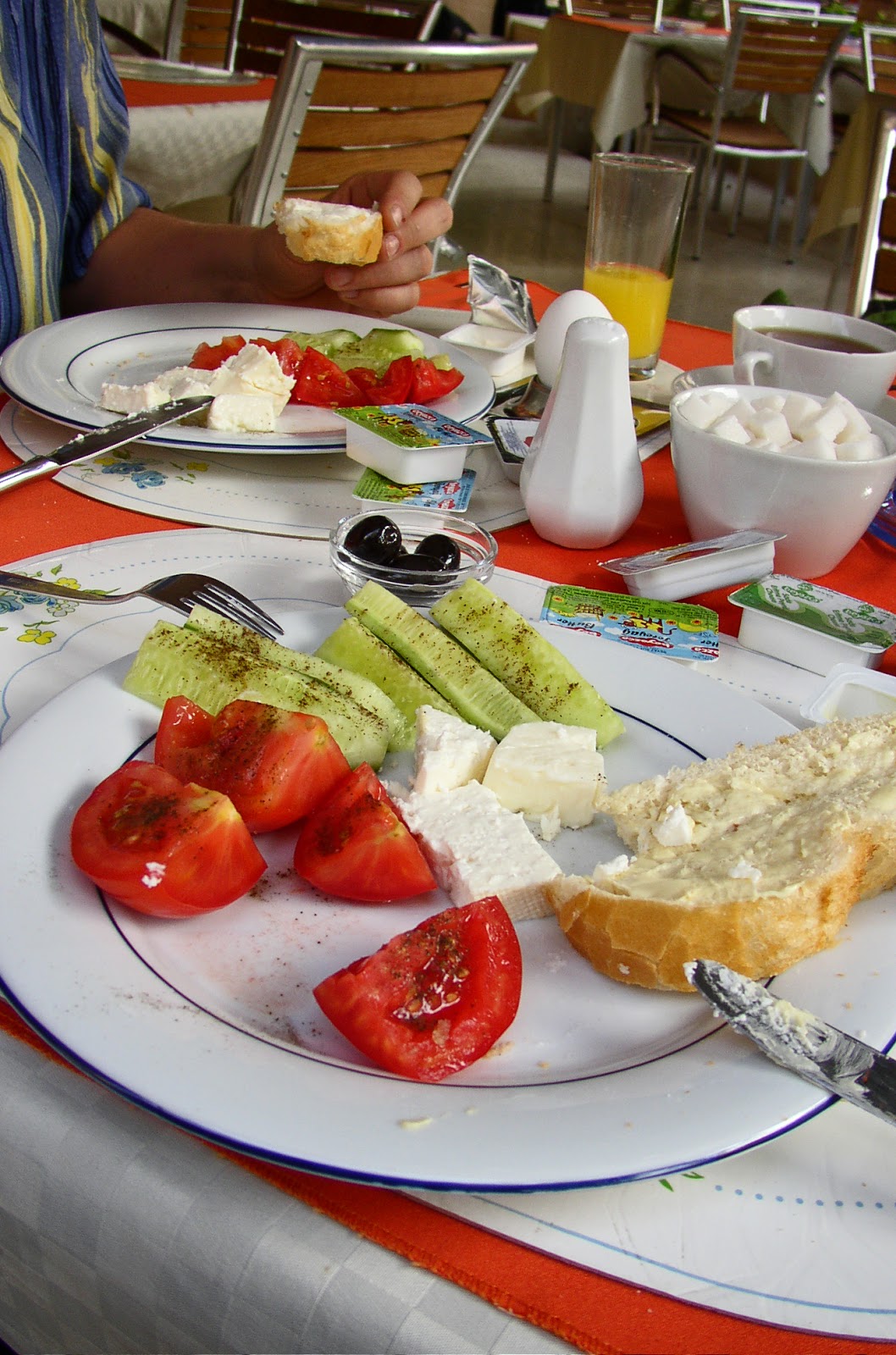
Breakfast: A buffet breakfast is included at virtually all Turkish hostels and hotels, so it’s a good opportunity to fill up early. The buffet will invariably include hard-boiled eggs, white bread, cucumbers, fresh tomatoes, olives, white cheese, fresh fruit (most often watermelon), butter, honey, çay (tea), and instant coffee. Usually there’s also yogurt. Additional items may include muesli, cereal, milk, croissants, various other cheeses, dried fruit, and sigara borek (rolled phyllo dough stuffed with feta and/or spinach).

Lunch: Lunch was a persistent challenge for us, partly because we didn’t know all our options. We didn’t want to spend a lot of money at restaurants, especially since we’d likely be eating at those same restaurants for dinner, but there didn’t seem to be a lot of other choices. For meat eaters, döner (shaved roasted meat in a pita) is ubiquitous and cheap, but there seemed to be no equivalent for vegetarians. At first, we mostly we either ate pide (melted cheese on a flat pita, essentially a Turkish pizza; actual pizza is also common), or found a local market and bought crackers and cheese.

Later, someone introduced us to cig köfte. Now, köfte is meatballs, so this was a little confusing for us: obviously we didn’t want meatballs. And reading online, it seemed cig köfte was a traditional dish of raw meatballs, so clearly we wanted that even less. However, in the last decades the raw-meat version of the dish has been outlawed for public health reasons, and it’s been replaced with a vegan substitute made of chickpeas or walnuts. There’s no meat involved whatsoever, and there are small fast-food joints that specialize in the dish. It’s also cheap, fast, and flavorful: the perfect thing for lunch when you’re out shopping or seeing the sights. Ask for a cig köfte durum, and you’ll get a tortilla wrap with walnut/chickpea paste, plentiful iceberg lettuce and/or arugula, spicy barbecue sauce and sweet pomegranate syrup (the sauces are optional but recommended).

Cig köfte durum

There are also two kinds of soup that became a staple for us, at lunch and dinner both. The first is mercimek çorbası, or lentil soup, a light soup of strained lentils served with lemon wedges and pita. It’s absolutely delicious, very reasonably priced, and provides the protein you’ll probably be craving. Be warned, however, that it is often made with chicken stock, so you may wish to ask before ordering.

In a similar vein is ezogelin, a red lentil and tomato soup seasoned with mint, again served with lemon and pita. This was one of our favorite dishes in Turkey, and perhaps the best lentil soup I’ve had anywhere.

Often we would order a soup with a green salad (yeşil salata), which varied far more than the soup. Always the salad would have cucumber and tomato (one time, only those), generally lettuce or arugula, sometimes green peppers and white onion.

Many cafes also advertise gözleme, which they describe as a “pancake.” Well, it’s not a pancake: it’s more like a crepe, with cheese and other fillings pressed between two thin layers of pastry. Turks often accompany it with ayran, a yogurt drink similar to kefir.

Supper:

Supper offers considerably more choices, with prices varying widely; restaurants outside tourist areas can be half the price of those inside. We’ll start with the cold meze (appetizer) platter, which is delicious and found at most every dinner restaurant. In general the meze platter is all vegetarian, but there may be a non-vegetarian platter available as well, so ask to be sure. The platter may include:

humus – simpler and less potent than its Middle Eastern versions
patlican salatası (eggplant salad) – mashed eggplant, similar to baba ganoush
saksuka – cubed eggplant with tomato sauce
cacık – yogurt with cucumber and fresh herbs
• ezme – spicy tomato salad
• roasted red pepper and walnut tapenade
• yogurt with roasted red pepper
• dolmas – grape leaves stuffed with rice
• olives
• pita or flatbread

Several hot vegetarian entrees are also common:

vegetable pilaf – rice and orzo with sauteed vegetables, typically some combination of bell peppers, carrots, eggplants, zucchini, green beans, mushrooms, and tomatoes
vegetables in saffron sauce – essentially the same vegetables as above, sauteed in a buttery saffron cream sauce and served with rice
• vegetable casserole – ditto, but with tomato sauce instead
vegetarian pastry – same vegetables, this time layered with cheese and thin hand-rolled dough (similar to crepes)
vegetable kebab (kebap) – just what it sounds like. Be warned, also, that an “eggplant kebab” may include pieces of sausage; ask when ordering.

Street food:
Most street food in Turkey is vegetarian. Common items include:

simit a bagel-like twisted bread covered in sesame seeds
mısır – corn on the cob
• roasted chestnuts

All considered, it’s true, it’s not difficult to be vegetarian in Turkey, although you might start craving broccoli or tofu after a while. As a side benefit, I found the Turkish diet remarkably easy on the digestion – nary a stomach ache in sight.

In the Mood to Consume: A College Text Adventure

You are on Boylston Street facing a low gray building. It has a fuchsia-pink door with a sign above it that says “Fred Wildlife Refuge.” There is another, smaller sign on the side of the building. You wonder briefly why it’s “Fred” and not “Fred’s.”

>west

You can’t go that way.

>read small sign

The sign says, “ENTER ON BELMONT STREET ONLY.”

>north

You are on Olive Street. You’re close to the Stumbling Monk, which has great beer.

> west

Wow, the Stumbling Monk is right on the corner. Maybe you should go there instead.

>south

Okay, obviously you’re determined to go to this art show thingie. It was the whole reason you came out on a Thursday night anyway, which you normally wouldn’t do since you have work in the morning.

You are on Belmont Street, facing a fuchsia door.

>go inside

You smash right into the door’s aggressively bright, aggressively hard surface.

>open door

The door is now open.

>enter building

Fred Wildlife Refuge seems pretty cool, even if it’s obviously hosting a college art opening. There’s a bar in the corner and some stairs leading up to a second level. It’s dimly lit with spotlights on the art pieces and there’s some techno music playing. Twenty or thirty college students are standing in clumps around the main floor, presumably discussing their improbable dreams of being professional artists and how they connect to the leaf-covered papier-mache globe upon which these dreams rely. Other art pieces include a series of abstract ballpoint-pen drawings (sure, just use the doodles you made during your Italian Futurism seminar, why not?) and a swaying-dots-over-translucent-ripples video projection (okay, actually kind of neat).

> find friends

The guy at the door wants to check your ID first.

>show ID

He hands it back to you wordlessly. There’s no stamp or anything.

>find friends

You cruise around the main floor for a minute, glancing at dimly lit faces. You conclude that college art openings would be a great place to pick up girls, if you were fifteen years younger and single, but you do not see your friends.

“Do you want to get a drink?” your girlfriend asks.

>fuck yes

There’s no need to be crude.

>go to bar

Amazingly, there’s no one in line.

> whiskey coke, please

The bartender hands you the drink. Unfortunately he’s overfilled it with ice and when you pick it up it slops onto your fingers, making them sticky. “Seven dollars,” he says. That may sound like a lot, but actually for Seattle it’s not crazy.

>go upstairs

On your way to the stairs you realize that there’s a table with snacks on it. Really not a bad spread.

>get snacks!

You eat some salty pita crisp thingies. There’s no hummus left for them. There never is. This follows a universal physical law dictating that the first two people to arrive at an art opening will be famished vegans who will promptly gorge themselves on the only readily available protein source.

>go upstairs

There are more college students up here. There is a small unmanned bar. There is a gray-green painting of cubes that is perhaps the worst thing you’ve ever seen, like an otherworldly assault from a neighboring dimension of ugliness on all that is beautiful in our own. Claire is here.

>claire!

“Hi, guys!” she says, in her threateningly cute way. Claire is the fuchsia door of friends: aggressively bright, gleefully obstructive. “You made it!”

Crystal is here. Shannon is here. Some girl you don’t know is here. You say hi to everybody.

>where’s mark bell?

“I’m right here, dude!” Mark Bell says. “I’m blending in!” You look down. Mark Bell is wearing an electric blue hoodie and is sitting on an electric blue couch. Did he plan this?

>where’s matt bell?

“My brother’s over there, behind the curtain. Go check it out.”

>north

In the far corner of this upstairs room, our three precocious authors – Max Kraushaar, Graham Downing, and Matt Bell – have created a little alcove by hanging a sheet between two pillars. Within its confines they are ensconced behind a banquet table, with a smaller table of books on one side and a nearly life-sized cardboard cutout of themselves on the other. This forces would-be book buyers to approach them like supplicants seeking favors.

>talk to matt bell

Matt Bell is busy signing books. There are at least six people between you and him, and the space is too small to get by them.

>wait

Okay, you’re waiting.

>wait

Still waiting. This could take a while.

>look at cutout

The cutout is nearly life-sized. In it the three authors are standing seriously, their faces carefully still, each holding a copy of the book they’re hawking. They are wearing nearly matching outfits of light blue button-up shirts and dark pants, the very same outfits they’re wearing tonight. You note that they’re arranged in order of facial hair length: clean shaven, short beard (Matt Bell) and long beard (you’re not sure if it’s Max or Graham – you’ve never met them before – but whichever it is, he has a quite glorious, long, silky beard, like something Dürer would want to paint).

You wonder how much it cost to print. You also have to admit, it makes the three guys sitting at the table look more impressive. I mean, they have an almost life-sized cutout! You know who else has a life-sized cutout? Spock, that’s who! And Arnold Schwarzenegger as the Terminator! No one to fuck with, anyway.

>look at books

The books are stacked very neatly on an end table to your left. There are more than you expected, at least twenty or thirty remaining. A sign says they are $10. You wonder how much they cost to print.

>pick up book

The book isn’t large, maybe four inches by seven. Its cover is printed in color on some nice card stock, and has a Photoshopped image of two people standing in a park whose torsos for some reason are disappearing, like Michael J. Fox getting erased from time head-first. The authors’ names are on the back, and on the spine is the title: in the mood to consume. Apparently they subscribe to the no-capitals school of naming.

>buy book

Sorry, they’re still talking to other people and signing books. They may be writing a whole other book within the pages of this one, for all you know.

>hang out with friends

Cool. Mark already has a copy of the book anyway, if you want to look at it.

>ask mark about book

“So basically they had a month to do this project for school, and they spent it writing this book. I think it’s great.”

>read book

Actually it’s too dim in here to read easily. Also, you’re hanging out with your friends. Are you really going to ignore them and read a book?

>browse book, then

Fine. Don’t be snippy.

It has a title page, which the authors have very amiably signed. It has a table of contents, although apparently this does not describe the actual contents of the book, since page 60 is listed as “blank” (it’s not) and page 250 as “synergy//regenerative landscape” (the book is 142 pages long). The first real sentence, which you read aloud, is “Jesus didn’t die for this.”

“Jesus didn’t diet for this,” Mark corrects you.

>so he’s fat jesus?

“Yeah. So basically Santa Claus. Santa Claus is Fat Jesus.”

The next two pages are an essay on carburetors. The most remarkable thing about them is the spelling of “carburetor,” which somehow you really thought was “carburator.” No, okay, that does look wrong.

Then there’s a page about how water is like blood, a recounting of a Bill Hicks joke you’ve already heard, and an incomplete short story about a mutiny on the Ride the Ducks tour bus (it’s a Seattle thing). There’s some ASCII art of types of swords: katana, broadsword, flaming sword, sword with skull. There’s another short story about a haunted Mack truck.

Continuing with this catalogue, there are a lot of one- or two-sentence aphorisms a la Jack Handy’s Deep Thoughts, only not so funny. There’s a play-by-play description of a chess game, which kind of annoys you because the narrator’s opponent loses his queen on move 9, which means the game is basically over, but then it goes on for another seven pages. There are two pages of the sentence “THIS PAGE INTENTIONALLY LEFT BLANK.” There’s a list of videos on Vine. There’s a first-person narration of an online MUD, which gives you an idea for this review.

It is, in other words, a lot of nonsense. Occasionally there’s a chuckle.

Really, it’s not so much a book as a mockup of a book, an almost life-sized cardboard cutout of a book. It seems intended as a sort of winking mockery of book publishing and author signings in an age where anyone can walk into an Officemax with a flash drive and walk out with a stack of neatly bound paperbacks. Want to be an author? Great! Put your money on the table! Want to be someone who knows an author? Great! Put your money on the table!

There are, however, several valuable lessons here:

1. There’s safety in numbers. As one person, you have a limited number of friends willing to go to your events. But you know how many more friends three people have? Three times as many! Team up to pump your sales numbers.

2. Gimmicks work. Who doesn’t love a gimmick? Make the buying process itself an adventure and people will do it for the sake of a story to tell their friends. You’re suddenly contemplating the viral value of dressing in costume for your own self-published book signings.

3. Drunk people love buying stuff. Seriously. Forget bookstore signings. Find the busiest, loudest, drunkest bar in town and set up by the front door.

Finally you see that the crowd by the authors’ table has dispersed. The way is clear.

>buy book

Sure, why not? You’re in the mood.

5 Tips for Making the Most out of Memrise

Before discovering Memrise, I had made some half-hearted attempts to learn Turkish. I got some books from the library, printed out some phrases from the internet, and dutifully set about learning how to say “hello” and count to a hundred.

Problem was, sitting on the couch repeating words to myself was really, really boring. Also, I had no idea if I was pronouncing the words correctly, so even if I successfully memorized a few phrases, I might find when I got to Turkey that no one could understand me.

But surely I can haz Turkish via the Internet. I looked at Rosetta Stone and some other language-learning software, but I didn’t want to pay a large fee. I’m going on a three-week vacation, not trying to emigrate.

Enter Memrise. It’s free. It has multiple language courses, including Turkish. You can use it on your computer or portable device. It offers not only audio, but user-created “mems” (read: mnemonic devices) to aid in recall. Via a simple gardening metaphor, it encourages you to learn new items (“plant”) and review what you’ve already learned (“water”). The review process itself is structured as interval training, meaning that you review newer items first, older items later, with reducing frequency depending on how many times you’ve reviewed them and how often you’ve identified the word or phrase correctly.

This all amounts to a powerful, simple, and fun learning experience. Maybe the most brilliant aspect of Memrise is that it turns language learning into a simple but addictive game. Since you’re only learning five or so items at a time, no one section is ever that difficult, especially if you review frequently, but cumulatively you learn a lot, very quickly. Imagine where you’d be if you’d taken those 4,000 hours you spent playing World of Warcraft and used them to learn languages.

“Yeah, so I’m like, a level 60 French learner.”

However, it’s not perfect. Fundamentally, Memrise is not language-learning software. Rather, it’s multimedia flashcard software with a clever structure and review process. What this means is that it’s very effective for memorization, but naturally it lacks key features of the costlier software packages or actual classes, in particular extended composition and face-to-face conversation.

Even disregarding its inbuilt limitations, there’s clearly room for improvement. My greatest frustration is that Memrise courses never explain anything. It’s all pure memory. Of course, learn enough items, see enough examples, and eventually you’ll deduce or intuit the underlying structure – that is, after thousands of examples. This is how we all learn languages as children. Nobody explains how to form the past progressive tense to us; we just hear it ten thousand times and absorb it by osmosis.

As an adult learner, though, I want to understand the how and why of things. It’s far easier for me to learn the six common pronouns (I, you, he/she/it, we, y’all, them) as a group, and then be able to pick them out from a given phrase, then to try it the opposite way and pick out the totally unfamiliar pronoun from a series of foreign words. What part of “O kaç yaşında?” (“How old is he?”) is the pronoun? In the phrase “Doğum günümde seni görmek isterim” (“I want to see you at my birthday”), which word is the verb? What denotes the object? If “gün” is “day,” what’s “günümde”?

Doğum günü: Doggone birthday

Often, too, I’d find that I’d learn a complex phrase, only to see its individual words included in later vocab sections. This is doubly stupid. First of all, why am I learning phrases about time, say, when I haven’t yet learned the words for “day,” “week,” “minute,” etc.? Second, if I’ve already successfully learned the complex phrases, then I’ve quite likely already puzzled out their components and don’t need to be retested on them.

This is part of the problem with crowdsourcing. You get a lot of content very quickly and cheaply, but it’s rarely as well-organized as a professionally designed course.

Fortunately, after a while I developed some strategies for avoiding these problems, and I’ll share these tips with you here:

1. Preview the course before you start, and compare it with other courses. There are hundreds of courses on Memrise, including dozens for each language, and not all courses are equal. Memrise will present the most popular courses, but popularity isn’t necessarily the best criterion for judging a course. Some courses include audio, others do not; some focus more on vocabulary, others on structure or common phrases. Click on the individual sections to see what the course includes and how it progresses.

2. Don’t be afraid to jump around. If the courses were all well-structured, they would build naturally, and you would want to move from A to B in the order suggested. Since this is not always the case, however, feel free to pick and choose. Personally, I would suggest learning the alphabet first, then very common phrases (“Hello,” “Goodbye,” “Where is the bathroom?”), then numbers, and then a good deal of basic vocabulary. With that vocab under your belt, you’ll feel more confident navigating more complex phrases.

Where is the toilet: Tuvalet nerede? (toilet nerd)

3. Buy a textbook. I spend way more time using Memrise than reading the Turkish textbook I have, but that textbook has helped me a lot in understanding key rules and structures.

4. Use a real computer. Memrise is available as an app for your portable device, and that app is terrific and fun in its own right. However, I found that using Memrise on my desktop computer was considerably more demanding, and hence better for learning. Also, a number of features, such as the ability to make your own mems (see #5), are only available on the web platform.

5. Make your own mems. Memrise will automatically show user-created mems whenever they’re available. If one works for you, great. If not, look for your own associations and make your own mems. You’ll remember it better for having created it.

What should I memorize?

So you’ve learned some basic mnemonic techniques like the method of loci, the link system, and the wardrobe system. Having learned the how, though, you immediately encounter the question of what: What should you memorize?

Right away certain things come to mind, most of them mnemonic challenges we encountered in school: memorizing the U.S. presidents, memorizing the fifty U.S. states and their capitals, memorizing the countries of the world and their capitals. These challenges are perfectly suited to mnemonics, comprising simple lists of information that can be placed along a mnemonic journey or linked to a list of peg words.

And these, naturally, were the first things I memorized or am still memorizing. However, I also noticed that finding this information in a simple, printable format was surprisingly difficult. So I have set about correcting this deficit by creating exactly such lists in Google Docs. Here enjoy:

Countries and capitals of the world printable list

U.S. states and capitals printable list

U.S. presidents printable list


While I’m at it, I’ll also observe that all these lists have something in common, namely that they are around 50 items in length. There are 50 U.S. states; 44 presidents; 49 countries in Asia, 54 in Africa, 50 in Europe, and 50 in North America, South America, Australia and Oceania combined. There are also, as it happens, 47 Super Bowl winners (soon to be 48) and 53 players on a football team. Even more significantly, to my mind, the alphabet times two equals 52, and there are 52 playing cards in a deck.

What this suggests, to me, is that these lists can be linked in a wardrobe system. I’m still experimenting with the system myself, but basically I’m beginning by accumulating simple alphabetical lists to serve as peg words. These include the radio alphabet along with alphabets of animals, modes of transportation, musical instruments, mythical creatures, and common objects. For convenience I’ve organized them into a spreadsheet of useful alphabets.

Along these same lines, I noticed that there are also a number of items in lists of 12 that would be nice to memorize. All of us of course already know one list of twelve, namely the months of the year, so this can serve immediately as a list of peg words. Other groups of 12 include birthstones, Western and Chinese Zodiac signs, the twelve apostles, the twelve tribes of Israel, and the Labors of Hercules. I’ve placed all six of these lists in a single printable document:

Correspondences of 12 items for memorization

I’ve also been experimenting with the different mnemonic systems mentioned above, and I’ll make one last observation regarding this early stage of memory design. In switching between mnemonic systems, I thought it would be easier to take something I’ve already memorized – say, the countries and capitals of Europe, via a memory palace – and transfer it to a different system, i.e. the wardrobe system, by way of experiment. This, as it turns out, was a mistake. After all, if you’ve already memorized something, why re-memorize it, especially when forming new links could muddy up the images you already have? Use your time to learn something new, and your images will be fresh and crisp.

Think of another list of 12 or 50 items that would be good to memorize? Write it in the comments.

Making Memories: Memorizing Phone Numbers

Having created a Major PAO system, I naturally wanted to test it, and so I decided to memorize the phone numbers of the 17 people I work with. I printed out a copy of the contact sheet and set to work.

The first thing I needed was a memory palace. I settled on the Trader Joe’s where I shop for groceries. Having wheeled a cart around its aisles every week for about three years now, I’m intimately familiar with its layout, and already have an established journey through it. Perfect.
I began outside the store, where in real life a local newspaper vendor often hangs out. The first person was Jim Albright (not his real name). Right away I noticed a problem: phone numbers are ten digits long, while the POA system I’d devised was best suited for multiples of six. I would have to either lose one Person, Action, or Object, or use two single-digit images (which would make things a bit repetitive).
After some trial and error, I came up with the simpler solution of making the first Person in the sequence the actual person whose number I was trying to remember. So if Jim’s number was (216) 728-0158, the first image was not of a knight (21), but rather of Jim himself. The Action then was knitting (21), the Object a chick (67), followed by my nephew (28) sitting (01) on lava (58). In total, Jim knitting for a chick (I imagined a little chicken-shaped sweater), with my nephew sitting on lava, presumably very uncomfortably.
I ran into a second problem, which is that these really formed two loci rather than one. I tried in each case to connect them somehow – my nephew could be angry with Jim for making him wait while he finished his chick-sweater, say.
(Incidentally, I later took up memorizing pi to the hundredth decimal, with 10 decimals per line. Since I didn’t need to connect any actual people with the numbers, I altered the system to POA-PO. In this system the same number would be a knight [21] with a chick [67] knifing [28] Sid with lava [58]. I might for instance imagine a knight dressed in steel armor made to resemble a chicken, stabbing Sid Vicious with a knife made of lava. The advantage is that all the images combine to form a single connected locus.)
A third problem worth noting was that many of my coworkers had the same area code, Seattle’s 206, and frequently the same next digit as well, a 6. This meant that a lot of images began with “so-and-so nosing hashish,” which is fine once or twice, and not so great the fifth or sixth time. To resolve it I basically switched up the order of POA to PAO, or used alternate words. So “nosing hashish” became “in a noose with a judge.” Altering the order might matter in memorizing a deck of cards in two minutes, but it didn’t cause me any problems here.
Finally, one last hitch. Having memorized all seventeen numbers (170 digits, by the way – no great feat for a mnemonist, but remarkable to anyone else), I went to work and proudly proclaimed the fact. Naturally my co-workers asked my to recite their numbers for them, and so I did, until one person, Robert, stopped me halfway through his number, saying, “Nope. That’s not it.”

The funny thing was, I remembered the image clearly: Robert nailing up a map while Lisa juiced a ram. Puzzled, I went back to the list and realized that I had transposed the last four digits of his phone number with someone else’s. I’d remembered the image, but I’d made the incorrect image in the first place. Lesson is: it’s no good memorizing something if the information isn’t right in the first place.

Ten nonfiction books to transform your consciousness

Periodically I see top-10 book lists on Facebook, and I’m generally struck by a few things. First, such lists frequently reveal more about the extent of the individual’s reading than the quality of the books included. Second, they’re nearly always fiction, or fiction with a smattering of nonfiction books that the person obviously read in college.

Now, I’m not an authority on nonfiction, but there have absolutely been a number of books that have profoundly influenced how I think and act. They extend from fundamental views of existence, as in the first three books listed here, to political consciousness, history, religion, memory, writing, and diet. I honestly believe that reading any of these books, just once, can move you toward a more positive, constructive, and centered existence. Don’t believe me? Pick one and give it a try.

1. Remember: Be Here Now by Baba Ram Dass. When I first encountered Be Here Now at age 20, it was like a bolt of lightning striking my brain. I felt like someone had finally sat me down and explained how life was, why people acted the way they did, and where to go from here. Divided into three distinct sections, Be Here Now first tells how Harvard psychologist and LSD researcher Richard Alpert became the yogi Ram Dass; then lays out the fundamentals of karma yoga and Eastern philosophy generally in hand-drawn letters and distinctive Blakean illustrations drawn by Ram Dass himself; and finally provides further resources for study and inquiry. If you haven’t read it, well, you haven’t read it.

2. Taking the Path of  Zen by Robert Aitken and The Three Pillars of Zen by Phillip Kapleau. These two books are recommended for beginning students at the Zen Center of Denver, and remain, in my opinion, the best introductions to Zen Buddhism. Aitken’s book is simple, clear and concise – deceptively so. I think often people read it and say, “Well, sure, that makes sense,” precisely because it rings so true that afterwards it all seems obvious. Partly it’s also because Aitken is careful not to introduce a ton of ideas about enlightenment that may later be a hindrance to practice. Kapleau’s book, on the other hand, includes all the bells and whistles, with lengthy accounts of sesshin (Zen retreats) and personal enlightenment stories. Critics may say that it presents enlightenment as an object to be acquired (which naturally becomes an obstacle to realization), but it certainly inspired me to pursue Zen practice, as it has inspired thousands of others.

3. The Gateless Barrier, various translations. Okay, last Zen book, I promise. But I would be remiss if I didn’t include it. The Gateless Barrier is a collection of forty-eight koans – the sayings and doings of past masters – that Zen students have studied for centuries. Rather than talk a lot about it, I’ll just include Robert Aitken’s translation of Case 19, “Ordinary Mind is the Tao”:

Chao-chou asked Nan-ch’uan, “What is the Tao?”
Nan-ch’uan said, “Ordinary mind is the Tao.”
Chao-chou asked, “Should I direct myself toward it?”
Nan-ch’uan said, “If you try to direct yourself toward it, you betray your own practice.”
Chao-chou asked, “How can I know the Tao if I don’t direct myself toward it?”
Nan-ch’uan said, “The Tao is not subject to knowing or not knowing. Knowing is delusion; not knowing is blankness. If you truly reach the genuine Tao, you will find it as vast and boundless as outer space. How can this be discussed at the level of affirmation and negation?”
With these words, Chao-chou had sudden realization.

4. The Autobiography of Martin Luther King, Jr. Technically this isn’t really an autobiography, since King died before he could write one; rather, it’s a collection of his writings and speeches arranged biographically. Regardless, it’s a wellspring of inspiration.

5. The UnconquerableWorld: Power, Nonviolence, and the Will of the People by Jonathan Schell. I have a running joke that I always recommend this to people and have yet to have someone actually read it. You could be the first! Schell deconstructs historical narratives of war and revolution and shows how, since governments invariably depend on the will of the people, violence is ultimately unnecessary for political revolution. I also highly recommend his book The Fate of the Earth, a study of the likely results of nuclear war and the military insanity known as “nuclear deterrence.”

6.  The Masks of God by Joseph Campbell. Campbell’s four-book masterpiece reviews the development of mythology from primitive man to the modern creative age, and shows how all stories act as metaphors pointing to universal human truths. Along the way you get a survey of world history and culture. Pretty useful, right? If you don’t want to spend the next six months reading four dense books, though, you can just read Hero With a Thousand Faces, which is also great and a hell of a lot shorter.

7. Moonwalking with Einstein by Jonathan Foer. I just read this book, but it’s been blowing my mind. Did you know it’s possible to use a few simple techniques to memorize long lists of random numbers, or random words, or the order of a shuffled deck of cards, or just about any damn thing you want? I didn’t! And it’s not even hard! It’s fun! So far I’ve memorized the countries and capitals of Africa and Europe and the phone numbers of everyone I work with. And I’m just getting warmed up.

8. The Elements of Style by William Strunk and E.B. White. You writerly types have already read this and can move on. If you are reading this post and have not read The Elements of Style, however… well, I’m sorry your education has so completely failed you. Essential for writers. Useful for anyone.

9. Diet for a Small Planet by Francis Moore Lappe. I’ll be honest with you, I don’t even remember this book all that well, but I’m going to recommend it anyway. I read it in a flurry of books back when I was 19, along with Peter Singer’s Animal Liberation, Philip Kapleau’s To Cherish All Life, and Phyllis Balch’s Prescription for Nutritional Healing. Later I would read Fast Food Nation by Eric Schlosser, Supersize Me by Morgan Spurlock and probably a half-dozen other books that don’t come immediately to mind. In any case, they convinced me thoroughly of a few things, namely that animals experience pain in exactly the same way we do; that needlessly killing them is wrong; that raising them as industrial commodities is unbelievably cruel; that eating meat causes enormous environmental destruction; and that eating a vegetarian diet is easy and healthy. Pick one book and read it. Even if you don’t immediately start eating vegetarian, I guarantee you’ll at least be more thoughtful about what you eat and why.

10. The God Delusion by Richard Dawkins. Dawkins lays out the essential arguments against a belief in an all-powerful creator with crystal clarity. If you’re already atheist or agnostic, it will clarify your thoughts on the subject. If you do believe in God, then I challenge you to read it and walk away unchanged.