Breaking Free from Gun Violence

The basic difficulty in ending gun violence is, I think, the immediate reflex toward self-defensive fear in the face of that violence. Where some of us, on hearing of another massacre, will advocate for stronger gun control laws and mental health care, many others see only possible danger to themselves as individuals, and cling to guns as means of self-defense (however uncertain that means is).

It’s a difficult spiral to break free from: violence to self-defensive fear to widespread gun ownership, which leads to more violence and more fear. It’s rooted very deep in our culture, which continues to worship warrior archetypes that invariably represent and advocate violence as the primary means of male power and redemption.

On a personal level, we have to break free of fear, first and foremost. We must recognize that all life is uncertain, and that the effects of our actions extend far beyond our individual selves. We are connected root and branch to the people around us, as the tree is to the soil, and our lives are, in the final analysis, just drops of rain in the torrent. Will we nourish life with kindness and self-sacrifice, or will we, in clinging to our fear and the desire for vengeance, allow our spirits to become poisoned?

On the societal level, we must turn to communities founded on principles of openness, compassion, and nonviolence, and provide them our energy, our material support, and our gratitude. We need also in particular to turn away from the destructive greed of capitalism and its feudal hierarchies, which perpetuate enormous inequality in our daily lives and workplaces. Really, it is when every person is loved and cared for, nurtured emotionally, spiritually and physically, that individual violence and its societal counterpart, war, will finally cease. On that day we will wake up at last to the world we have dreamed; and all we must do to accomplish it is give up our fears.

ancient-banyan-big-island-hawaii-james-brandon

Beyond the Worldwall, Chapter 3: The Surgeon, Fallen

tropical-rainforest-jungleThrown by that horse, was his first jumbled thought. That worthless roan. He was not a terrible horseman; but that mare had looked at him with almost a feverish eye, and fought the bit. But deep as he was in the opium, and deep as his infatuation was with Mary Henneman (whose father owned this land for miles around), he had jerked the reins and imposed his will upon the beast. Now she had had her revenge.

With great effort, Gowan MacMillan lifted his head and looked down at his body, aware of profound pain through the haze of the drug – grave bodily injury – his leg especially. He saw the blood soaking his gray trousers below the knee, lay his head back and croaked, “Help.” With that he was exhausted, and closed his eyes. He could just fall back asleep – that was the wonder of laudanum. Whatever your condition, the tincture laid a calming hand upon your brow and said, “It’s all right, it’s always been all right, everything will always be all right.” Sweet Mother Poppy.

No, dear God. You could bleed out as you lie here, you idiot. The others may not even know where you are. With a great effort, he opened his eyes again, looked up at the forest canopy – the strangely thick and verdant forest canopy – and yelled with what strength he could muster, “Help! HELP!” Continue reading

Beyond the Worldwall, Chapter 2: Dr. Phlogiston

balloon

Reverently, Dr. Philippe Joubert placed his hand against the unyielding surface of the Worldwall. It was perfectly smooth, perfectly even, and in the midday light revealed their reflections readily; but up close it had a translucent quality – a smoky gray depth not apparent from a distance. “Like glass,” he breathed.

“Some say it’s made of pure diamond,” Durmoth reflected.

“A diamond ring around the world,” said MacMillan. “To mark what union, I wonder?”

Sykes laughed. “Ever the poet. It doesn’t look like any kind of metaphor to me.”

“And you, madame?” Joubert asked Bisette, who had pulled off a glove to stroke the wall delicately with her fingertips. “Are you impressed?”

“Impressed, yes,” she allowed, craning her head back at its nearly inconceivably height. Withdrawing, she pulled her glove back on. “But undaunted.”

Joubert clapped his hands once in admiration, laughing. “Bravo! Just so! Our patroness shows us the spirit, gentlemen. Onward and upward!” Continue reading

Social Media as Commons

In reading about commons and commoning, and with the current storm over net neutrality, I have been thinking more and more about the ways in which we voluntarily cede common spaces to private interests. The only reason net neutrality is even an issue, after all, is because we have allowed corporations to exercise near-monopolies over internet access (namely, in Denver, the duopoly of Comcast and CenturyLink), which utilize what is really public infrastructure for that purpose (cable and phone lines, respectively).

These monopolies are well-established and difficult to uproot without new, disruptive technologies (mesh network, anyone?) to replace them. But we allow similar control even in spaces where it’s completely unnecessary, even where corporations offer little advantage over better, more community-oriented alternatives. Banking is one such area; corporate banks offer virtually nothing not offered by credit unions, and using corporate banks gives those institutions unbelievable power over our lives. So if you’re still giving your money (literally) to Chase, Well Fargo and their ilk, please, please consider moving to a credit union.

Another good example may literally be staring you in the face right now: Facebook. At root, Facebook is simply an online bulletin board system. It’s not so different from systems I remember using in the dial-up era. It is a public forum wherein we converse, share events, form communities and maintain friendships. It is, or should be, a commons: owned by none, shared by all.

And yet, by our participation, we have allowed this space too to be co-opted by corporate interests. What you see is not, strictly speaking, what your friends share; it is, rather, a subtly manipulated version of their contributions, with the not-so-subtle insertion of innumerable ads.

What’s especially concerning to me is the way it affects our mental processes. What should be about sharing, community and friendship instead becomes about buying and selling, production and consumption. With most of us barely aware of the change – indeed, unaware that a different experience is even possible – we become convinced that this is simply the way of the world. Capitalism becomes our inescapable daily reality, a sort of smog we’re squinting through all the time. Thus the plutocrats succeed in enclosing, not just a public forum, but our very thoughts and minds.

Yet, as with corporate banks, the ceding of this space is largely unnecessary. Alternatives exist that provide, if not exactly the same interface, nearly the same functions – without corporate control, without this subtle mental pollution.

If you are here saying to yourself, “Sounds great, but what can you do? Everyone’s already on Facebook,” I would ask you to consider that this very feeling of helplessness is precisely the reason to invest yourself in something different. Corporations, and the governments that support them, want you to feel isolated and powerless. It is a core mechanism of the capitalist state to keep the population under control.

Yes, using open-source and peer-to-peer alternatives is slightly more work, and can be slightly confusing as you get accustomed to a new interface. But that very investment in effort reflects a key difference: You must invest in your community. You must be an active participant and contributor rather than a passive, docile consumer. If you want to realize a new, more equitable vision for society, you have to make your stand for it.

With all that said, I’d invite you to check out Diaspora, an open-source social media app that does, more or less, what Facebook does. I’m not saying it’s the be-all, end-all. If you know of something better, let me know. But it’s past time to try something new.

Beyond the Worldwall, Chapter 1: Devil Dick

When they reached the port of Tewabo, just a hundred and eighty miles north of the Worldwall, Joubert brought out two bottles of an excellent Almithean wine he had been hiding somewhere. He poured a modest glass for each present in the company chief’s dining room (minus the seamstress, who had recently embraced teetotalism), raised his own and said, “It may seem that our greatest obstacles are ahead, especially that single great obstruction that cuts our world in twain. But in reality our greatest difficulties are now behind us. We have travelled across the first the Galling Sea and then the Rolonia. It has been an impressive and instructive journey, such as few have made.

“But before we could set off, we had to assemble our supporters, convince and cajole those with wealth to part with it, not for hope of material gain, but for knowledge and glory. And even before that, we had to defy gravity itself, using our science to set humanity free from the mud from which it arose.”

Prolix bastard, Richard Durmoth thought, not for the first time. His eyes flicked across the table to the seamstress, Bisette, who refused to meet his gaze. Continue reading

A Caper at Blacksward Hall

For many years Felwilmina Bloodweaver had taken pleasure in outlining to her only son, Grull, the structure of the social ladder and the means whereby to descend it; and tonight, having labored mightily to secure them invitations to the Marquis’s ball, she was hardly going to allow the opportunity to pass with Grull loitering by the refreshments and trying to fade into the wall. devilImp

“If I have to stand behind you and move your feet with my own talons, you’re going to dance with these young ladies,” she hissed.

A sour expression on his face, Grull consoled himself by popping another candied eyeball into his mouth. “I’m no good at waltzes.”

“Nonsense! I’ve seen you dance a hundred times. A thousand.”

“I don’t dance, I caper. I cavort. Sometimes I even frolic. I certainly don’t waltz.”

“Then what have I been paying that damn instructor for this last year?”

“I think you’re paying him to get drunk and berate me.”

She sniffed. “That really is a waste. I can berate you myself.”

Around them, the lesser nobility of Seven Circles swirled and spun around the elongated hexagon of the Marquis de Malcerveau’s Blacksward Hall. The Marquis, Pitoheizuhr Ziubon, had recently had the hall built by the Null Gods of the Outer Void, which meant it was carved from a single massive black crystal, the interior all glittering facets and physically impossible angles. If you looked straight up, into the gyre of the distant ceiling, you would eventually begin to see the gaping maw of the space between galaxies, which might drive one mad, if indeed demons could be said to go mad. In any case Grull kept looking up, which was giving him something of a headache. Continue reading

Forever Friendly Freddy

Her adoptive parents always said that Lili was a special girl, and on her fourth birthday they bought her a special toy. The box was quite heavy and half as large as she was, and when she tore open the wrapping, the teddycardboard came to life with animations, a cartoon bear speaking in a cartoon voice. “Hi there!” he said. “Are you Lili?”
“How does it know my name?” she said to her mother, amazed.

“It’s nanotech, baby. And we told the company when we bought it. Go ahead, answer. What’s your name?”

Continue reading

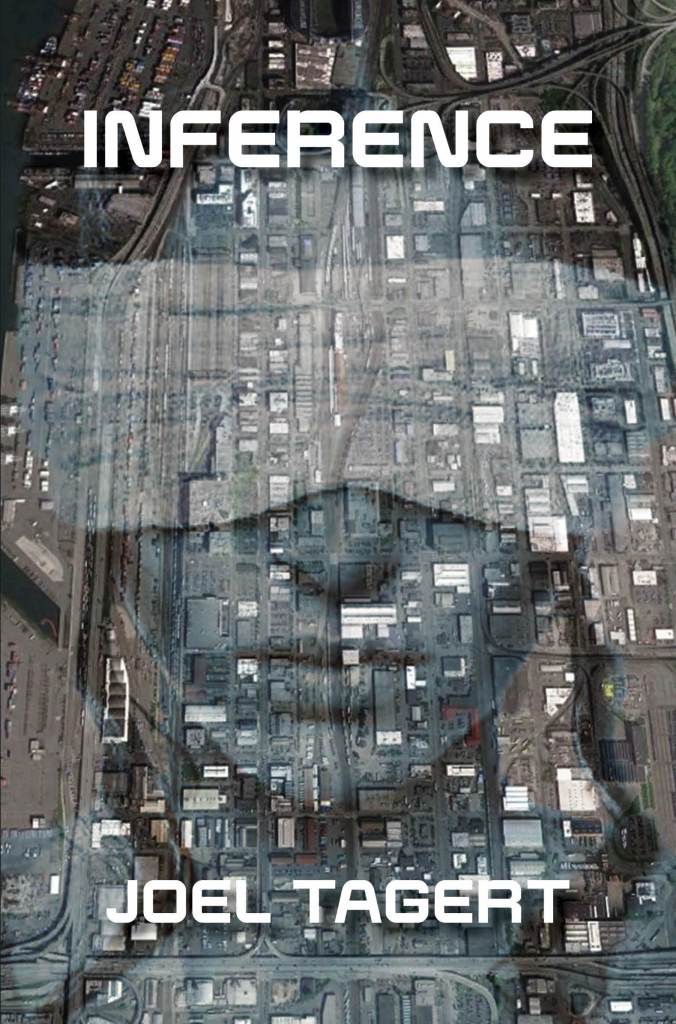
INFERENCE, at long last!

Inference Kindle cover

INFERENCE is now available on Amazon! After years of writing, rewriting, editing and design, I’m kicking my debut novel out of the nest and into the world. From the back cover:

“INFERENCE: the long-sought grail of law enforcement, a system to pinpoint suspects with unerring precision, enabled and executed by AIs whose eyes and ears are every auto, every satellite photo, every phone, toilet and light bulb in the U.S., a sea of data from which all human movement can be extrapolated like krill slipping through baleen. But even the most powerful tools have weaknesses, and when the body of a genetically engineered boy turns up in a Seattle alley, his likely murderer seems to have vanished into thin air. Now detectives Tom Mueller and Jackie Khleang have to crack the case the old-fashioned way — before more kids turn up dead.”

Your support is critical to the success of this book! Please like and share this post. If (or hopefully when) you have read the novel, please consider also posting reviews on Amazon and Goodreads. Even a sentence or two has weight with prospective readers.

INFERENCE is available in trade paperback or Kindle e-book. Thanks again for your support, and enjoy the read!