the relative absence of sound, last experienced in an apartment building in 1877, prior to the invention of the phonograph.
Uncategorized
In the Mood to Consume: A College Text Adventure
You are on Boylston Street facing a low gray building. It has a fuchsia-pink door with a sign above it that says “Fred Wildlife Refuge.” There is another, smaller sign on the side of the building. You wonder briefly why it’s “Fred” and not “Fred’s.”
>west
You can’t go that way.
>read small sign
The sign says, “ENTER ON BELMONT STREET ONLY.”
>north
You are on Olive Street. You’re close to the Stumbling Monk, which has great beer.
> west
Wow, the Stumbling Monk is right on the corner. Maybe you should go there instead.
>south
Okay, obviously you’re determined to go to this art show thingie. It was the whole reason you came out on a Thursday night anyway, which you normally wouldn’t do since you have work in the morning.
You are on Belmont Street, facing a fuchsia door.
>go inside
You smash right into the door’s aggressively bright, aggressively hard surface.
>open door
The door is now open.
>enter building
Fred Wildlife Refuge seems pretty cool, even if it’s obviously hosting a college art opening. There’s a bar in the corner and some stairs leading up to a second level. It’s dimly lit with spotlights on the art pieces and there’s some techno music playing. Twenty or thirty college students are standing in clumps around the main floor, presumably discussing their improbable dreams of being professional artists and how they connect to the leaf-covered papier-mache globe upon which these dreams rely. Other art pieces include a series of abstract ballpoint-pen drawings (sure, just use the doodles you made during your Italian Futurism seminar, why not?) and a swaying-dots-over-translucent-ripples video projection (okay, actually kind of neat).
> find friends
The guy at the door wants to check your ID first.
>show ID
He hands it back to you wordlessly. There’s no stamp or anything.
>find friends
You cruise around the main floor for a minute, glancing at dimly lit faces. You conclude that college art openings would be a great place to pick up girls, if you were fifteen years younger and single, but you do not see your friends.
“Do you want to get a drink?” your girlfriend asks.
>fuck yes
There’s no need to be crude.
>go to bar
Amazingly, there’s no one in line.
> whiskey coke, please
The bartender hands you the drink. Unfortunately he’s overfilled it with ice and when you pick it up it slops onto your fingers, making them sticky. “Seven dollars,” he says. That may sound like a lot, but actually for Seattle it’s not crazy.
>go upstairs
On your way to the stairs you realize that there’s a table with snacks on it. Really not a bad spread.
>get snacks!
You eat some salty pita crisp thingies. There’s no hummus left for them. There never is. This follows a universal physical law dictating that the first two people to arrive at an art opening will be famished vegans who will promptly gorge themselves on the only readily available protein source.
>go upstairs
There are more college students up here. There is a small unmanned bar. There is a gray-green painting of cubes that is perhaps the worst thing you’ve ever seen, like an otherworldly assault from a neighboring dimension of ugliness on all that is beautiful in our own. Claire is here.
>claire!
“Hi, guys!” she says, in her threateningly cute way. Claire is the fuchsia door of friends: aggressively bright, gleefully obstructive. “You made it!”
Crystal is here. Shannon is here. Some girl you don’t know is here. You say hi to everybody.
>where’s mark bell?
“I’m right here, dude!” Mark Bell says. “I’m blending in!” You look down. Mark Bell is wearing an electric blue hoodie and is sitting on an electric blue couch. Did he plan this?
>where’s matt bell?
“My brother’s over there, behind the curtain. Go check it out.”
>north
In the far corner of this upstairs room, our three precocious authors – Max Kraushaar, Graham Downing, and Matt Bell – have created a little alcove by hanging a sheet between two pillars. Within its confines they are ensconced behind a banquet table, with a smaller table of books on one side and a nearly life-sized cardboard cutout of themselves on the other. This forces would-be book buyers to approach them like supplicants seeking favors.
>talk to matt bell
Matt Bell is busy signing books. There are at least six people between you and him, and the space is too small to get by them.
 >wait
>wait
Okay, you’re waiting.
>wait
Still waiting. This could take a while.
>look at cutout
The cutout is nearly life-sized. In it the three authors are standing seriously, their faces carefully still, each holding a copy of the book they’re hawking. They are wearing nearly matching outfits of light blue button-up shirts and dark pants, the very same outfits they’re wearing tonight. You note that they’re arranged in order of facial hair length: clean shaven, short beard (Matt Bell) and long beard (you’re not sure if it’s Max or Graham – you’ve never met them before – but whichever it is, he has a quite glorious, long, silky beard, like something Dürer would want to paint).
You wonder how much it cost to print. You also have to admit, it makes the three guys sitting at the table look more impressive. I mean, they have an almost life-sized cutout! You know who else has a life-sized cutout? Spock, that’s who! And Arnold Schwarzenegger as the Terminator! No one to fuck with, anyway.
>look at books
The books are stacked very neatly on an end table to your left. There are more than you expected, at least twenty or thirty remaining. A sign says they are $10. You wonder how much they cost to print.
>pick up book
The book isn’t large, maybe four inches by seven. Its cover is printed in color on some nice card stock, and has a Photoshopped image of two people standing in a park whose torsos for some reason are disappearing, like Michael J. Fox getting erased from time head-first. The authors’ names are on the back, and on the spine is the title: in the mood to consume. Apparently they subscribe to the no-capitals school of naming.
>buy book
Sorry, they’re still talking to other people and signing books. They may be writing a whole other book within the pages of this one, for all you know.
>hang out with friends
Cool. Mark already has a copy of the book anyway, if you want to look at it.
>ask mark about book
“So basically they had a month to do this project for school, and they spent it writing this book. I think it’s great.”
>read book
Actually it’s too dim in here to read easily. Also, you’re hanging out with your friends. Are you really going to ignore them and read a book?
>browse book, then
Fine. Don’t be snippy.
It has a title page, which the authors have very amiably signed. It has a table of contents, although apparently this does not describe the actual contents of the book, since page 60 is listed as “blank” (it’s not) and page 250 as “synergy//regenerative landscape” (the book is 142 pages long). The first real sentence, which you read aloud, is “Jesus didn’t die for this.”
“Jesus didn’t diet for this,” Mark corrects you.
>so he’s fat jesus?
“Yeah. So basically Santa Claus. Santa Claus is Fat Jesus.”
The next two pages are an essay on carburetors. The most remarkable thing about them is the spelling of “carburetor,” which somehow you really thought was “carburator.” No, okay, that does look wrong.
Then there’s a page about how water is like blood, a recounting of a Bill Hicks joke you’ve already heard, and an incomplete short story about a mutiny on the Ride the Ducks tour bus (it’s a Seattle thing). There’s some ASCII art of types of swords: katana, broadsword, flaming sword, sword with skull. There’s another short story about a haunted Mack truck.
Continuing with this catalogue, there are a lot of one- or two-sentence aphorisms a la Jack Handy’s Deep Thoughts, only not so funny. There’s a play-by-play description of a chess game, which kind of annoys you because the narrator’s opponent loses his queen on move 9, which means the game is basically over, but then it goes on for another seven pages. There are two pages of the sentence “THIS PAGE INTENTIONALLY LEFT BLANK.” There’s a list of videos on Vine. There’s a first-person narration of an online MUD, which gives you an idea for this review.
It is, in other words, a lot of nonsense. Occasionally there’s a chuckle.
Really, it’s not so much a book as a mockup of a book, an almost life-sized cardboard cutout of a book. It seems intended as a sort of winking mockery of book publishing and author signings in an age where anyone can walk into an Officemax with a flash drive and walk out with a stack of neatly bound paperbacks. Want to be an author? Great! Put your money on the table! Want to be someone who knows an author? Great! Put your money on the table!
There are, however, several valuable lessons here:
1. There’s safety in numbers. As one person, you have a limited number of friends willing to go to your events. But you know how many more friends three people have? Three times as many! Team up to pump your sales numbers.
2. Gimmicks work. Who doesn’t love a gimmick? Make the buying process itself an adventure and people will do it for the sake of a story to tell their friends. You’re suddenly contemplating the viral value of dressing in costume for your own self-published book signings.
3. Drunk people love buying stuff. Seriously. Forget bookstore signings. Find the busiest, loudest, drunkest bar in town and set up by the front door.
Finally you see that the crowd by the authors’ table has dispersed. The way is clear.
>buy book
Sure, why not? You’re in the mood.
Ten nonfiction books to transform your consciousness
Periodically I see top-10 book lists on Facebook, and I’m generally struck by a few things. First, such lists frequently reveal more about the extent of the individual’s reading than the quality of the books included. Second, they’re nearly always fiction, or fiction with a smattering of nonfiction books that the person obviously read in college.
Now, I’m not an authority on nonfiction, but there have absolutely been a number of books that have profoundly influenced how I think and act. They extend from fundamental views of existence, as in the first three books listed here, to political consciousness, history, religion, memory, writing, and diet. I honestly believe that reading any of these books, just once, can move you toward a more positive, constructive, and centered existence. Don’t believe me? Pick one and give it a try.
1. Remember: Be Here Now by Baba Ram Dass. When I first encountered Be Here Now at age 20, it was like a bolt of lightning striking my brain. I felt like someone had finally sat me down and explained how life was, why people acted the way they did, and where to go from here. Divided into three distinct sections, Be Here Now first tells how Harvard psychologist and LSD researcher Richard Alpert became the yogi Ram Dass; then lays out the fundamentals of karma yoga and Eastern philosophy generally in hand-drawn letters and distinctive Blakean illustrations drawn by Ram Dass himself; and finally provides further resources for study and inquiry. If you haven’t read it, well, you haven’t read it.
2. Taking the Path of Zen by Robert Aitken and The Three Pillars of Zen by Phillip Kapleau. These two books are recommended for beginning students at the Zen Center of Denver, and remain, in my opinion, the best introductions to Zen Buddhism. Aitken’s book is simple, clear and concise – deceptively so. I think often people read it and say, “Well, sure, that makes sense,” precisely because it rings so true that afterwards it all seems obvious. Partly it’s also because Aitken is careful not to introduce a ton of ideas about enlightenment that may later be a hindrance to practice. Kapleau’s book, on the other hand, includes all the bells and whistles, with lengthy accounts of sesshin (Zen retreats) and personal enlightenment stories. Critics may say that it presents enlightenment as an object to be acquired (which naturally becomes an obstacle to realization), but it certainly inspired me to pursue Zen practice, as it has inspired thousands of others.
3. The Gateless Barrier, various translations. Okay, last Zen book, I promise. But I would be remiss if I didn’t include it. The Gateless Barrier is a collection of forty-eight koans – the sayings and doings of past masters – that Zen students have studied for centuries. Rather than talk a lot about it, I’ll just include Robert Aitken’s translation of Case 19, “Ordinary Mind is the Tao”:
Chao-chou asked Nan-ch’uan, “What is the Tao?”
Nan-ch’uan said, “Ordinary mind is the Tao.”
Chao-chou asked, “Should I direct myself toward it?”
Nan-ch’uan said, “If you try to direct yourself toward it, you betray your own practice.”
Chao-chou asked, “How can I know the Tao if I don’t direct myself toward it?”
Nan-ch’uan said, “The Tao is not subject to knowing or not knowing. Knowing is delusion; not knowing is blankness. If you truly reach the genuine Tao, you will find it as vast and boundless as outer space. How can this be discussed at the level of affirmation and negation?”
With these words, Chao-chou had sudden realization.
4. The Autobiography of Martin Luther King, Jr. Technically this isn’t really an autobiography, since King died before he could write one; rather, it’s a collection of his writings and speeches arranged biographically. Regardless, it’s a wellspring of inspiration.
5. The UnconquerableWorld: Power, Nonviolence, and the Will of the People by Jonathan Schell. I have a running joke that I always recommend this to people and have yet to have someone actually read it. You could be the first! Schell deconstructs historical narratives of war and revolution and shows how, since governments invariably depend on the will of the people, violence is ultimately unnecessary for political revolution. I also highly recommend his book The Fate of the Earth, a study of the likely results of nuclear war and the military insanity known as “nuclear deterrence.”
6. The Masks of God by Joseph Campbell. Campbell’s four-book masterpiece reviews the development of mythology from primitive man to the modern creative age, and shows how all stories act as metaphors pointing to universal human truths. Along the way you get a survey of world history and culture. Pretty useful, right? If you don’t want to spend the next six months reading four dense books, though, you can just read Hero With a Thousand Faces, which is also great and a hell of a lot shorter.
7. Moonwalking with Einstein by Jonathan Foer. I just read this book, but it’s been blowing my mind. Did you know it’s possible to use a few simple techniques to memorize long lists of random numbers, or random words, or the order of a shuffled deck of cards, or just about any damn thing you want? I didn’t! And it’s not even hard! It’s fun! So far I’ve memorized the countries and capitals of Africa and Europe and the phone numbers of everyone I work with. And I’m just getting warmed up.
8. The Elements of Style by William Strunk and E.B. White. You writerly types have already read this and can move on. If you are reading this post and have not read The Elements of Style, however… well, I’m sorry your education has so completely failed you. Essential for writers. Useful for anyone.
9. Diet for a Small Planet by Francis Moore Lappe. I’ll be honest with you, I don’t even remember this book all that well, but I’m going to recommend it anyway. I read it in a flurry of books back when I was 19, along with Peter Singer’s Animal Liberation, Philip Kapleau’s To Cherish All Life, and Phyllis Balch’s Prescription for Nutritional Healing. Later I would read Fast Food Nation by Eric Schlosser, Supersize Me by Morgan Spurlock and probably a half-dozen other books that don’t come immediately to mind. In any case, they convinced me thoroughly of a few things, namely that animals experience pain in exactly the same way we do; that needlessly killing them is wrong; that raising them as industrial commodities is unbelievably cruel; that eating meat causes enormous environmental destruction; and that eating a vegetarian diet is easy and healthy. Pick one book and read it. Even if you don’t immediately start eating vegetarian, I guarantee you’ll at least be more thoughtful about what you eat and why.
10. The God Delusion by Richard Dawkins. Dawkins lays out the essential arguments against a belief in an all-powerful creator with crystal clarity. If you’re already atheist or agnostic, it will clarify your thoughts on the subject. If you do believe in God, then I challenge you to read it and walk away unchanged.
Aphorism: Intuition
Intuition is most valuable when it helps you bring unconscious impulses to light and follow the deepest promptings of your heart. Yet if you follow your intuition uncritically, it rapidly devolves into irrationality and rank superstition. A dash of doubt seasons the soup of character.
The true cost of car ownership
It seems Millennials aren’t buying cars. Well, they are, but not as many as their parents. Worse yet, they don’t even seem to care that they’re not buying them. They’re not even getting driver’s licenses, for Chrissakes.
Everyone’s remarking on the trend, and everyone has a different set of explanations. NPR ran a puff piece a few days ago suggesting that cars are losing their position as key status symbols for teenagers. The Atlantic points to the rise of smart phones and car-sharing services, among other culprits. Time echoes the “cars aren’t cool” teen sentiments revealed by several opinion studies, while also citing the views of automakers that it’s the economy, stupid, and when jobs pick up, the kids will buy cars just like their parents. (Forbes, ridiculously, says it’s just that young people are pickier than ever– that if they can’t have a BMW when they’re sixteen, they’ll wait until they’re eighteen. Because of coursethey’re getting a Beamer.)
Every article mentions the high cost of owning a car. It turns out – surprise! – that owning a car is really expensive, and a lot of young people, especially those living in the city with its greater car-owning costs and transit options, have realized they can’t afford it. What I want to say here, though, is that a car isn’t just really expensive. It’s really, really, reallyexpensive, representing for most people the largest portion of their disposable income. It is, in short, about the worst financial decision you can make, and if you can possibly avoid buying a car, you should. On a broader level, our society’s obsession with personally owned cars is profoundly unhealthy, representing a huge misplacement of wealth that could otherwise be spent on desperately needed public investments.
So just how expensive is car ownership? AAA estimates that the average sedan costs $8,946 per year to operate. That’s right: almost nine thousand dollars, including car payments, maintenance, insurance and gas.
This figure alone blows my mind. See, I don’t own a car. Mostly I ride my bicycle, and occasionally take the bus. Once a week my girlfriend and I walk to the grocery store and carry our food home. When we want to go out, we walk to a nearby restaurant or bar – easy to do here in Seattle’s urban Capitol Hill neighborhood.
The total cost of owning a bicycle? Well, I bought it new for about $600, with tax, four years ago. I bring it to a bike shop for regular professional maintenance, costing me at most $200/year. I’ve also bought a fair number of bike accessories, jackets, gloves and the like, so let’s add another $200/year for that. And let’s say I’ll buy a new bike next year (I won’t, but lots of people would), at a similar price.
My total yearly cost of ownership: $520.
But wait! What if I actually need a car? What if I’m moving? What if I want to go to Portland? What if I want to eat at a restaurant in Ballard?
For this, I have a number of options. I’m a Zipcar member (I refuse to say “Zipster”), and a Car2go member. I can also rent from Enterprise if needed, and I never hesitate to take a cab.
Aren’t those expensive, though?
It doesn’t take a mathematician to see they’re not expensive at all, compared to $9,000/year. Stop and think: for $9,000, you could rent a Zipcar at a daily rate of $90 for 100 days. More realistically, you could rent a car two days a week, every week – or more realistically yet, sign up for one of their heavy-user monthly plans, use a car two or three days a month, and save thousands.
Now, not everyone drives a new car. The amount spent on car ownership naturally tends to decrease with income, and the lowest 20% of income earners on average spend about $2,800/year. That’s a far cry from $9,000, but still a lot more than the $1,000 or so I’ll spend on my bicycle and car-sharing services.
The true cost of car ownership, though, is far greater than these figures alone, because they must be balanced against not just the money you would otherwise retain, but the money you could save, and the interest on that money. When you begin looking at car costs as lost savings, you realize that they represent, over the long term, hundreds of thousands of dollars.
Start with the average cost of ownership versus non-ownership. If I save $8,000/year, over ten years I’ll have saved $80,000. Right?
No, of course not. There’s interest accumulating on that. At an interest rate of 6.5% compounded monthly, you’ll have saved $113,000.
So: after ten years, you could have a car, and whatever else you manage to save. Or you could have no car, and $113,000.And this is for an averagecar. Over a twenty-year period, the results are even more astonishing: by not owning a car, you could amass a golden nest egg of $329,000.
By now some readers are bursting with objections, the first of which is certain to be: “But I have to own a car. I need it to get to work. I need it to pick up my kids from school, and get groceries, and visit Mom in Bellingham. I can’t do without it, and so all these calculations are meaningless.”
For many people, especially those living outside of city centers, these objections are perfectly valid. In the long term I would question the wisdom of development models centered around cars – i.e. sprawling, inefficient suburbs – but in the short term, it’s what we’re stuck with. And of course the economic calculations involved in buying a car are far more complex than just choosing to ride a bike or take the bus. Owning a car can often mean a substantial increase in income, because it vastly increases the radius within which one can reasonably search for employment. This should really be balanced against the cost of owning a car – are you making $8,000 per year more? Can you move closer to work? – but jobs also aren’t always just about the bottom line. For that matter, visiting Mom in Bellingham may not be a purely secondary consideration. Family is important, and if it costs a lot to visit our loved ones while maintaining a decent life for ourselves, that’s a price many are willing to pay. And for those living outside of major cities, cars are often the only way to get anywhere. After eighty or ninety years of car-centered urban planning, it’s how most of the country is built.
But I want to return now to the lower-income cost of car ownership. Less well-off people spend about $2,800/year. That’s a lot more than the $1,000 I’ll spend, but it’s also a lot less than $9,000. How do they do it? First off, they drive cheaper cars, which is to say, they buy used. They also are more likely to have only liability insurance instead of full coverage, and drive less, because they’re more conscious of gas prices.
However, they still own a car.They can still drive to work if they need to. They can still visit Mom, get groceries, and take the kids to karate class. They have all the mobility and convenience of every other car owner.
The point is this: Practically speaking, there is no difference between a cheap car and an expensive car. They do the exact same things and travel at the exact same speeds. Practically speaking, economically speaking, the latest model hot off the lot offers absolutely no more value than a ten-year old clunker. So why, why, whybuy a new car? Why, people?
“Because it’s cool! It’s fun to drive!”
Crap. Total crap.
This kind of reasoning is for four-year-olds. Ask some little kids what they would do if you gave them a thousand dollars each, and they’ll say, “I’d buy toys! And candy, lots of candy.” The kids could do lots of things with that money. They could buy lessons, take a trip somewhere new and interesting, get something of lasting value. But because they’re kids, they’re not even aware of the possibility. All they want is the stuff they’ve seen advertised on Saturday mornings.
As adults, we need a broader perspective. We need to see that money doesn’t just buy us toys; it buys us opportunities.When we choose to buy a car instead of a bicycle, or an expensive car over an inexpensive one, we are foreclosing on our own futures.
One last calculation: $9,000 vs. $2800, the average car cost vs. the low-income cost, a difference of $5200 per year. Over a ten-year period, with interest, you’d save $73,000. Over twenty years, it’s $213,000. Remember: You still have a car. It works, it gets you everywhere you need to go. It’s just not new.
Think of what you could do with that money. You could put a down payment on a house (a second house, for that matter, since you’re probably paying rent or mortgage already). You could open your own business, exponentially increasing your earning power. You could go back to college on your own dime, and study whatever you want. You could give to charity. You could help out your friends and family and community in vital ways.
Or you could drive around a slightly shinier vehicle. You could (maybe) impress a few friends with your purchase, until it becomes old hat and you start to want a new one.
When I see a Lexus SUV or a BMW convertible, I don’t see something that’s “fun to drive.” I see a terrible failure of the imagination. I see ambitions so small, dreams so circumscribed, that they seem drawn straight from TV commercials. I see individuals so unconsciously obsessed with status that they’ll throw away their futures for the sake of a hood ornament.
And when you multiply these costs across a whole nation, across the whole Earth, you see something still more devastating: a world that devotes its energy to the shallowest of objectives, on mere possessions. With the money we waste on cars, we could do nearly anything. We could build high-speed rail lines through every metro area, construct a hyperloop, put a colony on Mars. We could end homelessness permanently, make higher education universally accessible, and pay for truly universal medical care.
All it would cost is to stop worrying about how shiny our toys are.
Darkness and Light
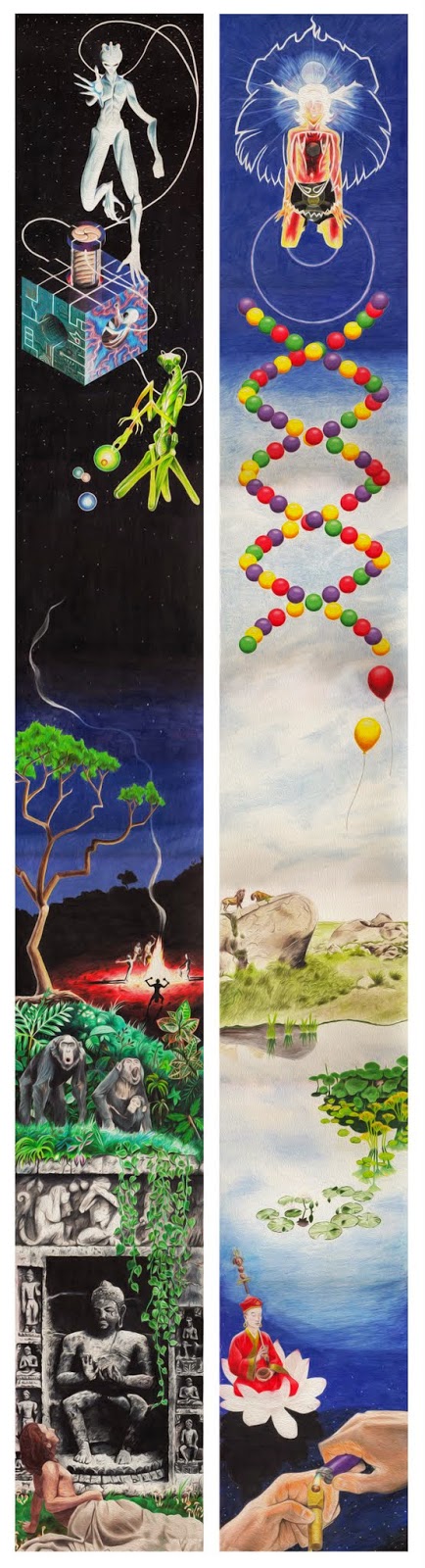 |
| Color pencil and Photoshop. Drew this back when I was 21, and finally got around to scanning it and piecing it together. Then I ran Photoshop’s oil painting filter on it, which blew my mind. You can see detail shots on Picasa Web Albums. |
Reflections on Independence Day
When Meg and I arrived at Lake Union Park for the Fourth of July the sun had set and the park was teeming. People poured in from neighboring streets, and each new streetcar creeping from downtown was packed with would-be spectators. For all that, the place wasn’t genuinely packed, and I was happy to see plenty of spaces on the grass affording great views across the lake to Gas Works Park, where the fireworks display would actually be held.
“They have vendors here,” I exclaimed, surprised somehow. “They have ice cream!”
“If you want to wait in line,” Meg replied. It was true, the line snaked back for a long ways.
“We’re not in a hurry. I need to get money first, though.”
I withdrew forty dollars from a little ATM placed right there by the walkway, sheltered by its own ATM-sized tent. Then we stood in line for ten minutes, listening to a nearby musician tapping out Bob Marley tunes on a steel drum, adding to the festal air. Once I’d obtained my cone, we ambled happily away across the grounds toward the clean white edifice of MOHAI, whose acronym I couldn’t quite puzzle out.
People were congregated more densely closer to the water, with families staking out little domains with blankets, towels and lawn chairs. We kept to the concrete walkway, skirting MOHAI’s cafe patio, which was cordoned off with velvet ropes, until we reached the railing by the water. Several yachts were moored there, clearly the properties of the fabulously rich and profligate, whose preposterously small number of friends and hangers-on were flaunting their access by standing on the decks drinking champagne and laughing at the huddled masses behind them. We lingered in a spot close to the building with the patio behind us, breathing the summer air and watching the play of light on the water.
After a while I wished to move on, but Meg, ensconced in her corner away from the crowds, refused to go. “We won’t be able to see the fireworks,” I said, pointing out the obstructing hulks of the yachts.
“Sure we will,” she argued cheerfully. “They’ll be up there, in the sky! Boom!” She was, by this point, more than a little tipsy.
And she would not be moved, however I argued. The truth, I suspected, was that she just didn’t like crowds, but wasn’t willing to say so. In any case, I had a desire to empty my bladder before the show started, so I set off to find a bathroom alone, leaving her there.
The Porta Potties were set up in several long ranks at the edge of the park, easily visible by their bright blue plastic exteriors. In front of them, naturally enough, a queue had formed, as so often happened with crowds. I stood there, waiting patiently, texting Mark and Crystal, until I heard someone nearby talking. “You don’t have to wait,” this person claimed. “There’s all kinds of entrances to the Porta Potties. I don’t even know why there’s a line.”
And on second examination, I realized how strange the line was. There were maybe fifty people queued up, but … there were also at least thirty or forty blue units. Investigating, I got out of line and joined another, smaller line by the second rank of Porta Potties.
As I waited again for my turn, I noticed that the people in front would wait for a door to open, and then head to that vacated unit. But I also noticed that there were a lot of units – at least ten in this little corridor. I began to suspect that most of these units were not in use, at all. When I got to the front of the line, I took a risk and didn’t wait for a door to open. Instead, I walked immediately up to a door I hadn’t seen open, and yanked on it. Sure enough, it was unoccupied.
See, most of the units were unoccupied. It’s just that the lines fulfilled people’s expectation that there would be a line, and we were all apparently perfectly willing to stand there holding our bladders rather than test the validity of what we thoughtwas true. What we risked by such a test was rudeness: being perceived by the crowd as a transgressor of the social compact, one willing to step in front of their fellows out of sheer self-interest.
Pressure relieved, I met up with Mark and Crystal and together we walked back over to Meg’s corner. Again she resisted leaving, but this time was overcome by the pressure of the majority. We found a spot somewhere in the middle of the park and sat down on a patch of surprisingly dry grass, with a great vista of the lake and Gas Works before us. After a while even Meg seemed to relax, despite the proximity of our many neighbors.
The last light was leeching out of the sky when suddenly it seemed half the crowd was standing up. Our great view disappeared, blocked by hundreds of bodies. “Why is everyone standing up?” I asked. “Are the fireworks starting?”
Mark Bell, not one to be caught sitting down, was peering off in the distance. “I think there’s a fire.”
“What?”
“There’s definitely a fire. You can see it. It’s huge.”
Sure enough, once I got to my feet I saw a big plume of thick dark smoke pouring into the sky from somewhere across the water. At its base was the bright orange spark of open flames. “Wow! I hope that’s not the fireworks.”
“It could be. It’s a big fire.”
“So are there even going to be fireworks, then?” Crystal asked.
You could feel the uncertainty in the crowd. From amused and patient spectators we’d been transformed into concerned and anxious citizens. What was happening across the water? Mark tried to access the news on his phone, only to find that he couldn’t connect with thousands of other people in our immediate area trying to do the same. “I want to get a better view,” he said. “Let’s move up to the front.”
“What for?” asked Meg. “We already have a good spot here.”
“We’ll be able to see better up front.”
People were packed three and four and four deep by the railing. There wasn’t much more visible from our new vantage, just that black smoke roiling away into the dusk. Everyone was talking and speculating. We shuffled this way and that, jockeying for a better view through the forest of heads. The smoke diminished. Night fell. Suddenly a panoply of light blossomed in the sky: the fireworks had started. Whatever had happened with the fire, Seattle was going on with the show. We cheered.
Not everyone was happy, though. Right behind us, on the grass, a family of three had set up camp to watch the fireworks, a father, pregnant mother, and young daughter. When the crowd had swarmed to the walkway to see the fire, however, these unfortunates had lost the view they’d coveted. Now the father, who I thought maybe was Thai, was yelling politely enough, “Sit down, please! Everyone, please sit down! The fireworks are starting!”
Heads turned curiously toward him, and then turned back to the fireworks. No one sat.
“Sit down, please! Guys, can everyone please sit down? My daughter wants to see.” His voice was plaintive, chiding, but when he saw that no one was sitting as requested, it became increasingly aggrieved. “Some people have been waiting here for a long time to watch the fireworks. Can everyone please just sit down?”
He went on and on. Still no one sat. His wife joined him in his harangue, less pleasantly: “Doesn’t anyone carethat we’ve been waiting here for five hoursto see the fireworks? Don’t you care that our daughter can’t see?”
This, finally, elicited a response from someone standing right up by the rail. “Some of us have been waiting here for quite a while too,” he ventured.
“If everyone just sat down,we could all see,” she snapped back.
As for us, we just looked at them, puzzled. We weren’t directly in their way, after all, standing off to their left, but it was immediately obvious to us that theirs was a Quixotic struggle. There were at least a dozen people directly in front of them, and if that dozen had sat down, the railing would have blocked theirview, and the people on the edges of the sit-down would have to contend with those still standing. Meanwhile, they were just a few of the thousands of the people in the park, most of whom were standing. It was fighting the tide. Who would even try?
These two, apparently. In a angry, offended huff that stopped just short of swearing (no doubt to protect their daughter’s tender ears), they packed up their blanket with broad aggressive gestures, put their daughter in her stroller, and began forcibly pushing their way to the front of the crowd, determined to obtain the pleasures due their patience.
The really funny thing, of course, is that they weren’t wrong. Hadn’t I made the same comment, back when we were sitting on the grass? If everyone sat down, everyone would be able to see. It was that simple. Instead we all stood, and had to contend with the heads of those in front of us.
The fireworks went on, filling that little low portion of the sky with their familiar spectacle, flowers and fireflies, comets and Saturns. People cheered, several twenty-something men next to us being the loudest. “‘Merica!” they yelled. “Pretty lights!” Or my favorite this year: “Hodor!”
And all the cheers were tinged with irony, I noticed, as I’d noticed at every July 4 celebration I’d ever attended. Even if someone were to yell “Right on, America!” or something, I have to imagine it would be colored by that same self-conscious, semi-sarcastic tone. A crowd will sing the national anthem and place their hands over their hearts, but when watching fireworks they feel forced to acknowledge the ridiculousness of it. They don’t yell “America,” they yell “‘Merica!” Because let’s face it: Shooting colored explosives into the air, as an expression of national unity, is about the lowest common denominator. We may not agree about much else – we may rant and rage about our cousins’ posts on Facebook – but who doesn’t enjoy fireworks? (Okay, probably some people don’t.) It’s a flashy distraction for the masses, candy thrown from a parade float, coins flung from a royal balcony.
As if to prove the point, the fireworks suddenly ended. We waited, but that was it. “That wasn’t much a finale,” I observed.
“I know,” said Meg. “It seemed really short this year.”
It was short: shorter than last year, shorter than the year before. Each year seems to suffer a diminishment. Apparently the city has stopped funding the fireworks, its budget prioritized for more vital needs. It wasn’t clear there even would be a fireworks display this year.
But at the last minute, or so I understand, some private parties stepped in as sponsors: the executives at Amazon, I imagined, and Microsoft, Boeing, Seattle’s corporate titans. I have a theory the reason it was last-minute was because everyone was hoping someone else would foot the bill, playing charity chicken. Finally someone blinked, and threw some coins from their balcony.
There’s a deep ambivalence here, toward crowds, toward our fellow citizens, toward the society we live in. On the one hand, we’re so intent being polite that we’ll wait needlessly for the bathroom for twenty minutes, because we’re afraid that even investigating the situation might upset someone. On the other hand, we’ll all stand up, fighting each other for a view and blocking those with a better claim, even when it’s clearly against our common interest. We all want a celebration, but no one wants to pay for it. We”ll sympathize with someone who gets their house (or boat) burned down, but we won’t actually stop using fireworks to prevent it.
And I wonder, are there countries where everyone stays sitting down? What would that be like? And what would we give up for it?
To know is not to know
She says, It’s like I know, but I don’t know.
The light an amber syrup on her skin.
Desire is a drug, saccharine and low.
We sit on the couch all three in a row,
and with these words I see the truth within.
Yes, I reply. I know, but I don’t know.
You think it’s some secret between us, though,
a plan for betrayal and carnal sin.
Desire is a drug, saccharine and low.
I say, You’ve got to give in to the flow.
Terri pulls out some whipped cream with a grin.
I watch entranced. I know, but I don’t know.
She sucks the nitrous from the tip, and oh!
the bead of cream that trickles down her chin.
Desire is a drug, saccharine and low.
She slips into our bed in dawn’s gray glow.
Right beside you I slide the dagger in.
You see? It’s like I know, but I don’t know.
Desire is a drug, saccharine and low.
Lilith
Perhaps you were determined to beat
every man who haunted you, clear the night
of looming ghosts. Perhaps you desired
only to know what it was to party,
to enjoy the power of your young body,
feel the light of worship on your face.
So at a house in the suburbs you faced
thirty men in button-up shirts, heart beating
as you threw off your dress for the first time, body
frail and wan in the harsh light. That night
ended in no disaster, and you left the party
with a need for a nom de guerre. You desired
something classy. You should call yourself Desire,
I said, which you rejected with a face.
You said you liked Lilith, though at the next party
we found men’s drunken tongues were beaten
by its lisping sounds. They were Teamsters that night,
great hulks, and in play they lifted up your body
as you protested unheard. But your body
was your tool and you learned to use it, the desires
of men slowly acceding to its will. Each night
you learned a little more, how to face
down a troublemaker with a joke, to playfully beat
an unruly father with a riding crop, keep the party
under control with a gesture. Even when the party
turned mean, and a frat boy pressed upon your body
with brute insistence, or a coke dealer beat
upon your fears with an unspoken threat, your desire
for mastery was pure as alabaster, your face
locked in a diamond smile framed by night-
black hair. Still there’s no expressing the nights
we spent that way, the endless parties,
the river of nameless men’s faces,
your bared flesh, the naked voluptuous bodies
swaying and shimmering in a heat wave of desire,
and through it all the city’s electric beat.
And yours was the ivory face of the goddess of night
glimpsed through a party of tortured supplicants beating
themselves from the desire to touch your shining body.
Water and Moon Kuan-Yin
 |
| From My art |
 THE FELL AND THE FAE