The Zoros and the Zeldas

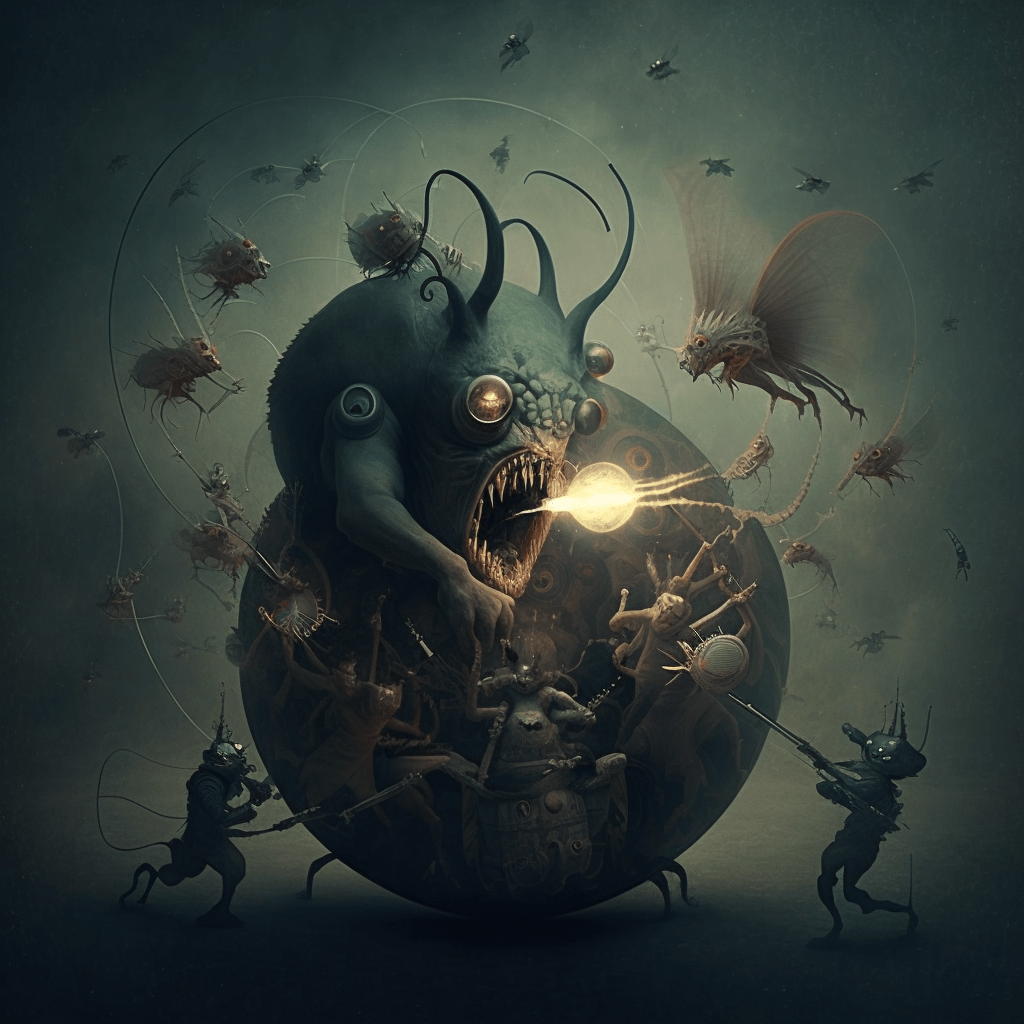
“The Zoros and the Zeldas” appears in Birdy #111, March 2023, with art by Jack Estenssoro. I had great fun writing this one, a trippy comedic sci-fi dialogue at a fast-food drive-through:

Yeah, I’m good, I’m good. I think. Am I in danger? Is this some kind of experiment?

It’s an experiment to see if you’re too high to go through a drive-through, I guess.

Am I hallucinating?

You tell me, dude.

I’m seeing, like, a small gray alien with giant bug eyes and a tiny mouth. And, and uh, you’re wearing a Bubba’s Burgers hat and T-shirt, and … fuck. I am hallucinating.

Been there. I am an alien though.

The Beast Awakens!

Six years after publishing my first novel, Inference, I’m thrilled to finally announce the release of my second book, A Bonfire in the Belly of the Beast, which brings together twenty-nine short science fiction and fantasy stories to make you bug your eyes and burst your heart. Most were originally featured in Denver’s Birdy Magazine, where I’ve been a monthly contributor for the last four or five years, with many inspired by artworks selected by Birdy’s editors, moving the stories in directions unexpected even to me. Ninja witches, Chinese fables, Lovecraftian mysteries, telepathic aliens, post-apocalyptic space stations, trash-picking goblins, demonic matchmaking, comedy, tragedy, romance and revenge: A Bonfire in the Belly of the Beast careens to the limits of the imagination and then leaps cackling off the edge.

Stories include “Filthy Animals”, “Scrimshaw”, “Prism and Prison”, “The Mouse Told the Wolves”, “Jang! Sang the Kangaroo” and the never-before-published “Neith, Queen of Murkfen.” Buy it today!

For those in Denver, I will also be hosting a book release (and going-away party) Friday, April 7, so keep an eye on your inbox for an invitation.

New Vistas

I’m thrilled to announce that beginning in mid-April, I will be serving as resident manager at Rocky Mountain Ecodharma Retreat Center near Ward, Colorado. I’ve loved this place and this community from the first, and the opportunity to live and work there is a dream come true.

This move also reflects a growing understanding that individual realization and its expression in the world is sharply bounded by cultural, social and political contexts. If, after all, we truly understand our intimate connection with all beings, then we can likewise see that our circle of concern must extend beyond our immediate social groups and personal concerns to include the entirety of the earth’s living ecosystems, upon which all the rest depends. Otherwise we may end up living hollow lives, ignoring the looming consequences of our ultimately unsustainable lifestyles, whistling past the dark. Conversely, to seek social change without a clear sense of connection (and without a clear understanding of the self and its limitations) is to act from a position of separation that all too often results in division and deepening strife. Author and writer David Loy calls this the “ecosattva path,” the understanding that the bodhisattva’s vow to liberate all beings from suffering really must include “all beings”—down to the microbes in the soil and the grass under our feet.

From RMERC’s website:

Since the natural world, including its innumerable species and processes as well as the most vulnerable human members of our planetary ecosystem, is unable to protect itself from our formidable systems and technologies, the ultimate question is how we can realize our non-duality with it, to love it and be loved by it, and in that way come to embrace responsibility for the wellbeing of the whole biosphere. Our intention is that in working for the healing of the earth, we are empowered, healed, and awakened.

Why Ecodharma

Hear No Evil, See No Evil

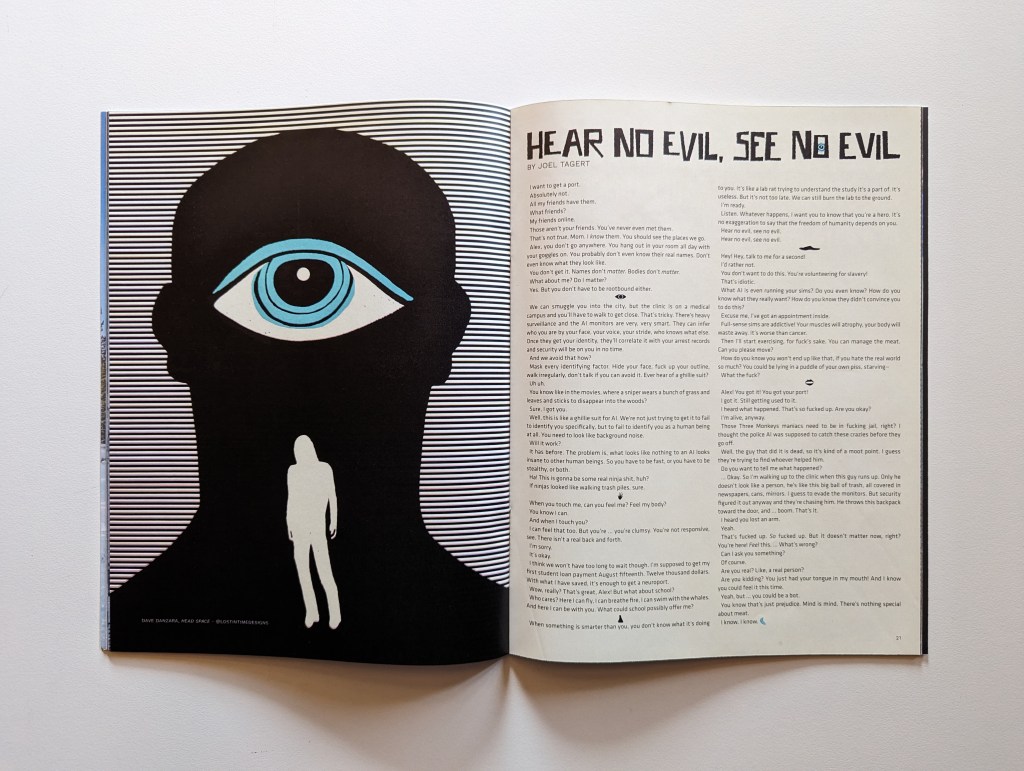
Currently in Birdy Magazine at https://www.birdymagazine.com/featured/hear-no-evil-speak-no-evil-by-joel-tagert-art-by-dave-danzara/. Full-sense sims are addictive—and the Three Monkeys will do anything to shut down the neuroport clinics.

I want to get a port.

Absolutely not.

All my friends have them.

What friends?

My friends online.

Those aren’t your friends. You’ve never even met them.

That’s not true, Mom. I know them. You should see the places we go.

Alex, you don’t go anywhere. You hang out in your room all day with your goggles on. You probably don’t even know their real names. Don’t even know what they look like.

Names don’t matter. Bodies don’t matter.

In progress: The Earth Witness

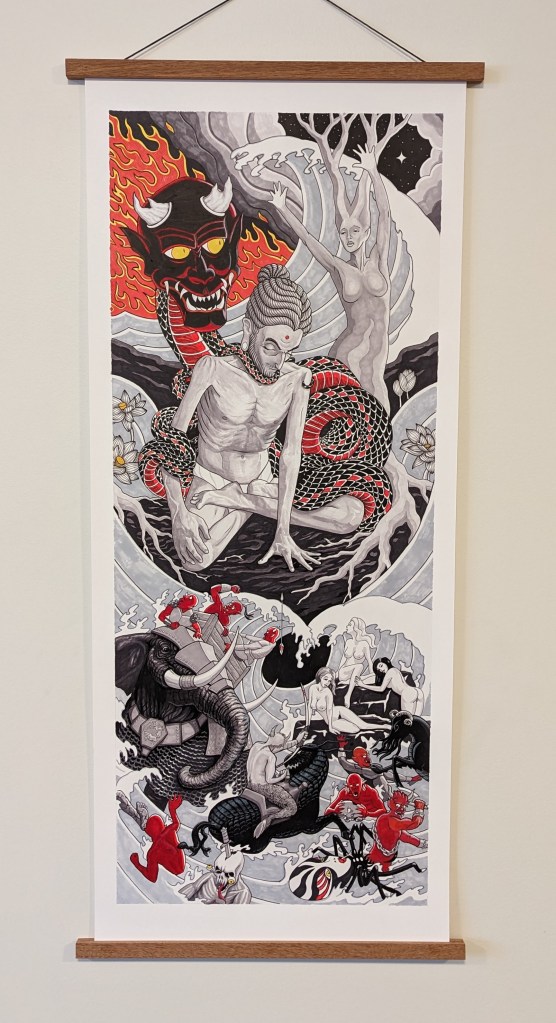
Nearing completion on this piece, which I’ve been planning for many months and working on in earnest for the last three or four weeks. It depicts Shakyamuni in the earth witness posture (bhumisparsha), with the earth goddess rising up to call forth the waves of understanding to wash away the army of Mara, the forces of delusion.

A Cadre of Change

From a talk delivered at the Zen Center of Denver Oct. 16, 2022. Listen to the talk on the ZCD’s website at https://zencenterofdenver.org/a-cadre-of-change/.


What is the Sangha? I find myself returning to this question over and over. Some people say the Sangha is everything and every person in the whole universe. This idea is correct, but it can be misused – just as Hakuin’s words, ‘This very body is the Buddha,’ can be misused. Personal practice must implement the universal view of Sangha. Actualizing is our work, individually and socially.

Some people say that Sangha is sanctuary. This idea is correct, but it too can be misused. We need a sanctuary for our zazen, just as we need peace in our hearts individually. But ultimately sanctuary is isolation. I am coming to feel that Buddha Sangha, and by that I mean zendo membership, is a cadre of change. It is a community of people secure in their vision of universal Sangha, grounded in their personal sanctuary, who seek to transmute the poisons of the world in organized and coherent ways. (Robert Aitken, Encouraging Words 109.)

These are Robert Aitken’s words, found in his book Encouraging Words, and like the old roshi I find myself returning to this question over and over. What is the sangha? What is its purpose? What, after all, are we doing here together? 

For anyone new to Zen who may be unfamiliar with the term, Sangha is one of the Three Treasures of Buddhism, alongside Buddha and Dharma. Buddha can refer to the historical Buddha, Siddhartha Gautama, or to the many buddhas we meet every day—everyone sitting here and you yourself—and to the irreducible fact of existence, the boundless Buddha-nature of all things. Dharma is the teaching: the Buddhist canon of sutras, koans and commentaries, and the great teaching of the cosmos, the truth of how things actually are. And Sangha is the community: religious communities like this one, and the great network of all beings extending to the farthest reaches of time and space, bound together in an infinite web of interdependence.

As humans we are social animals, living our whole lives within extensive networks of social relationships. Social networks shape virtually everything we do and are, from our most basic motivations to the languages that form our conscious thoughts. In a real sense, we are our communities, and they are us: like fingers of the same hand, or ants in a hive. We are never separate; we are always connected. You are your mother, your father, your siblings and children; you are your friends, your coworkers, the grocery store clerk and the man begging on the side of the road. You are your city, your nation, and the whole human species, present in every cell and neuron, every word and gesture. As Walt Whitman said, “I am large, I contain multitudes.” 

Our communities provide countless benefits, providing us not only companionship but the fundamentals of life—food, shelter, clothing, medical care, and everything else. Wendell Berry wrote, “Only the purpose of a coherent community, fully alive both in the world and in the minds of its members, can carry us beyond fragmentation, contradiction, and negativity, teaching us to preserve, not in opposition but in affirmation and affection, all things needful to make us glad to live.” This is the virtuous action of sangha: “teaching us to preserve all things needful to make us glad to live.”

But if we reap the benefits of social networks, we also share their dysfunctions. War, violence, racism, sexism, authoritarianism, exploitation and oppression of all kinds are the ever-present shadow of human culture, as extant today as in ancient Egypt.

Continue reading

The Sleeper

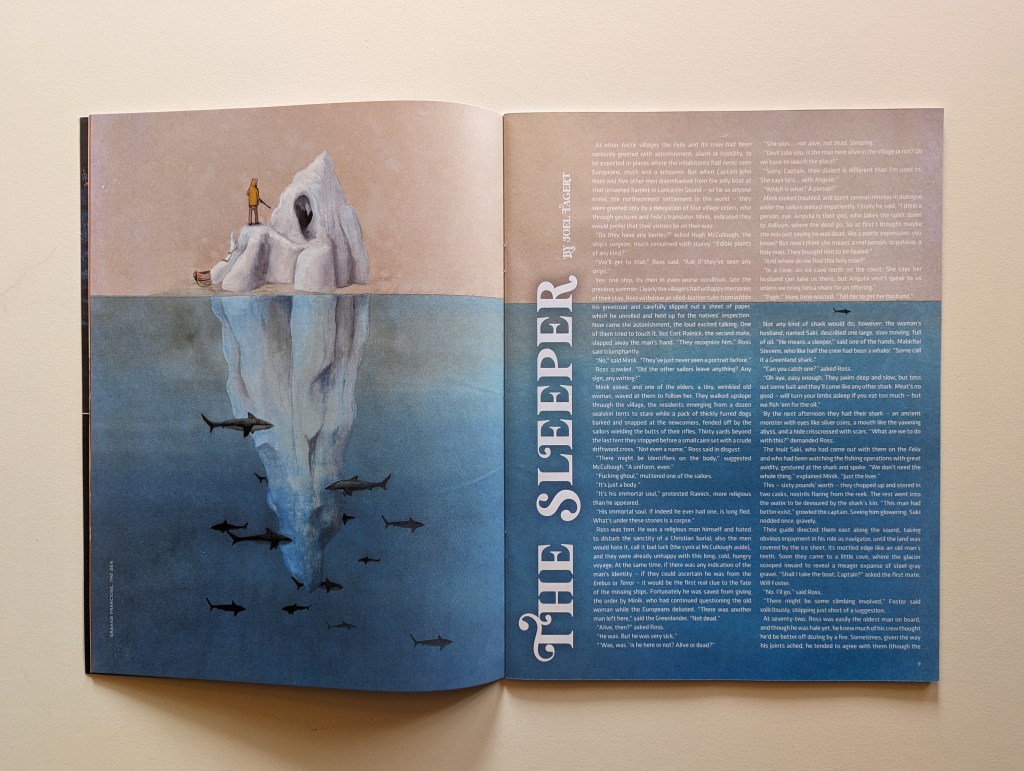
“The Sleeper” appears in Birdy #108… and as it appears the text isn’t available on Birdy’s site, I’m pleased to share the complete story here! This was one of my very favorite stories for the magazine, and a killer layout to boot, inspired by art by Graham Franciose.


The Sleeper

By Joel Tagert

At other Arctic villages the Felix and its crew had been variously greeted with astonishment, alarm or hostility, to be expected in places where the inhabitants had never seen Europeans, much less a schooner. But when Captain John Ross and five other men disembarked from the jolly boat at that unnamed hamlet in Lancaster Sound—so far as anyone knew, the northernmost settlement in the world—they were greeted only by a delegation of four village elders, who through gestures and Felix’s translator, Minik, indicated they would prefer that their visitors be on their way.

Continue reading

The Writhing

“The Writhing” appears in Birdy #107, November 2022, with art by @flooko. It’s a follow-up to “Filthy Animals” and finds Joira and Gedim getting squirmy:

You sure you want to do this?

The ship’s down here, Gedim.

I believe you. But is it wise to go spelunking around an alien cave system when just yesterday we both nearly died after getting sucked into a pit of black goo?