Mingus Rides North

mingus

Mingus rode north and Death rode with him. Mingus was, or had been, a canary. Death was this Swedish kid named Niclas he’d picked up hitchhiking outside Billings. Kind of a strange kid, truth be told. Did a lot of drugs.

“Stop here,” urged Niclas as they approached a Petro-Canada. “I need smokes.”

Mingus angled the Malibu toward a spot out front, but gave his passenger a dubious look. “You should let me go in.”

The skull looked at him intently. Mingus could see the back of its eye sockets, which wasn’t something you often saw when you looked at someone. “So what now, I never can talk to another human being?”

“That’s just it,” Mingus gently argued, “you don’t seem to be human exactly anymore.”

“I have a body, man. Look, it’s human.”

“It’s a human skeleton, yes. Walking and talking and smoking.”

“Yeah, like I say.” Niclas looked out the tinted window with dissatisfaction. “Fine, you go. But then we stop at a rest area or some place.”

“Okay.” Mingus got out. In Canada, it seemed, even the gas stations had beautiful views – mountains, a lake with a dock. Some boats down there. He felt refreshed, like maybe things would work out for the best after all. They’d find somewhere without any people, and spend their days chopping wood and carrying water and such. It was all admittedly a little vague, but it felt worth pursuing.

Inside the forty-something clerk was watching a television on the counter. Her gaze barely left the screen as she retrieved the cigarettes. Bizarre creatures were loping and flying and squirming down city streets, buildings burning, policemen in riot gear. “What do you think?” she said, jerking her chin absently at the TV.

He glanced at it nervously. “Oh, I don’t know. Probably good to stay away for now.”

“But what do you think it is? Look, this cop just turned into a walking refrigerator.”

“Well, if I had to guess… I’d say that probably a scientist was researching interdimensional phase changes using planar crystals in a lab in Denver. Then, probably, she found out she’d succeeded when her canary, which she kept around partly to warn of dangerous dimensional fluctuations, suddenly turned into a middle-aged man in a blue suit.

“Then, probably, she made the mistake of touching him, which initiated another phase change, turning her into an octopus. It’s like how very pure water won’t freeze until you introduce a little impurity, and then it freezes instantaneously.”

Her eyes narrowed. “But what about all this shit?”

“Oh, well, turns out it’s communicable. Just by touching. So… might want to stay at home for a little while. Or just not worry about it. It’s not so bad.”

She backed away. “I think you should go now.”

He nodded. “No worries.” He was hearing shouting anyway.

Outside a big red-bearded guy was backing away from his motorcycle, which Niclas had come out to admire. “You’re not taking me!” the biker was yelling, ducking around the pumps toward Mingus. “I’m not ready to go!”

“I’m not really Death, man,” said Niclas. “It’s just how I look. I can’t help that, you know?”

Mr. Redbeard seized a window-washer from a plastic well and waved it in front of him.

“Back off! I’ll use this!” Washing fluid sprayed the concrete.

“Excuse me,” Mingus said, and tapped the fellow on the neck. With his bare finger.

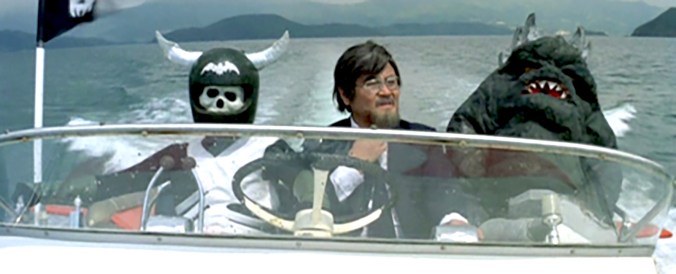
There was a crackling noise and a brilliant fragmented alteration of the space around the biker, as though he’d been suddenly encased in a sparkling glass mosaic. When it dissipated, there stood a short, exceptionally ugly gray-green demon thingie. Sharp, curving horns, flesh like rock, remarkably large triangular teeth, flaming orange eyes.

This squat devil looked down at itself, gasped, and made a rush for the motorcycle, deciding death was preferable to staying put, but unfortunately the keys had disappeared in the transformation along with his clothes. Also, his short legs couldn’t reach the chopper’s pegs. He raised his hideous visage to the sky and howled.

“Calm down, man,” said Niclas. “It’s okay, you’re just a little different now.”

The biker’s name was Fred. After a lot of reassurance, they all sat on the curb and contemplated their changed existences. “Listen,” Mingus said finally, “I’m sick of driving anyway. What say we walk down to that dock, steal a boat, and look around for a nice cabin on the lake?”

Fred shrugged in defeat. “Sure. I mean, I was going to meet my buddy in Prince George, but now he wouldn’t even recognize me.”

“Hey, everybody changes, man,” said Niclas breezily. “Can I take your helmet?”

Out on the water the air was crisp and fresh. As a canary, he’d been kept in a cage. This new life was confusing, but the mountains offered grand vistas of possibility.

Mingus rode north, and Death and the Devil rode with him.

A little flow

One of my not-so-secret secrets is that I like to dance. I find dancing an altogether remarkable activity, at once social celebration, artistic expression, and low-impact cardiovascular exercise. In some ways it seems to me also the mirror of zazen: where in zazen one forgets the self through stillness, in dancing one forgets the self through pure uninhibited motion.

Beyond the Worldwall, Chapter 4: A Guide to the Land of Devils

Once MacMillan was safely back at camp, Boleti turned back toward the site of the attack. He held his rifle at the ready, cradled in his arms. There had been quite a few of the creatures – a half-dozen or more – and the men had killed at least three. It passed through his mind that perhaps they could eat them, but then he saw again the creatures’ black blood, and dismissed the idea. Nothing that bled that color could be good for people to eat.

beads

When he neared the glade, he first stood a long time in the shadows, waiting. Perhaps the animals were likewise lying in wait. But after an hour he had seen and heard nothing, and he stepped forth from his hiding spot. There was plenty of that black blood visible, on the low ferns, the moss, the tree trunks; but the bodies of the beasts themselves were gone.

That was too bad, and a bit puzzling. He had hoped to have a closer look at their anatomy, having never seen anything like them, and he was sure the others would be interested as well. No doubt MacMillan would have wanted to dissect one, if the surgeon hadn’t been rendered insensible from his injuries. (Personally Boleti doubted he would live.) He especially wanted a look at that odd, bifurcated, tentacled proboscis… like two hands, almost.

Had some other scavenger dragged the bodies somewhere, perhaps up into the trees? It was possible. But somehow he thought that the creatures had returned to claim their dead. It was a strange thought; what animal cared for its dead? But perhaps they had taken the bodies merely to consume them.

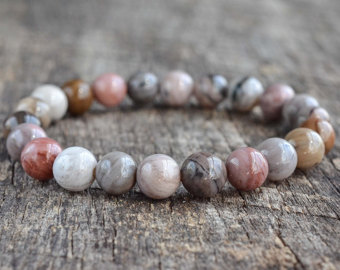
He squatted and picked up something that had caught his eye, handling it carefully: a variety of hard, multicolored seeds or nuts, each drilled through its center and run though by a cord of fibrous brown string. The cord had parted, and many of the crude beads were flung about the ground nearby, but still he could see a pattern to the arrangement: red nut, green nut, red nut, green nut. Continue reading

War is propaganda. Peace is truth.

Contrary to popular belief, the real point of war is not to destroy your enemies or raze their lands. It is, rather, to persuade them that you are in control, that one government’s rule is illegitimate and powerless while another’s is rightful and effective. It is only when a population acquiesces to one side or another that a war may be said to be over. Thus, war and propaganda are essentially inseparable. War itself is propaganda.

Seen in this light, the real purpose of “limited strikes” and “proportional response” becomes clear. The intent is not to end one government or even substantially hinder its military capability; rather, it is a means of persuading various parties of your authority. In the case of the recent missile strikes on targets in Syria, it seems likely that they will sway nearly no one within that country, and Assad’s jaunty walk to work the next day is perfectly in keeping. Who, then, are these strikes meant to persuade?

The answer is perfectly obvious: The real target is the American people. The strikes were done for the express purpose of convincing us that the current government, and especially the President, possess real power and the moral authority to wield it. It’s classic sleight-of-hand: The magician draws your attention to a bright handkerchief with one hand while relieving you of your valuables with the other. Don’t be deceived. Don’t look away.

Breaking Free from Gun Violence

The basic difficulty in ending gun violence is, I think, the immediate reflex toward self-defensive fear in the face of that violence. Where some of us, on hearing of another massacre, will advocate for stronger gun control laws and mental health care, many others see only possible danger to themselves as individuals, and cling to guns as means of self-defense (however uncertain that means is).

It’s a difficult spiral to break free from: violence to self-defensive fear to widespread gun ownership, which leads to more violence and more fear. It’s rooted very deep in our culture, which continues to worship warrior archetypes that invariably represent and advocate violence as the primary means of male power and redemption.

On a personal level, we have to break free of fear, first and foremost. We must recognize that all life is uncertain, and that the effects of our actions extend far beyond our individual selves. We are connected root and branch to the people around us, as the tree is to the soil, and our lives are, in the final analysis, just drops of rain in the torrent. Will we nourish life with kindness and self-sacrifice, or will we, in clinging to our fear and the desire for vengeance, allow our spirits to become poisoned?

On the societal level, we must turn to communities founded on principles of openness, compassion, and nonviolence, and provide them our energy, our material support, and our gratitude. We need also in particular to turn away from the destructive greed of capitalism and its feudal hierarchies, which perpetuate enormous inequality in our daily lives and workplaces. Really, it is when every person is loved and cared for, nurtured emotionally, spiritually and physically, that individual violence and its societal counterpart, war, will finally cease. On that day we will wake up at last to the world we have dreamed; and all we must do to accomplish it is give up our fears.

ancient-banyan-big-island-hawaii-james-brandon

Beyond the Worldwall, Chapter 3: The Surgeon, Fallen

tropical-rainforest-jungleThrown by that horse, was his first jumbled thought. That worthless roan. He was not a terrible horseman; but that mare had looked at him with almost a feverish eye, and fought the bit. But deep as he was in the opium, and deep as his infatuation was with Mary Henneman (whose father owned this land for miles around), he had jerked the reins and imposed his will upon the beast. Now she had had her revenge.

With great effort, Gowan MacMillan lifted his head and looked down at his body, aware of profound pain through the haze of the drug – grave bodily injury – his leg especially. He saw the blood soaking his gray trousers below the knee, lay his head back and croaked, “Help.” With that he was exhausted, and closed his eyes. He could just fall back asleep – that was the wonder of laudanum. Whatever your condition, the tincture laid a calming hand upon your brow and said, “It’s all right, it’s always been all right, everything will always be all right.” Sweet Mother Poppy.

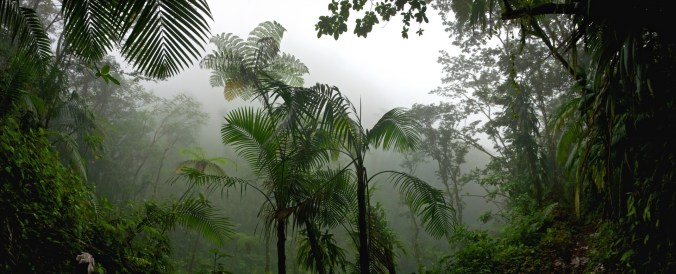
No, dear God. You could bleed out as you lie here, you idiot. The others may not even know where you are. With a great effort, he opened his eyes again, looked up at the forest canopy – the strangely thick and verdant forest canopy – and yelled with what strength he could muster, “Help! HELP!” Continue reading

Beyond the Worldwall, Chapter 2: Dr. Phlogiston

balloon

Reverently, Dr. Philippe Joubert placed his hand against the unyielding surface of the Worldwall. It was perfectly smooth, perfectly even, and in the midday light revealed their reflections readily; but up close it had a translucent quality – a smoky gray depth not apparent from a distance. “Like glass,” he breathed.

“Some say it’s made of pure diamond,” Durmoth reflected.

“A diamond ring around the world,” said MacMillan. “To mark what union, I wonder?”

Sykes laughed. “Ever the poet. It doesn’t look like any kind of metaphor to me.”

“And you, madame?” Joubert asked Bisette, who had pulled off a glove to stroke the wall delicately with her fingertips. “Are you impressed?”

“Impressed, yes,” she allowed, craning her head back at its nearly inconceivably height. Withdrawing, she pulled her glove back on. “But undaunted.”

Joubert clapped his hands once in admiration, laughing. “Bravo! Just so! Our patroness shows us the spirit, gentlemen. Onward and upward!” Continue reading

Social Media as Commons

In reading about commons and commoning, and with the current storm over net neutrality, I have been thinking more and more about the ways in which we voluntarily cede common spaces to private interests. The only reason net neutrality is even an issue, after all, is because we have allowed corporations to exercise near-monopolies over internet access (namely, in Denver, the duopoly of Comcast and CenturyLink), which utilize what is really public infrastructure for that purpose (cable and phone lines, respectively).

These monopolies are well-established and difficult to uproot without new, disruptive technologies (mesh network, anyone?) to replace them. But we allow similar control even in spaces where it’s completely unnecessary, even where corporations offer little advantage over better, more community-oriented alternatives. Banking is one such area; corporate banks offer virtually nothing not offered by credit unions, and using corporate banks gives those institutions unbelievable power over our lives. So if you’re still giving your money (literally) to Chase, Well Fargo and their ilk, please, please consider moving to a credit union.

Another good example may literally be staring you in the face right now: Facebook. At root, Facebook is simply an online bulletin board system. It’s not so different from systems I remember using in the dial-up era. It is a public forum wherein we converse, share events, form communities and maintain friendships. It is, or should be, a commons: owned by none, shared by all.

And yet, by our participation, we have allowed this space too to be co-opted by corporate interests. What you see is not, strictly speaking, what your friends share; it is, rather, a subtly manipulated version of their contributions, with the not-so-subtle insertion of innumerable ads.

What’s especially concerning to me is the way it affects our mental processes. What should be about sharing, community and friendship instead becomes about buying and selling, production and consumption. With most of us barely aware of the change – indeed, unaware that a different experience is even possible – we become convinced that this is simply the way of the world. Capitalism becomes our inescapable daily reality, a sort of smog we’re squinting through all the time. Thus the plutocrats succeed in enclosing, not just a public forum, but our very thoughts and minds.

Yet, as with corporate banks, the ceding of this space is largely unnecessary. Alternatives exist that provide, if not exactly the same interface, nearly the same functions – without corporate control, without this subtle mental pollution.

If you are here saying to yourself, “Sounds great, but what can you do? Everyone’s already on Facebook,” I would ask you to consider that this very feeling of helplessness is precisely the reason to invest yourself in something different. Corporations, and the governments that support them, want you to feel isolated and powerless. It is a core mechanism of the capitalist state to keep the population under control.

Yes, using open-source and peer-to-peer alternatives is slightly more work, and can be slightly confusing as you get accustomed to a new interface. But that very investment in effort reflects a key difference: You must invest in your community. You must be an active participant and contributor rather than a passive, docile consumer. If you want to realize a new, more equitable vision for society, you have to make your stand for it.

With all that said, I’d invite you to check out Diaspora, an open-source social media app that does, more or less, what Facebook does. I’m not saying it’s the be-all, end-all. If you know of something better, let me know. But it’s past time to try something new.

Beyond the Worldwall, Chapter 1: Devil Dick

When they reached the port of Tewabo, just a hundred and eighty miles north of the Worldwall, Joubert brought out two bottles of an excellent Almithean wine he had been hiding somewhere. He poured a modest glass for each present in the company chief’s dining room (minus the seamstress, who had recently embraced teetotalism), raised his own and said, “It may seem that our greatest obstacles are ahead, especially that single great obstruction that cuts our world in twain. But in reality our greatest difficulties are now behind us. We have travelled across the first the Galling Sea and then the Rolonia. It has been an impressive and instructive journey, such as few have made.

“But before we could set off, we had to assemble our supporters, convince and cajole those with wealth to part with it, not for hope of material gain, but for knowledge and glory. And even before that, we had to defy gravity itself, using our science to set humanity free from the mud from which it arose.”

Prolix bastard, Richard Durmoth thought, not for the first time. His eyes flicked across the table to the seamstress, Bisette, who refused to meet his gaze. Continue reading