Thumbscrew

Violet Thayer woke to a bright, merciless light above her that sent razor-blade rays of pain through her eyes and into her brain. God, her head hurt. What had happened? Where was she?

She tried to get up and found she couldn’t. She couldn’t move at all. There was some kind of restraint around her forehead, she realized, strapped painfully tight. Neither could she move her arms or legs. “Hello?” she cried, finding her voice hoarse and querulous, like an old woman’s, which she was.

“Wakey wakey,” called a voice. It was weirdly deep, somehow distorted. The light above her dimmed and she saw that two feet above her head was positioned a complicated apparatus. She couldn’t quite make out what it was for, but it had two nasty-looking drills pointing downwards like accusing fingers. Set above this pair was an iPhone held in a simple clamp, and it was broadcasting via Facetime, like she sometimes did with her daughter in Portland. Even realizing this, however, it took her a minute or two to understand what she seeing on screen.

It was someone wearing a mask, a mask made entirely of curving spirals and spikes, glinting silver metal and black shadows. The mask was dominated first by two large protrusions on the lower cheeks, where the filters on a gas mask would be, and perhaps that’s what they were. Next she noticed the mirrored surfaces of the eyes, which were precisely engraved with black spirals. Gradually she realized that the whole mask was covered in screws, thousands of them in different shapes and sizes, so the mask’s edges were a blurred irregular outline no matter how the wearer turned.

It was familiar, somehow, but Violet’s head still hurt, and she couldn’t wrap her mind around it. “Where am I?”

“Not important,” said the mask on screen.

“Am I in a hospital? Did I have a stroke?” You never knew, at her age.

“Not a hospital. You could say it’s a private facility.”

“Where’s the doctor, then? Why are you talking to me on the phone?”

“Fine questions, all.” The voice sounded pleased. “I see the anesthesia is wearing off. I do my best to be precise about the dose, but I’m not quite a professional, and sometimes I overdo it. Always disappointing when that happens.”

“What do you mean, you’re not a professional? And what’s this thing I’m seeing? Some kind of TV show? Where am I?” Something was wrong. This wasn’t adding up, stroke or no. She tried again to look around. To her right, in her peripheral vision, she saw white walls, a windowless door. To her left there seemed to be another table, with another person on it. “Excuse me! Hello! Are you there? Whoever’s on that bed, are you there?”

“Take it easy!” her observer said. “We don’t want you to tire yourself out. We have important things to talk about. There are decisions to be made.”

She closed her eyes and hung her head, focused on just breathing. “Where am I?” she repeated.

“I’m happy to say that you’ve been chosen to be part of an experiment,” the voice said. “You can regard it as an opportunity. If you live up to expectations, you get to leave here unharmed. If you fail, well, let’s just say you’re screwed.

She looked up, eyes widening, seeing those drills again. They were positioned, she realized, directly above her eyes. All of a sudden she was fully awake, adrenalin spiking through her thin old body. She shuddered once, uncontrollably. “You’re the one they’ve been talking about on the news. That killer, what do they call you? The Screwball or something.”

“They call me Thumbscrew, thank you very much,” the madman growled. “Screwball seems a little undignified, wouldn’t you agree?”

Oh, she was in bad trouble here. She hadn’t been in trouble like this maybe ever, unless you counted when she’d run from Arnie, her first husband, after he’d smashed a beer bottle over her head when she was nineteen. That had been a bad time, too, but this was worse. “What do you want?”

“I want to show the world something essential about the human spirit,” Thumbscrew said. “Namely its utter emptiness. Its pliability. The darkness at its core. There remain those who believe in something righteous at the heart of it all, and I simply detest them. They’re either hypocritical or ignorant, every one, and the damage they do in this belief is simply incredible. So I like to take people of faith and goodness, like yourself, and give them the chance to open their eyes. To accept the reality of the world, red in tooth and claw.”

“Let me go,” Violet said suddenly. “If this is a joke, you’ve gone far enough. It’s not funny. Let me leave now, or I’ll call the police.”

Thumbscrew laughed. “You’re not going anywhere. Not until we’re finished.”

“Help!” she screamed, as loud as she could. “Somebody help! Anybody!” She struggled in her restraints, but she couldn’t move an inch. There was even a collar around her throat.

“There’s no one here to help you,” said her tormentor. “And Violet, the longer you go on like this, the harder it’s going to be for you. On the other hand, if you’ll just do something for me, one little thing, I’ll certainly let you go. Did you notice your friend over there?”

“Yes. But I don’t think I know him.”

“Can’t see very well, can you? Here, let me show you.” The phone cut to an image of a man’s face. He was white-haired, with a goatee and mustache. Not bad-looking. He looked dignified; she imagined him as a professor, or retired doctor. Around his forehead was a band of brown leather, cinched tight.

“I don’t know him.”

“Of course not. Though after today, I doubt you’ll forget him. Now, let’s begin.”

Above her, the drills began turning. They didn’t move fast, maybe one revolution per second. They didn’t look like medical drills. Their metal was dark, stained with what she hoped was oil but suspected now wasn’t. “What are you doing?”

“It’ll become clear. Look at your friend.” On the phone, she saw that there were also two drill bits in the picture there, likewise pointed toward the man’s eyes. And they too were moving.

Her eyes flicked back to the drills above her. Had they dropped, a tiny bit? Were they closer? They were! “What do you want?!” she half-screamed, muscles contorting involuntarily, desperate for escape.

“Feel under your right hand,” Thumbscrew directly. She scrabbled with her fingers, found a little handheld device. She grasped it, found a single button beneath her thumb.

“What is it?”

“Press it and see.”

She pressed it. The drills above her kept right on turning.Involuntary tears slipped down her cheeks. She pressed it again, and saw that while hers were unaffected, the drills above her neighbor’s face whirred to greater life.

“That’s clear enough, isn’t it?” Thumbscrew explained. “It’s sort of a race, really. With each revolution, the screws drop a little lower. If you do nothing, sooner or later they’ll reach your delicate little eyeballs and start doing what they do. Soon enough… pop! Although I seriously doubt you’ll die, at that point. No, they’ll keep right on drilling through the gooey mess until they reach your optic nerve, and while I’m not certain, I bet that’s going to hurt even worse than having your eyeballs burst. Then, finally, they’ll reach your brain, and you’ll die.

“I have to warn you, though: at their current speed, it’ll take at least half an hour or so.

“That’s all hilarious enough, but of course there’s a twist. I love twists, I live for them, really. The twist is that when you push that button, your partner’s screws speed up. They drop faster. And if you hold it down, he’ll be dead in, oh, probably less than five minutes. That’s all it takes: five minutes of pushing a button.

“The game ends when one of you is dead. Whoever lives gets to go free. Do nothing, and you both die. As it happens, you have something of an advantage, because Mr. Wassen here is having trouble waking up. Do it fast, maybe he’ll be unconscious for the whole thing. Wouldn’t that be a mercy? I suppose I should have waited, really, but I was impatient to get started.”

“Why are you doing this?” It was all she could think to say. Her brain seemed stuck on it. Her brain that would soon be just so much pudding under a mixer.

“I told you! You and your goodness, your churchiness! You work at a soup kitchen, you’ve done hospice work, you say kind words to strangers! I’ve been watching you, I hear what people you know say: Violet Thayer, she’s a saint! Kindest, gentlest woman you ever met. She wouldn’t hurt a fly.

“And I say, bullshit! You wouldn’t hurt a fly because there’s no self-interest involved. There’s nothing at stake. But I know that everyone is rotten at the core. Everyone will kill someone else to save themselves. It’s the truth!”

She tried to sort it out in her mind, but all she could focus on were the two drills dropping slowly toward her. They must have dropped an inch already. On the phone, the old man frowned, blinked his eyes. “Look, he is waking up,” Thumbscrew said. “John! Oh, John. You think you’re a goody-two-shoes, you should meet this guy. Runs a fucking animal sanctuary. Literally saves stray dogs and birds with broken wings. I bet he’ll decide to kill you in under ten minutes. John!”

The drills! Their dark metal shafts, their bright silver tips! What would it feel like? The button beneath her thumb felt large as a mountain. It felt magnetic, like it was drawing her thumbtip down without any conscious volition on her part.

Violet, no, she thought then. You know better.

“No,” she told her captor. “I’m not playing.” With an powerful effort of will, she lifted her thumb from the button. Then she let the device drop.

“You’re going to die a nasty, slow, violent death,” he said. “In unbelievable pain.”

“That may be,” she replied. “But I won’t participate in it. That’s what you want, I know. You want absolution. You’ve done unspeakable things, and to excuse yourself, you have to prove that anyone would have done the same in your circumstances, no matter how good they seem.

“I learned that from my first husband. He was always hurting me, and then trying to make it feel like it was my fault, somehow. Well, it wasn’t. It was all him, just like it’s all you now.”

The cut back to the man in the mask. “You’ll both die, then. You’ll be responsible not just for your death, but his too. You’ll be a murderer not once but twice.”

“We’ll both die, maybe, but neither of us is responsible. We’re only responsible if we join you. And I won’t do it. I refuse to share in it. Your violence is your own.”

“You’ll DIE!” he shouted. “You’ll have a drill in your fucking brain! Push it! Push the fucking button!

“No.” Spastically she scrabbled with her fingers, trying to push the button away from her, and succeeded in pushing it off the edge of the table. Above her the screws kept turning.
The Panelord’s Wife

Whenever Jareth had bad luck with a girl he needed someone to complain to, and tonight it was the bartender. He hadn’t quite caught the man’s name, but he was a tall fellow with a long blond beard and waxed mustachios, and he listened well. Eventually, though, business picked up in the inn, and Mr. Blondbeard had to attend to other parties.

“It’s always hard,” said the person next to him at the bar. Jareth looked over, saw an old man. Bit paunchy, white shoulder-length hair combed straight back. His clothes looked expensive but overly used and years out of fashion: a long, worn black coat with silver buttons, laced black boots, silver hose with visible runs in them. Stains on his silk shirt, gray stubble on his jaw. Jareth himself wore a bottle-green suit, pants hemmed at the shin, and low buckled shoes. He’d always believed in dressing well.

“What’s hard?” he said, not much interested but with no one else to talk to.

“Time. How people change. You can’t ever anticipate it. You start seeing someone, and you think you know who they are. Then the years go by, and you end up with someone different than you started with.” The man sipped his mug of treacle stout, looking contemplatively up at the painting on the wall opposite, of The Abduction of Lorallis. Satyrs groping young maidens. “It puts me in mind of a friend I had. A panelord.”

“Really?” Jareth exclaimed, ears pricking. “You knew a panelord?”

“Aye, knew him well. We were close as brothers, once. Met him at Bettner College.”

“Are you a paneweaver too, then?” Jareth said skeptically. There weren’t many of them, after all. It took natural talent in the first place – not just anyone could weave a pane – and then years of study to learn to control it. And a panelord was no ordinary paneweaver. Only they could open their doors not just to Havershire or Borden Locks, but to far Samaway and the distant East, and even to other worlds entire.

But the old man shook his head. “No, no panes for me. I was studying philosophy. I thought I would go on to be a barrister, but it didn’t go as planned.” He took another sip of his beer, wiped away the dark liquid from his lips.

“What was your friend’s name, then?”

“I shouldn’t really say.” But then he shrugged, leaned in close. “But if you want to know, it was Cannody. Bryce Cannody.”

Hell, that did sound familiar.  “You still in touch with him, then?” Maybe he could get an introduction. It’d be sweet to know a panelord. Maybe he could take a trip…

“No, not for many a year. Not since he lost his dear Tara.”

“Was that his girl?”

“His wife.” The old man shook his head. His eyes were damp, and Jareth could see it was no put-on. Sorrow had shaped his face from inside out. “Ah, he loved her so. Loved her with a passion that wracked him. You’re young, but even so maybe you’ll understand. If not… well, if you’re lucky, you’ll know a love like that before you die. Not everyone does.

“They met just after we finished school. It’s traditional, when a paneweaver gets their robes, to take a trip around the isles. A roustabout, they call it, and Bryce was kind enough to take me along on his. Ah, we had a fine time, wandering through the pubs of Quinck, going to the top of Mount Helston. Generally being drunken louts.

“Well, we took one pane further, to the coast of Selieu. I was a little worried about it, since after all he’d only just gotten his robes. What if we ended up getting stuck there? How’d we get home? But he just laughed it off, and summoned the pane, we stepped through that window in space easy as kiss your hand.

“It was in Selieu that he met Tara. First we’d gone to the town, a little fishing village, and drank raka. Then he said, let’s go down the water, and so we did.

“That town was famous for its oysters, and also for its pearls. So we walked down by the cliffs, and there we saw five or six young people diving for oysters. It may sound immodest to us, but the men just wore a bit of cloth around their parts, and as for the girls, they went naked as seals to swim. We went over and talked to them, and though only one spoke English, they welcomed us and did nothing but laugh. They shared their oysters with us and we sucked them straight from the shell with the sea-water still dripping from them.

“There were two girls there, and one was Tara. I doubt she was seventeen, but then Bryce was only twenty-two. And she was lovely, oh so lovely. I think he had never seen someone so natural or so bright. She was tanned gold from the sun, and her hair was golden too. She was lithe and limber, had spent her life so far just swimming and dancing, and there was a haze of freckles on her cheeks.

“And when she dove, ah, it was like watching an arrow slip through the air! She would leap from the cliff and point her whole body, and disappear into the waves with nary a ripple. I’ve known warriors who would charge an army with their swords swinging high, but none were so fearless as that Selliean girl.

“We went dancing with them that night, and I could see him looking at her with something like devotion in his eyes. One of her friends said her family had a bit of the blood of the sea sprites, the merwish. I know everyone says that, ‘Oh, I’m one-thirty-secondth faery,’ but when you looked at Tara you could believe it. Her eyes were just the green of the sea.

“The next morning, Bryce shook me awake and said we should leave now. I couldn’t see what the hurry was, until I saw Tara standing just behind him. ‘She wants to come with us,’ he said, just like that. ‘We’re going to get married.’

“I told him he was crazy, but he was adamant, and Tara said simply with her Selliean acccent, ‘I love him. We see all the worlds. Here, I only die.’

“So he summoned the pane back home. It took him some concentration this time, and for a second I was worried we really would be booking passage on a ship home. He had never opened a pane this far before, after all, and the further the journey, the greater the effort for the paneweaver. They say summoning a pane literally uses up your life-energy, and I know that that’s true. That’s why the weavers are always quick to open and shut their windows, and why they usually use a relay of multiple weavers to go long distances.

“His parents weren’t happy when he got home, that’s for sure. For a good two years they wouldn’t acknowledge Tara at all, virtually disowned him. But Bryce set himself up in business, and a paneweaver never lacks for work.

“He was good at it, too. He could send you and your whole carriage to Espanora if you had the coin, or drop a package on the front step of your aunt’s house in Yoder Lane. When he and Tara had a child, a little girl they named Sephanora, his parents came round. When he bought a house in Lakeside, they forgot they’d ever had a disagreement.

“Ah, those were golden years for those two. You can’t imagine the glory of being a young paneweaver with literally the whole world in front of you. Three days a week he would work, sending this traveller here, this shipment of dye there, always attentively, always developing his craft. Then, when it came Friday evening, he and Tara would decide where they’d want to travel, and set off with little more than few coins and a bag strapped over their shoulder.

“They ate scented chocolates in Callais-au-fein, they looked in on the shops in Lu-kwon. They sailed in the Bay of Tears, and swam beneath Queen Sola’s Falls. Sometimes Tara would swim nude, to the scandal of the locals. They slept between sheets of finest silk and at the top of Mount Heron in Lethiye, in the ruins of a castle there. They were more kings and queens than the actual rulers of nations.

“When Sephie was born they had to take a break, of course. They couldn’t be dragging an infant around so much. Then, too, Bryce’s father had made some poor decisions financially, and to get him out of the poor house he had to hand over a surprisingly sum. And maybe he himself wanted not just any place, but one place to call his own. A home, and a comfortable one. So they bought a new manor, and Bryce worked five days instead of three.

“On the weekends, now, he was too tired to take a trip every week. But Tara was restless. She was used to wandering the cliffs of her hometown, on her own time, with the sky above her. She wasn’t interested in what kind of sofa they purchased, or the state of the garden. She liked owning horses, and rode them joyously, but even her daughter seemed to hold limited interest for her.

“She pestered Bryce, and sooner or later he would relent. But now it seemed even the usual places weren’t enough. She had been to Davermark, and the Orange Coast, and the Tores Mountains. Where else could they go?

“Bryce wasn’t without curiosity himself. Where could they go? So he pushed further, to An’nu’nu’akia at the south pole, to the islands of Tor Aru, the dark caverns of Milastre. And finally, gathering his powers and concentration to a blinding point, he opened a pane to Felland.

“There are few that can open the panes from one place to another in our world, to be sure. One in a hundred thousand maybe, and maybe one out of five of them will ever develop their talent to a useful point. But even smaller is the number of those who can open a window between the worlds. One in ten million, perhaps five in all our country.

“These are the panelords, and what wonders they bring forth! Felland is the closest world to ours, as I’m sure you know, and I’m sure you’ve seen the moving statue in Timely Square, which Helmud the Farwalker brought back with him those centuries ago.

“But you’ve never been to Felland itself, I doubt. There small silver birds zip through the air on weird mechanical wings, and the Fellish stare at you like the stranger you are, with your furless skin and rounded ears.

“You can’t stay there too long, though. You’ll be lost, for certain, and it has happened many a time. It’s best to make your trips short, because the longer you stay, the more energy you will need to return home. It’s just this that happened to Helmud, and his grave is in their world, not ours.

“But Tara went there, and laughed, and showed the Fellish how to dive, which amazed them, for they hate the water.

“She was alive again, nearly exploding with energy, like a burning star. For weeks she spoke of nothing else, and barely seemed to notice her husband’s listlessness, his quickness to tire, or the new bit of gray in his hair.

“Travel within our world is demanding enough. But travel between worlds drains your life itself.
“Soon enough, though, Tara wasn’t satisfied. She could think of nothing but returning to Felland. And within a couple of months, Bryce felt well enough again to cast a new pane, and again they stepped through it, and brought back a souvenir, a gem that would expand and contract with a touch.

“And a little more of Bryce’s hair turned.

“‘Why stop at Felland?’ Tara asked. ‘Lots of people have been there. Probably dozens, maybe hundreds. Aren’t there other worlds?’

“There were, of course. Who knows how many? Like pebbles on the beach, but we ourselves like grains of sand to a grain of sand, and each pebble a million leagues away. But Bryce felt her hunger, told himself it was his own, and opened another pane, and another.

“Xao’xao: the world of the Rano, the bird-people.

“Uvalu-wu-alu: the cloud-world, where people live on floating trees.

“Danatias, a land of machines and burning smoke, which only two other living people have visited, and they only for moments.

“There were new lines in Bryce’s face, and at times he seemed to have trouble breathing. They barely returned from Danatias, and when they got back he collapsed and stayed in bed for three days.

“For a year, then, Bryce didn’t open another portal. He wrote of his experiences, and from each world he took a token to prove he had been there, and among the panelords he became famous.

“Eventually, though, Tara asked again.

“‘What use is life if you don’t explore?’ she challenged him. ‘You want to sit here in your armchair, when you could see worlds no one else, no one, has ever seen before? You have one life, and one life only.’

“‘I may not even have that, if this persists,’ he replied.

“‘One more,’ she insisted. ‘One more, further than ever. A door to the edge of possibility.’

“There was a wild light in her eyes. He knew it had gone too far, that when you push so much, you’re bound to lose yourself at some point. But at the same time, her fearlessness gripped him. He couldn’t say no to it. How could he live with himself if he didn’t find his true, absolute limits?

“He prepared carefully, laying his spells over the course of days, of weeks. But he could not achieve everything; if you wanted to expand your reach, you had to give up some stability. He would not be able to hold the portal open for long. Maybe long enough for him to step through and back; a minute, or maybe five, if his strength held out.

“Finally the day came. His runes were drawn in gold ink on the floor of his workroom. He said the words and made the motions, working unceasingly for hour upon hour, neither drinking nor eating. Nothing less would do.

“It took all his strength, every fiber, every bit of marrow, while Tara watched on. With voice hoarse, muscles straining, mind a single point of light, he wrenched open a door.

“It was small at first, but he fought it open. It was ten inches, then twenty. At thirty inches he could do no more.

“Through the pane they saw a eerie pink light. There were stones floating among pink clouds, and something shaped of rainbow light lifted itself on ray-like wings and floated toward them curiously.

“‘I can’t hold it open,’ he said through gritted teeth. He was sweating, his very organs trembling. Color seemed to be draining from him like water emptying down a sink.

“Tara, though, was looking through it with lips parted, in fascination. ‘It’s beautiful,’ she said.

“‘I have to close it.’

“‘She looked at him, and finally seemed to see the strain he was under. She nodded slowly. ‘All right, my love. Come find me if you can.’

“And with that she leapt through the pane, and into some other world.”

***

The old man was weeping silently now, tears wet on his cheeks. Before the two of them stood a number of empty glasses, as Jareth had kept buying rounds while the old man told his story. “He couldn’t keep the portal open. He tried, but… she didn’t come back. In ten seconds it snapped shut.”

“Do you think she’s still there, then?” Jareth asked. “In that unknown world?”

“Unless she’s… unless she’s passed on to some other world yet. Whatever awaits us all.” He shook his head in defeat. “I could never … he could never open it again. He’d spent too much of himself, passed some midway point where it ceased to be possible. No other panelord has even heard of such a place, much as they might wish it.”

“So you are him,” Jareth said, trying not to sound awed. “You’re Bryce Connady.”

“I’m just an old man,” he said, standing up. “And it’s time for me go home. Thanks for the beers.”

The bartender wandered over. “Any more? No? Be two silvers thirty pence, then.”

Jareth handed over the money. “Do you know who that was?”

“Sure. That’s Monro Hughman.”

“Maybe that’s what he goes by now. But his real name’s Bryce Connady.”

The bartender laughed. “Oh, he told you that one again, did he? His beloved Tara, flown from this world?”

Jareth was stung. “What, you think it’s funny? A man loses the woman he loves, and you laugh at him?”

“Don’t take it hard, lad. I know you’ve had a rough day yourself. But Monro tells that story at least once a week. He lost his wife, sure, when she ran off with a vintner down in Dockville.” He shrugged. “Guess he took it hard. Been drinking ever since, leastwise when he can get somebody to pay for it.”

The Scratch

Danny Lee Brewer’s body was finally found by an old tinker woman on the road three miles south of the Scratch. She came into Castro’s store with her wares dangling on the wooden frame pack she wore, battered pots and tin cups clanging, and announced, “Dead body down south. You wanna buy a cup, maybe?”

Well, maybe he did – travelers were few and far between – but the mention of a corpse soured him on an immediate transaction. “What’s it look like?”

“Don’t look like much. Like raw meat. Sandstorm had its way. Maybe you spare a pone for an old lady, I can go show you.”

Normally he would have ignored this beggary – it was a store, not a charity – but he knew well that Danny Brewer had been missing from his home last night, when the storm winds had been shrieking over the canyon walls of the Scratch and the townspeople had been huddling in their cellars with their finest breathing masks tied across their faces. Hadn’t Ella Weaver come to this very shop in tears, braving the stinging sand, to ask him if he’d seen Danny, because Danny wasn’t at home?

Well, Castro hadn’t seen him. But he had an idea where he was now.

“All right,” he sighed, coming from behind the counter. “One pone, and you show me.” He ducked his head in the back room, said to his son, Segundo, “Watch the shop. We may be a while.”

When he handed the old lady the pone, she cradled it reverently. “A little paste?” she said hopefully. “No paste, no good, right?”

He sighed and got a jar of beejum from under the counter. It was a salty, fermented paste made from the bodies of bloodbeetles (minus their poison glands, full of bitter ink-blue toxin), and it and swordgrass pones were the staples of life in the Scratch. The beetles lived in the swordgrass, and the grass was nearly all that grew unprotected in the wild anymore.

He got out a knife, too, and cut the pone in half for her, then spread the beejum himself. If he’d let her do it, no doubt she’d have spooned up half a cup. Still, she grinned a happy gummy smile, and he had no doubt the calories would do her good. She was a withered doll beneath her rags, old leather stretched across a frame of sticks.

He made another pone sandwich for himself, and put it in a bag along with two plastic water bottles (worn gray with use, but still serviceable), put on his woven grass hat and ancient boots, and they set off.

Along the way they stopped first at the well, so the old lady could fill her own bottles. She grinned and waved at the other townfolk she saw, proffering a little painted clay bear to the children. “Ask your parents, it’s not much, five pones and he’s yours.”

“What’s your name?” Castro asked.

“Mayfair Mary. What you need, I carry.”

“Except food,” he observed sardonically. “You don’t carry that.”

“That I carry it in my belly,” she cackled. “Whenever I can.”

On the way out they stopped at Mason’s, because Mason liked to know such things. Cormac Mason was the mayor, as much as the Scratch had a mayor, or anyway people tended to do what he said, because he was a builder and it was always good to be in favor with a builder. Also he was the strongest man in town, even at nearly fifty years of age, a consequence of lifting stones all day, and people naturally seemed to respond to physical strength and size. It fit their preconceptions of a leader.

Mason wasn’t there, but his wife told them where he was, and it was on their way. They found him making a foundation for a new room for the Weavers, toward the southern end of the canyon. He was pounding a heavy stone mallet up and down on the dirt, packing it firm, shirt off, big arms flexing. His bushy beard came halfway down his chest, and his bald head was covered with a grass hat against the devilish sun.

Briefly Castro told him about his task and Mason frowned, eyes flicked to the window of the Weavers’ house. “Quieter, if you don’t mind,” Mason said. “Don’t want to upset her.” Belatedly Castro realized that was Ella Weaver’s room, and everyone knew she’d been seeing Danny. No point in upsetting her needlessly.

“Go see if it’s him,” Mason directed. “If it is, I’ll get Derrek and Braun with a cart and go get him. If not, it’s food for the flies.” He shook his head. “Saw him just yesterday, at noonday. Shared a meal. Then the same night he wanders off and dies. That’s the problem with brewers. Always sampling their own stock. ” Mason, Castro knew, was a Straightaway Evangelist, and didn’t approve of drinking, but of course the alcohol Brewer made from the swordgrass flour had many uses besides intoxication, and so Mason couldn’t oppose it too vociferously.

The road south was a strip of ancient asphalt through a wasteland of red rock and scrub bushes. Once there had been pines covering the hills, but the trees were long gone, known now only by precious scraps of scavenged wood. They had been killed, like everything else, by radiation, by endless drought, by the scorching sun pouring unimpeded through the damaged sky.

In places the road was drifted over with sand, and they slogged through it silently. Forty-five minutes on they left the asphalt and turned east. Squinting Castro thought he could just make something out. “You must have good eyes, to have spotted him,” he observed.

Mayfair Mary laughed. “You need good eyes, to live in this world.”

The body was at the very edge of a swathe of swordgrass, that hardiest of plants. Maybe the wayward traveller had thought to take shelter beneath it, somehow, or maybe he had been confused, thought he was at one of the patches closer to town.

It was a pitiful sight, curled up in a fetal position with its arms raised. He had taken off his shirt in an apparent effort to protect his eyes, wrapping it completely around his face, and the sandstorm had abraded most of the skin off, leaving raw red flesh embedded with grit.

Kneeling for a closer look, Castro saw that the dead man wore no shoes, and what’s more, his feet were strangely unaffected by the storm. Obviously someone had taken them. He raised an eyebrow at Mayfair Mary. “Know where his shoes are?” She shrugged innocently. No doubt stashed in her pack somewhere, to be traded at Harrisville, or Norton.

Tenderly, Castro extended a hand, lifted the head, and unwrapped the shirt. Sure enough, it was Brewer. His nose was crusted with dust, his eyes blood-red, and there was dark blood at his mouth. His skin was pale white, though, and his lips had turned dark blue with death. Having confirmed it, Castro covered his face with the shirt again.

Probably he’d died of suffocation, or dust inhalation, as was common with such storms. It was hard enough to breath inside the houses in the Scratch, and they were well-protected from the worst of it by the high canyon walls. That’s how come the Scratch even had survived, being a location protected from storms, easy to defend, and with good water at hand.

That night they had a funeral. They had it in the square outside Castro’s store, under the bare remnants of an oak that had grown there, long ago. Everyone who wasn’t too sick showed up, all hundred and twenty or so of the town’s residents. Ella May Weaver cried inconsolably.

Mason said some words. He said Brewer had been a fine man, fun to be around, always with a joke ready. He was sociable and everyone liked him. But there was also a lesson to be learned from his death: that this life demanded discipline. It demanded sober decisions. It demanded self-sacrifice. They all knew that Brewer liked a drink, or several drinks, and now it seemed it had caught up with him. Probably he’d been a bit tipsy and had gone out of town a ways, to look at the stars, because he was that kind of dreamer. Then he’d gotten turned around, somehow, and started walking the wrong way, and the storm came up and he was blinded. One mistake was all it took.

From now on, Mason decreed, alcohol would be used for the purpose God intended: as medicine and fuel. Anyone found drinking would be spoken to. Meanwhile Jephrie Piller, the apothecary, would take over the brewery.

But for now, let them remember the Danny they’d all known and loved, recognizing his virtues along with his faults. Solemnly they bowed their heads to pray.

The silence was interrupted by the low raspy cackle of the tinker lady, Mayfair Mary, laughing from the edge of the crowd, where she sat on a large stone. Despite her mirth, Mason began his prayer, but still she kept laughing, and after a few words he stopped, glaring at her. “If you can’t keep silent, leave.”

“No, no, I’m sorry,” she said, still smiling. “Go on, please.”

He did, but again she started laughing. “Do you want to share with us what’s so funny?”

“Well, you say this fellow laid out here was a jokester,” she said, eyes twinkling, “but it seems to me that you’re the really funny storyteller here.”

Mason’s dark eyes glinted in the lamplight beneath his heavy brows. “I’m not amused. And old lady or not, I’ll happily escort you out of this community, if you can’t manage to respect it enough to wait to laugh until this man is buried.”

She nodded, and stood up, bones almost audibly creaking. “Fair enough,” she said. “But don’t you want to let everyone in on your joke?”

His expression turned hard. “That’s enough. It’s time for you to go.”

“Oh, I will, I will.” She turned and lifted her pack up to the stone, preliminary to putting it on. “But look at Mr. Brewer there! Doesn’t he look like he’s grinning, too?” Involuntarily the townspeople looked, and indeed his lips were held in a grim rictus. “Why, he’s laughing so hard, he’s blue in the face! Literally!”

“I’m not laughing,” Masons said, stepping down from the platform, obviously intending to make good on his word and escort her away.

“Wait,” Castro said to the old woman. “What are you saying?”

“Look at his lips. Blue as can be. Bloodbeetle blue.” She shook her head. “This man didn’t die in the storm. Didn’t die of drink, either. He was poisoned.”

An astonished murmur from the crowd. “To my knowledge, ” she went on, still smiling, “it takes about ten hours for the poison to work. So say he ate it around lunchtime. It would have be a concentrated form, though. It takes knowledge to prepare it like that… someone who knows how to extract it.” Her eyes fixed on Jephrie Piller, the apothecary. “And why would someone do anything like that? It would take motive. A desire for property, say. Or a pretty girl between them.” She looked at Ella May Weaver. “And a determined man to do it.” And finally her eyes returned to Mason.

“Get out,” the big man demanded, closing the gap between him and Mary in a few angry strides, all politeness gone from his tone. For a second Castro thought he might actually strike the old woman, but then Mason seemed to remember the others there and restrained himself. “You come to our town, spreading lies, accusing people falsely – we ought to string you up, you, you witch.”

“No need,” she said, turning her back on him. “You won’t see me again, I promise. But –” she turned a knowing eye one last time to the crowd – “I just think people should know what they’re really living with.”

With that she trudged away, heading north into the wastes. Mason stared after her, big fists clenched, face tight with rage. Then he turned and faced his neighbors.

The Assassination of Snuffkin McGillis

Snuffkin had been exsanguinated.

Normally, when Patty McGillis woke up in the morning, her cat was one of two places: sitting on her pillow meowing in her face, or, if he’d refused to come in the night before, sitting on the back step meowing at the door. Today he was not on her pillow, so she stepped outside, expecting to hear his insistent cries.

And sure enough, there he was, lying at her feet in the early summer sunshine. “Good morning, Snuffy,” she said, squatting down to pet him. “All tired out?”

As soon as she touched him, she knew something was wrong. He didn’t respond at all, didn’t stretch out and flex his claws, didn’t flop over for a belly rub. His calico fur was soft as ever, but the lithe little body beneath it was unmoving. “Snuffkin?”

She laid her hand on his body and shook him just a tiny bit, then retracted her hand, tears already coming to her eyes. She sat watching him for a good minute, but his sides failed to rise and fall, his fur didn’t expand and contract, and his eyes, she saw, were half-open and utterly unmoving. Snuffkin was clearly, unalterably dead.

Gingerly, she reached out and took the cat in her arms. A sob shook her, at this completely unexpected hurt in what was already a difficult year. Snuffkin wasn’t even old! He was just six years old, full of life… too much life, sometimes, like how he’d offer his belly and then decide to scratch the shit out of you, or how he was always staying out at night, fighting with the other cats in the neighborhood, like that wild tom they called Lion who seemed to live in the empty lot down the street… It wasn’t fair! It wasn’t his time!

She stroked his fur, her cheeks wet, sobbing. But how had he died? She always expected, if this happened, that Snuff would just disappear, hit by a car, or carried away by a fox. Instead, here he was. He hadn’t been sick.

As she petted him this last time, she examined his little body, looking for a sign. He could have been hit by a car, and come back here and died of internal injuries. That was the most likely answer, though her fingers came up with nothing in particular.

Then she spied them, on the left side of his neck: two dots of dried blood in the patch of white fur there. She peered closer through her tears, spreading the fur away from the injury, saw the two small puncture wounds in his skin.

“Motherfucker!” she cried, with venom. A vampire had killed her cat.

***

“It’s one of these crazies I’ve been writing about,” she told the officer taking her statement, a big, pink-faced, blond man named Askew, which was how Patty felt today. Also hurt, enraged, and a little afraid. “These cultists, the Sons of Judas.”

They were standing in her back yard, over Snuffkin’s body. The other officer, a woman, stayed in the patrol car, apparently deeming this not worth her time. “Why do you say that?” Askew asked.

“Because a vampire obviously did this. He drained poor Snuffkin and set his body here on the step.”

“Do you have video of this, or…”

“No, I don’t have video. What I have is an inbox full of threats.”

She’d finally gotten his interest. “Can you show me?”

Sitting at her desk, the same place she’d written most of her stories, she showed him the three or four threatening emails she’d received. They were all from nonsense addresses, of course, but three were signed “True Son,” and all made vague if increasingly violent threats against her person. “We know where you live,” one read, “and you know we’re invisible at night.”

“See?” she said.

“Yeah, these guys aren’t happy,” said Askew. “But you know they can’t actually turn invisible, right?”

“Of course I know,” she snapped. “I just finished writing a three-part expose on the Sons of Judas. I’m well aware of what they are and what they can do.”

Askew gave her a troubled, disapproving look. “They’re not all like this, you know. My nephew’s got vampirism. It’s not his fault. He takes his pills, works the graveyard shift, stays inside during the day. He’s a good kid.”

Vampires, it turned out, had always been with humanity. It was a unique virus, transmittable only through bodily fluids. After a brief period of coma-like sleep, those afflicted developed a powerful desire to drink blood, were sensitive to light, and grew the famous fangs. For millennia they had either hidden themselves out of fear for their own survival, or simply died shortly after contracting the virus.

These days, there were medications they could take to control the bloodlust, if not the other symptoms. Nearly all had the fangs filed down or removed. A very few, however, took their condition as a special mark, a sign of divine favor, and claimed all sorts of supernatural powers.

Among these organizations were the Sons of Judas, who had a thriving little club here in Denver. As a reporter for the Denver Post, Patty had spent months learning about their organization, and her final expose had run just this last Sunday.

Now the Sons were receiving renewed scrutiny, and they were clearly pissed. There was no other reason to kill her cat but to threaten her; you couldn’t transmit the virus between species.

***

Back outside, Askew’s partner used a couple cotton swabs to take samples from Snuff’s wounds. “We’ll run the DNA, see if we can get a match,” she said.

“Until then, you might want to set up a security camera or two around your place,” Askew added. “Maybe also get some bars on the lower windows.”

Patty crossed her arms, shivering. “Can’t you guys, like, stand watch tonight or something?”

Askew raised an eyebrow. “We could have someone drive by a couple times, if you want. Beyond that, I’m afraid you’d have to contact a private security contractor. Until there’s a more serious crime, that’s all we can do.”

“So after they kill me, then you’ll really investigate.”

The officer sighed. “There’s not much else we can do, at this point.” He jerked his head and the two officers began walking to the back gate. “Sorry again about your cat.”

***

That evening she dug a hole beneath the catalpa in the back yard and buried Snuffkin there in an Adidas shoebox. She held it together while she was digging, but when she tried to speak she lost it. “Snuffkin, you were a good cat. You were always so full of life, you taught me how to live better myself.” She patted down the last shovelful under pink skies and went back inside to wash up.

She slept restlessly, waking up again and again, thinking she heard a cat outside meowing. Then, somewhere around three or four a.m., she woke from a doze with a jolt, certain she really had heard a cat.

She hurried downstairs in a bathrobe, heart beating fast. She left the lights off, though. What if it was actually the guy who had killed Snuff, returning for her? Moving silently, she advanced to the window in the back study, and lifted the curtain to look outside.

The moon was high and nearly full. She stared and stared, and sure enough saw a cat hopping up the steps. It’s a ghost, she thought wildly. It’s Snuff’s ghost.

Quickly she stepped to the back door and jerked it open. With her movement the back light turned on, and the creature there ran off a few yards. But it was tawny, not calico, and it was larger than Snuff, with matted fur.

It was Lion, the wild tom from the empty lot. And he had left her a present. She knelt down and looked at it.

It was a rat, and thoroughly dead. Turning her head, she could see two little puncture marks on its neck where the blood had been sucked out.

The Sons of Judas hadn’t killed her cat, she realized. It was just Lion, fighting with Snuff they way they always had. But this time Lion had changed. The virus, she realized, had mutated. It had jumped species.

Mind aswirl, she closed the door and went back upstairs to bed. One way or another, she had another story to investigate.

***

In the early dawn she woke suddenly, eyes wide with realization. “Oh God,” she cried, as she threw on her robe again. What if she was too late?

She shoveled in her house slippers, getting them filthy. She hoped her neighbors didn’t see her. They’d think she was crazy. When she thought she was close to the box, she got down on her knees to clear away the last of the soil.

When she heard the first meows, she began crying again. Snuff wasn’t dead, of course, not really. He’d just been sleeping, in the pre-vampiric coma.

She opened the lid and Snuff exploded out of the box like a rocket, tearing halfway across the yard before stopping to lick himself. “Snuffkin!” Patty cried with joy, extending her arms to him.

But Snuffkin only hissed at her, and from where she sat she could see the exaggerated fangs. She retracted her arms, and Snuffkin turned and climbed over the fence and was gone.

Oh well, she thought. Snuff always had been a bit of a handful.

Sirens at Seven Bells

It was Jemmy Ducks as saved me, that ugly Irish farmboy we’d pressed in Galway. Name of O’Hearn, face like a smashed potato. I don’t know what happened to him, maybe someone hit him with a shovel, but his nose had gotten mashed flat and never recovered. Couldn’t breathe through it at all, only with his mouth, so it was always hanging open. Looked dumb as a rock, and he couldn’t tell you different, either, because he spoke only Irish. Any case he was good with the chickens, so that’s the job he got.

But if it weren’t for him, I’d be dead now, and no mistake. And maybe the whole ship too, every man jack of the H.M.S. Octavia leaping off the rails like boys jumping into a pond.

We were five days out from the Maldives, having taken on supplies there, sailing west-northwest with the wind light on our starboard tack. For days we’d been nearly becalmed, just barely making way in the water with everything spread but the pennants, but that night we’d finally caught a breeze and were making two or three knots, which had pleased everyone, with the captain saying a cheerful word before going to his cabin.

Well, past seven bells, toward the end of the watch, that breeze failed too, and we were left just wallowing. The water so calm it looked like black oil. No sound, not a lone gull or albatross, just the lonely stars and the moonless night, the men on deck staying quiet, mindful of their mates down below, sleeping sound as whales in the deep.

I was on the quarterdeck, of course, looking out at the sea, listening the creak and moan of the rigging, thinking maybe we should shake down the topgallants again, when I heard a sound like rain. And squinting into the darkness, I thought maybe I could see a disturbance in the water like a squall approaching, but that was strange because the night was perfectly clear. I didn’t know what it was, so I called up to the boy in the lookout. “Not sure, Lieutenant Hoskins,” he called back. “But I see sort of a… glow in the water, sir.”

I was going to ask what the devil that meant, but the squall, if that’s what it was, got closer and closer to the ship, so I could hear the splashes and ripples in the water just yards away. And then it stopped, suddenly as it’d arisen.

I didn’t know what to make of it, but anyone who’s been on a long voyage has seen stranger, so I shrugged it off, while keeping my eyes sharp. And standing there, I slowly began to see what the lookout had meant. There was, all around, a growing phosphorescence in the sea. It started very faintly, just a hint of pale green light, like a glowing mucus, but as we watched it grew until looking over the rail I could see it illuminating the hull of the ship. The men were murmuring, growing amazed and a little alarmed. Looking into the water, too, I could see small forms within that luminescence darting back and forth, some kind of fish, maybe.

I won’t lie, gentlemen, it gave me the shivers. More eerie than a will-o’-the-wisp, and I’ve seen those, too, back home. But gradually I also became aware of a certain scent, a very pleasant scent, actually, like perfume. In fact it reminded me strongly of my dear Anna’s perfume, back in Kettering, half a world away.

Suddenly I felt, somehow, that she was there, waiting for me. Tantalizing me, ready, if you take my meaning, and you’re men of the world, I’m sure you do. It was like she was there just out of my reach, her skin just glowing, glowing like the light in the water, and the smell of her… It was intoxicating, in every sense of the word. I looked down at the glowing, swirling depths, and in that moment I was certain she was down there, awaiting my embrace.

I wasn’t alone. The first man to jump overboard was the second mate, I think, Harry Blyme, but I barely paid any attention. Other men were moving toward the rails, throwing off their shirts and jackets, and I could see they were – well, they were standing at attention, sirs. I don’t mean to be coarse, but that’s how it was, and they went over one by one calling the names of their wives and lovers.

Some part of me knew it was wrong, but that part was small and far away. I felt like I’d inhaled a strong dose of ether, or some ambrosial gas, and with the others I tore off my jacket and hurried to remove my shoes. The fact the first men to jump in were screaming, and writhing in the water, or that the glow was turning red, didn’t stop me. I saw the master, Blake, jump in hands-first, more shocking yet when you knew he couldn’t swim a stroke.

I had my foot on the rail when Jemmy Ducks tackled me and took me to the deck. I don’t know how he was awake at that hour, maybe his hens were clucking, but when he saw the men jumping and myself about to leap, he didn’t hesitate. He ran and brought me down, and say what you will about Irish farmboys, they don’t lack for strength. I fought him, too, and would have drawn my pistol on him, had he not struck me a fierce blow to the face.

He broke my nose, as you can see, and I thank him for that. For a second the pain quite blinded me, but when it diminished blood was streaming down my chin and I no longer wished to drown myself.

Below us the water was quite agitated, screams of dying men filling the air, and some creatures were launching themselves entirely out of the water in their frenzy. Still I couldn’t make out what they were until one slapped against a sail, smacked Ducks in the cheek and stuck there.

He tore it off with a scream, threw it to the deck and smashed it with his heel and when he had I saw it was a little squid with stubby little barbed tentacles and the devil’s own eyes staring from its misshapen and mutilated body. Between its tentacles it had a ring of little teeth like a lamprey’s, and it was with these that it had bitten into Ducks’s cheek, and I’m afraid the wound did nothing to improve his beauty. He cursed the damned thing in Irish, calling it something or other, and I joined him in English.

A more vicious and revolting predator, with a more insidious technique for its hunt, I cannot imagine. Like flying fish, they can propel themselves entirely out the water, and if they land on a ship, they can still crawl away with those stubby barbed limbs. When they find their prey, they invade its sense of smell with their glowing exudation, and if it affected us so even on our ship, imagine how much worse it must be in the water!

At the first screams the men belowdecks had awoken, and they poured from the hatches and ran to the rails, thinking to help, but of course they then too would succumb. Turning I saw the captain stumble from his cabin beneath the quarterdeck, and knew I must stop him before he too was caught. “Shut the hatches,” I yelled to Ducks, knowing if he failed we would soon be alone on the frigate. “Jam them shut, if you can!”

Then I raced down the steps and seized Captain Thayer. I could tell by the look in his eyes that he was already falling victim to the squid’s scented trap. He fought me, but being younger than him by twenty years, I prevailed, and shut him in his cabin.

You may say that by the letter of the law this was mutiny, and of course this is the reason for this court-martial. But I tell you that beneath the grip of these animals he was a man momentarily insane, and he would have died along with the other two hundred we lost that night. And we would have lost the other hundred too, were it not for Jemmy Ducks.

Memory Tip: Travel while you travel

Just a little tip: Road trips with another person are a great time to make memory palaces. If you’re driving the vehicle, especially, you really can’t do much of anything anyway. So have your companion help you construct memory palaces while you drive. The other week we drove to Santa Fe and memorized the Greek alphabet and the teams of the NFL and their divisions.  You can also use subsequent drives to review memory palaces you’ve already created.

Bring Forth What is Within You

“If you bring forth what is within you, what you bring forth will save you. If you do not bring forth what is within you, what you do not bring forth will destroy you.” – The Gnostic Gospel of Thomas

I ran across this maxim in Robert Aitken’s book The Mind of Clover, and was immediately struck by it. It reminds us that if you do not act according to a conscious dynamic, you will invariably act according to an unconscious dynamic. Repression is truly dangerous because it implies a refusal of knowledge, which leaves us subject to all kinds of negative forces inherited from our personal and collective pasts.

I have a certain interest in dreams, and often in discussing them, I run across the opinion that they’re just meaningless garbage spewed forth by the sleeping brain, a sort of psychological excretion. I can understand this viewpoint, but in the same way that biological feces can reveal a great deal about an individual’s health and diet, so too are our dreams composed of material rich with meaning. After all, nothing in a dream is accidental. Unlike the waking world, every detail of our dreamscapes is generated by our own minds. To dismiss them as meaningless is to ignore the subtle promptings of our unconscious, which desires ultimate union with the universe.

One time years ago, I was arguing just this point with someone, a young man who almost violently rejected the notion that his dreams were meaningful. “I have dreams about sharks a lot,” he said to me in challenge. “I’ll be in the ocean, or in a swimming pool, and I’ll know there’s a shark coming for me, and it scares the hell out of me. I’ve never even seen a shark outside of an aquarium. What does that mean?”

I had to stop myself from chuckling, because his dream was so to the point. In dreams, water invariably signifies the unconscious, and living creatures within the water indicate hidden or emerging impulses. Thus a whale might indicate a significant impending transformation or need for it, or perhaps repressed experiences coming to the surface. A shark, on the other hand, indicates precisely a fear of the unconscious, the belief that if he were to give his unconscious doubts about his life free rein, it would precipitate a painful transformation. So the very example he gave as evidence his dreams were meaningless showed instead his fear that his dreams were meaningful, and the depth of that trepidation was in exact proportion to the need to acknowledge these inner impulses.

This is also the dark side of many religions (and this person was religious). By acceding their beliefs to an external dogma inherited from past generations, and amputating their own natural curiosity, believers fail to recognize the real reasons behind their behaviors, and thus open themselves to all kinds of harmful impulses. Often they lead double lives, one day an upright churchgoer, the next a dissolute drunk.

Even when the offenses appear minor, there remains a cognitive dissonance between their religious and secular lives. Many religious followers find no problem liking, say, both a sermon and a football game; but in fact these two activities are worlds apart, the viewpoints inherent in them separated by enormous chasms of time, geography, economics and history. What relationship, after all, does a Biblical text handed down from a Middle Eastern tribe thousands of years ago have with a twentieth-century sporting event viewed on an LCD television? Virtually none, of course, but even so they coexist in the minds of their followers, the tension between them unacknowledged, its pressure building and building like water behind a poorly built dam. How long before cracks appear? How long before it bursts? Better by far to let the river flow free.

Drugs, Addiction, and Honoring the Great Light

From a talk I gave at the Zen Center of Denver, Oct. 1, 2006.

Our guide as Buddhists to drug use is the Fifth Precept, the Precept of Not Giving or Taking Drugs. At this temple we add the phrase, “…that dull the mind,” and so we say, “I take up the way of not giving or taking drugs that dull the mind,” and vow also to keep the mind clear at all times. I think these are useful clarifications that pose the question: Is your mind clear, or has the drug interfered with your naturally clear consciousness?

In my own life, I’ve gone through many phases of drug use. I won’t go into the sordid details, because I don’t want to unintentionally glorify drug use, but with that said, between the ages of eighteen and twenty-one, I took most recreational drugs that came my way. Understand, though, that this wasn’t part of an addictive pattern. It seems to me that people most often do drugs for three reasons: first, to gain social acceptance; second, to fulfill emotional needs; and third, to discover meaning as part of a spiritual search. This last was true for me. I took drugs because I was looking for something genuine in the world, and when I finally discovered Zen practice, I stopped doing drugs so intensely.

I’ve often heard zazen compared to drug experiences, and in some ways this is understandable, but in others it’s completely mistaken. People compare the two, I think, because of the separation between their everyday lives and their zazen. They regard zazen as something out of the ordinary, and their experiences of samadhi or kensho as “altered” states of consciousness. Yet zazen is not an altered state of consciousness. It is pure, unaltered consciousness itself. 

There is a relationship here, though, in that we must be careful not to cling to any experience at all. In this respect, any experience or state that we cling to may be regarded as a drug. Television can be a powerful drug, as can video games, Internet pornography, trashy novels, or whatever we do to escape reality. Even peak experiences during zazen can be a terrible obstacle to practice, because we often look to re-create those experiences.

One may see meditation vs. drug use as being analogous to the Zen concepts of joriki and tariki. Joriki is self-power or self-reliance, and this is the type of energy cultivated by Zen practice and meditation. There are no crutches in zazen. Nobody can do this practice for us. We sit upright, under our own power.

Tariki is other-power, reliance on external spiritual power. Most often this term is used in reference to religious sects that pray to external powers—deities and such—in the hope that those powers will favor the petitioner. However, tariki is perfectly reflective of drug usage. Rather than cultivating wisdom through long and difficult spiritual practice, one instead seeks an emotional state or insight through the drug.

I would like to be clear that these insights and states are not necessarily false or delusive. I say this to avoid the dichotomy often seen in public discourse and government policy. There’s no doubt that drugs can be extremely harmful, even deadly, but it’s also true that drugs sometimes help people to overcome psychological blockages and become more insightful and open.

Still, these experiences come at a price. There’s a catch to using drugs, and it’s that whatever other effects they cause, drugs most often encourage continued reliance on the drug, and that reliance is often in proportion to the degree of positive emotions or insights that the drug provides.

So you get caught in this cycle. You want happiness and turn to the drug to provide it, but once that state fades, you turn again and again to the drug to recreate it.

This is clinging to a state of mind. You feel dukkha, lack, that life is out of joint, and you take a drug and experience of sense of well-being. Then the feeling fades, and you find that your sense of lack has actually become more acute.

And the more you cling to this state, the worse your suffering becomes, because clinging causes suffering. And the more you suffer, the more you want to escape. This is the downward spiral of addiction.

I have a friend who calls using drugs getting twisted. This is an interesting expression and very descriptive of drug effects. You take the drug and it twists your mind, and because you’re in a different state, sometimes you can see things about your life that you didn’t see before, or you can temporarily escape whatever state you were in. But when the drug wears off, you don’t return to the same place; you’re somewhere different than where you started, and with continued drug use it becomes difficult to see how off-center you’ve become.

Bodhidharma said, “Self-nature is subtle and mysterious. In the realm of the intrinsically pure Dharma, not giving rise to delusions is called the Precept of Not Giving or Taking Drugs.”

In any case, after discovering Zen, I cooled off and stopped taking psychedelic drugs. I actually cooled off all the way a couple years later when Lindsey (my ex-wife) and I went to Hawaii to train with Robert Aitken there. The entire time we lived with Aitken Roshi, I took no drugs whatsoever, including alcohol and coffee. I took nothing stronger than black tea for about a year and a half. This was also instructive. There’s no doubt that it helped to drive me into my practice, and I’d come there to practice, and that’s what I did.

However, I also learned that complete abstinence didn’t altogether suit me. It made me rigid, uptight, and inflexible, and kept me separate from people, kept me from connecting with them.

Zen also has the archetype depicted in the tenth ox-herding picture: entering the marketplace with helping hands. The picture shows the spiritual traveler with a wine gourd over one shoulder, ready to share it with whoever comes along, completely open.

So when I came back to Denver, I gave up abstinence too. Since then, I drink alcohol socially, though even that tends to slowly escalate. I’ve also smoked marijuana a few times—maybe a couple of times a year—which is something I continue to examine. It seems that I do it to feel close to old friends, but every time I do I conclude that I really shouldn’t again. Until the next time.

Dogen said: “Drugs are not brought in yet. Don’t let them invade. That is the great light.” Our minds are naturally bright. We are naturally full and complete and aware. How do you honor that great light while remaining open to the people around you?  

A Brief History of Science Fiction and Fantasy, via the Best Sci-fi and Fantasy Novels Ever Written

Recently I was talking to a friend about some of my favorite science fiction and fantasy novels. “Make a list,” he said, and so I began. But the more books I added to the list, the more I ran into the question of how to organize them. I could have used a rating system – start with Lord of the Rings and work my way down – but people’s tastes vary widely, and who’s going to choose a book rated at #59?

Instead I settled on the date of publication. And as I rearranged my list, I started to see historical patterns emerging, trends I suppose I’ve always known were there, but hadn’t considered through the lens of specific works. The list became a jumping-off point to consider the history of science fiction and fantasy as a whole, with its various subgenres and development more clearly delineated, and authors placed in relationship to each other.

Understand, however, that these books haven’t been chosen to fill out a history lesson (with a few exceptions, mentioned near the end of this post). The list came first. These are actually my favorite books in the genre, and picking any one at random will yield something amazing. I guarantee it.

The Progenitors: So Old School They’re Wearing Top Hats

Jules Verne, Journey to the Center of the Earth (1864), 20,000 Leagues Under the Sea (1870)
Lewis Carroll, Alice’s Adventures in Wonderland (1865)
H.G. Wells, The Time Machine (1895), The War of the Worlds (1897)

Today we call Jules Verne and H.G. Wells science fiction, although of course in their time there was no such genre. In fact, Verne was largely ignored by the French literary establishment of the time, who dismissed his popular books as boy’s adventure stories (thus establishing the pattern for the next century and a half). As with Carroll and Wells, we’re all familiar with the stories from television and movie adaptations, but the originals are well worth reading at least once. Edgar Allan Poe probably also deserves a place here, although only a few of his works engage with fantasy per se.

The Founding Fathers: Classic Sci-Fi and Fantasy from the Mid-Twentieth Century

H.P. Lovecraft, At the Mountains of Madness (1931)
Aldous Huxley, Brave New World (1932)
J.R.R. Tolkien, The Hobbit (1937), The Lord of the Rings (1954)
George Orwell, Nineteen Eighty-Four (1949)
Isaac Asimov, I, Robot (1950)
Ray Bradbury, The Martian Chronicles (1950), Fahrenheit 451 (1954)>John Wyndham, The Chrysalids (1955)
Walter Miller, A Canticle for Leibowitz (1959)

There isn’t a single thread connecting these mid-century writers, unless it’s in the energy with which they pursued and developed their ideas, their works shaping whole subsequent genres. H.P. Lovecraft wrote dozens of memorable short stories whose imagery and structure have shaped fantastic horror ever since. Tolkien, of course, almost single-handedly invented what most people still consider fantasy, with countless imitators down to the present day. Aldous Huxley’s and George Orwell’s revolutionary political ideas are found to some extent in nearly all modern dystopian novels.

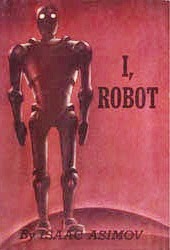
0936e-i_robotIsaac Asimov and Robert Heinlein (mentioned below), among many others, wrote countless short stories and pulp novels published in the venerable sci-fi magazines of the ’50s, mostly to do with space travel, time travel, alien races and the like, all the science fiction tropes that were, for the most part, old hat even then. Most of these works have aged poorly, cursed with flat characters and dull prose, tossed into the boys-adventure bin alongside Doc Savage and the Hardy Boys; but their best works, informed by compelling ideas, remain relevant and entertaining. Most sci-fi lists include Asimov’s Foundation series, and while I agree that its millennia-spanning vision of galactic civilization has been influential, it also reads like a historical artifact, whereas I, Robot remains interesting to modern readers. Ray Bradbury worked alongside the pulp authors, but his work has fared far better over the years, since it always relied more on his lambent prose than the novelty of a new premise.

Worth mentioning together are Wyndham’s and Miller’s books, both set post-nuclear apocalypse. While Wyndham used nuclear armageddon primarily as an excuse for a fantastical future dystopia (the most common application of apocalypse in fiction), Miller’s is concerned with the human drive to self-destruction itself, a theme addressed also in Neville Shute’s On the Beach (1957) and, much later, in Cormac McCarthy’s The Road (below).

Expanding Consciousness: Trippy Shit From the ’60s

Robert Heinlein, Stranger in a Strange Land (1961)
Anthony Burgess, A Clockwork Orange (1962)
Philip K. Dick, The Man in the High Castle (1962), Do Androids Dream of Electric Sheep? (1968), Ubik (1969)
Madeleine L’Engle, A Wrinkle in Time (1962)
Frank Herbert, Dune (1965)
Arthur C. Clarke, 2001 (1968), Rendezvous with Rama (1973)
Ursula K. Le Guin, the Earthsea trilogy (1968), The Left Hand of Darkness (1969), The Lathe of Heaven (1971), The Dispossessed (1974)
Kurt Vonnegut, Slaughterhouse-5 (1969)

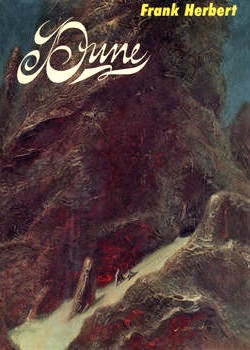
ae45b-frankherbert_dune_1stThe ’60s were a decade marked by experimentation, and nowhere is that clearer than in science fiction. These authors pushed against boundaries in every direction, demanding readers fundamentally re-examine their views on religion, sex, marriage, history, politics, gender, and consciousness itself, from the alien views and mystical powers of Heinlein’s Michael Valentine Smith, to Philip K. Dick’s over-the-limit reality-bending, to Herbert’s mind-expanding spice. Herbert’s Dune demands special mention as perhaps the single greatest science fiction book ever written, at once lyrical, daring, philosophically fascinating and tightly plotted. Ursula Le Guin has consistently crossed boundaries in her writing, her stories invariably moving in unexpected directions to challenge our own genre expectations.

There are a couple of odd ducks here as well. Burgess’s A Clockwork Orange is more in keeping with the dystopias of the ’50s, milk with knives in it notwithstanding, although the Cockney-Slavic dialect he wrote it in is as experimental as it gets. Arthur C. Clarke stands with Heinlein and Asimov in his hard-sci-fi style, although his is yet more opaque in character, enhancing the sense of mystery in his uncommunicative alien artifacts. Kurt Vonnegut’s Slaughterhouse-5 is, to my mind, only nominally science fiction, the fantastic elements mostly a narrative method to convey Vonnegut’s own experiences in World War II, but it’s also one of my favorite books, so I’m including it anyway.

Escape from Reality: ’70s and ’80s

Roger Zelazny, The Chronicles of Amber (1970)
Phillip Jose Farmer, the Riverworld series (1971)
Larry Niven and Jerry Pournelle, The Mote in God’s Eye (1974),Footfall (1985)
Piers Anthony, A Spell for Chameleon (1976)
Frederick Pohl, Gateway (1977)
Anne McCaffrey, The White Dragon (1978), Crystal Singer (1982)
Douglas Adams, The Hitchhiker’s Guide to the Galaxy (1979)
Michael Ende, The Neverending Story (1979)
Stephen King, Skeleton Crew (1979), The Running Man (1982), It (1986), The Drawing of the Three (1987)
Julian May, Saga of the Pliocene Exile (1981)
Alan Dean Foster, Nor Crystal Tears (1982)
Tim Powers, The Anubis Gates (1983), Last Call (1992)

By and large, these are light books, paperbacks to read on the bus, or for a twelve-year-old to stick in his backpack (as was invariably the case with me). Their prose is not necessarily the finest, their ideas not necessarily the freshest; they rely primarily on world-building for their fascination. And yet, I have a tremendous fondness for them, as I do for beautiful places I travelled to once and enjoyed a great deal. And in each there is something remarkable: Zelazny’s shadow-riding princes of Amber, Farmer’s colorful cast of historical misfits, Niven’s and Pournelle’s inventive aliens, Anthony’s light-as-air humor, May’s embellishments and refinements of psychic powers.

2b669-tumblr_lid950guze1qc1enbo1_500There are also, however, a few more substantial works in with the escapists. Adams’ Hitchhiker’s Guide is one of the funniest books every written, with profundity constantly peeking from beneath the absurdity. Ende’s Neverending Story is about fantasy itself, the liberating power of the imagination, and how that power gets lost in adulthood. (Also, while everyone’s seen the movie, the movie actually only covers the first half of the book – and that’s not even necessarily the better half.) Stephen King, of course, is always put on the horror shelf – I think they put that shelf there just for him – but in fact, he’s a superb fantasist and an unmatched master of suspense. I’ve listed four of his best, but if you’re going to just read one, make it It.
The Digital Age and Dawning Disillusionment

William Gibson, Neuromancer (1984), Idoru (1996), The Peripheral (2014)
Orson Scott Card, Ender’s Game (1985)
Greg Bear, Blood Music (1985), Hull Zero Three (2010)
Alan Moore and Dave Gibbons, Watchmen (1986)
David Brin, The Uplift War (1987)
Dan Simmons, Hyperion Cantos (1989)
Neal Stephenson, Snow Crash (1992), The Diamond Age (1995)
Jeff Noon, Vurt (1993)
Phillip Pullman, His Dark Materials (1995)
Bruce Sterling, Holy Fire (1996)
George R.R. Martin, A Song of Ice and Fire (1996)
Mark Z. Danielewski, House of Leaves (2000)
China Mieville, Perdido Street Station (2000), The Scar (2004)
Neil Gaiman, American Gods (2001)
Richard Morgan, Altered Carbon (2002), Broken Angels (2003)
Susanna Clarke, Jonathan Strange and Mr. Norrell (2004)
Vernor Vinge, Rainbows End (2006)
Cormac McCarthy, The Road (2006)
Max Brooks, World War Z (2006)
Paolo Bacigalupi, The Windup Girl (2009)
Lev Grossman, The Magicians trilogy (2009)
Kim Stanley Robinson, 2312 (2012)
David Mitchell, The Bone Clocks (2014)
Yoon Ha Lee, Ninefox Gambit (2016)

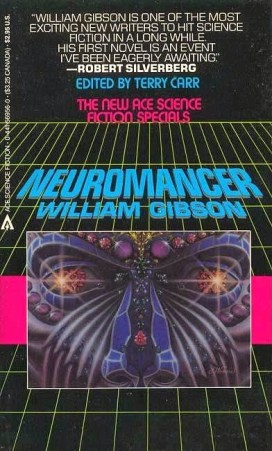
2dedc-neuromancer_bookFew books stand so clearly as boundary markers in literature as William Gibson’s Neuromancer. At its pulsing heart was a burning vision of the digital future, in which all information could be represented in virtual reality, and hackers rode programs like cracked-out sharks diving into deadly AI ice. Its ideas, and the dawning computer age that informed them, invigorated the genre like nothing had since space flight and LSD. Most futurist novels that followed dealt with the implications of the digital revolution, along with the continuous miniaturization of computer systems that accompanied it: Blood Music, Hyperion Cantos, Snow Crash, Vurt, Holy Fire, American Gods, Altered Carbon, Rainbows End, 2312.

There is a second trend here, namely a broader cultural mood of disillusionment and pessimism about the future. McCarthy’s The Road may be the darkest book every written, and its ashen landscapes are a precise description of nuclear winter. George Martin brought new life to sword-and-sorcery by casting his characters as cynical, power-hungry scrabblers in a dirty, violent world, and Phillip Pullman stoked some minor controversy by penning a popular young-adult trilogy with an atheist slant. Alan Moore’s Watchmen (yes, it’s a graphic novel, but it’s too good not to include) offered a vital critique of superheroes, depicting them variously as violent vigilantes, sociopaths, sexual fetishists, or disinterested gods.

Several of these works also display an increasing literary sophistication, from the hard, unsparing sentences of The Road (the only sci-fi book to ever win the Pulitzer), to David Mitchell’s cunningly interlocked plots, Susanna Clarke’s endless spinning of fairy tales, and Mark Danielewski’s labyrinthine textual constructions. Along with the wonderfully inventive genre-bending of his New Crobuzon books, China Mieville is known for literary experiments like The City & the City and Embassytown. Worth mentioning also is Michael Chabon’s The Yiddish Policemen’s Union, set in an alternate-universe Alaska.

While it’s true I’ve included a few of these selections for “educational” purposes (Verne and Wells, Huxley, Orwell, Miller, Burgess), I also want to say that as a rule, these aren’t hard books to read. To the contrary: they’re nearly all fast-paced, grip-you-by-the-throat stories that I’ve read and reread until the pages fell free from their bindings, out of pure fascination and delight. Just last Sunday I finished Gibson’s The Peripheral, and it was good, so freaking good, I felt like I was thirteen again, reading Neuromancer for the first time, with the very same sense of wonder at how strange the world is and how strange it may yet become.