The Shadow of All Things Past

JoelTagertStoryImage

Orrin hadn’t wanted such a large group, but his sister, Patience, wouldn’t be dissuaded, so in the end they were four, including his friends Matt Deving and Tom Rodriguez. Patience was the youngest, at eleven; Orrin the oldest, at fourteen (and the tallest, by a good five inches). Before dawn they made their way to the surface with their bicycles. In the early days of the Fort, you wouldn’t have been allowed outside at all without a rad suit, but these days even kids were allowed outside to play. There was talk of moving to the surface entirely, and some families had – there was obviously more space up there – but most still preferred the security of the great underground bunker that was Fort Haven.

They brought protein bars, and plenty of water, at least a gallon each; Orrin insisted on checking each backpack individually, and brought a little filtration system too. As the day went on it would get hot – a hundred and ten, maybe – but by that time they’d be down in the city. It would have made sense to go at night, but none of them wanted to be there after dark. “Everyone set?” he asked when they were gathered by the road.

“Let’s go already,” Matt said.

Orrin had read that the Romans built roads to last a thousand years, but it seemed like the Americans’ hadn’t lasted ten. Occasionally the kids took to the blacktop where sections still remained, but mostly they rode on the gravel shoulder. Rusted hulks of vehicles were lined all along the roadside or pushed down the ravines, long ago moved for the convenience of travelers. The kids kept peering into them, looking for skeletons, but it had been a long, long time, and most had collapsed into dust.

As the day lightened the landscape came clear: the mountains at their back, rough rocks and scrub grasses at either hand, the plains ahead. Once there had been trees, but they had all died in the Fall, and been burned for fuel by the survivors. At a small rise Orrin paused, staring into the sun. “There it is.”

Far below, the ghosts of roads still lay etched upon the earth. Upon that grid the broken remnants of human activity lay like cracked and discarded teeth. Disordered heaps of steel and concrete were dotted with larger structures; and in the far distance, a cluster of high-rises, or at least their skeletons, still clutched at the cloudless sky.

It took three and a half hours to reach the outskirts, by which time their asses were hurting bad from the bike seats. They stopped several times to rest and drink water, but Orrin kept pushing them on, thinking how much harder it would be on the return trip, riding uphill.

They came to a concrete bridge and rode it over a dry riverbed, and at last came to a building, or the remnants of one. It was large but low, constructed of cinder blocks that still retained some traces of beige paint. Of course the roof had long since fallen in.

“Should we go in?” asked Thomas.

“It’s why we came,” Orrin said, setting his kickstand.

“What if there’s someone inside?”

“There’s not.”

The double doors, made of ancient red-painted steel, still hung from their hinges. When Orrin opened the right it squealed like a disgruntled spirit. What if there was someone inside? But then, who could live here? What would they eat, with all the animals gone? Insects? He’d heard that’s what the Scratchers did, in their desperate surface lives: harvested beetles and ate them.

He shoved his way inside and entered a wide and roofless hallway. Nothing much but sand and debris from the roof, ancient boards, bits of metal. He turned at the first doorway.

Chairs and desks, dozens of them, in chaotic arrangements, tumbled and rusted. The color of the chairs’ plastic surfaces had only partially faded, orange, red and blue. He felt the others come up behind him and look over his shoulders, except for Patience, who peered around his stomach. “It’s a school,” she whispered.

Of course it was. Had been. He turned and went on. There might be a nurse’s station.
Indeed there had been, the red cross on a kit on the wall still visible. But it had been looted entirely, probably in the first days of the Fall, leaving nothing but grit and cobwebs.

They rode on, past the square concrete footprints of vanished houses, vehicles burned down to the axles. “Where are we going?” Patience asked.

“There,” Orrin said, nodding at the cluster of high-rises. If there was anything worthwhile, that’s where it would be.

The sun rose higher, and they sweated beneath their baseball caps. The dead city seemed to go on and on. He’d seen videos, of course, but he hadn’t realized it was so vast. Millions of people had lived here. How many in Fort Haven? Two thousand, stuffed into their concrete chambers like ants in a hill. How many at the larger refuge of Centcom, a hundred miles south? Maybe twenty thousand. And in all the world? A few million? Fewer than had lived in this single city.

They passed the remnant of a stadium, an enormous, half-shattered circlet of steel and concrete, like the discarded crown of a long-dead god. And on, until they stood at the foot of one of the high-rises, looking up awed. It was the tallest structure they had ever seen, by far; and it was a blasted ruin, the top third missing, its windows shattered or melted.

They did not try to go inside, but continued past plazas of dust and broken monuments, rubble heaped like mountains, avenues of drifted sand, and one building that had collapsed at an angle and still stood leaning wildly, like a soldier trying to stand on a broken leg. Further east, where they dared not stray, the destruction was still worse, the landscape reduced to an uneven expanse of cracked black glass.

Finally, in the heat of the day, they chose a building that was comparatively intact. They wandered its dead halls touching the gray faces of computer screens, the pitted and melted plastic, picking up broken bits of objects whose purpose they could only guess at. In its open-faced lobby they sat and ate, saying little.

They explored a few hours more, finding much of interest but nothing of use, until in late afternoon Tom pointed to a concrete wall. “Look at this.”

On the pale gray surface lay dark patterns. After a moment the shapes fell into place, and Orrin’s blood ran cold.

Three human-shaped outlines were etched there, each in a running pose. Here they had been caught; here their forms remained, forever fleeing. “Ghosts,” breathed Patience.

With difficulty Orrin tore his gaze away. “Just shadows.”

“Are we going to keep looking?”

He shook his head. “There’s nothing good here. It’s all gone.”

Together the four began the long hard ride back home, the sunset flaring in their eyes. Long before they arrived the moon rose, and its battered and lifeless face seemed a foreshadowing.

Regarding the Titans

eyeballs

When the last Titan fell the world threw a party. The one Emilia went to was in the largest dance hall in the city, and it had been decorated with their remains. They had not been human, nor nothing like; yet still she found it in poor taste. Here was a clawed manipulator tall as she was; here a flanged bit of armor; here an energy core, which had once pulsed red with power. “That was taken from the one they called the Flamer,” said someone nearby, who was wearing a Navy uniform. “Destroyed half of Seattle before they got it with some artillery.”

Ed Durrow, who had dragged her here, growled his approval. “Damn right. Sent it straight to hell.”

“Do machines go to hell?” Emilia asked.

“These have, I’m sure.”

On the stage a band of twelve was playing jaunty music, and people were starting to dance. “Emilia!” cried her friend Kelsey Sullivan, spying her and rushing in for an embrace, face flushed. “Isn’t it great? Come on, let’s have a toast!” She began pushing through the crowd, pulling Emilia in her wake.

Emilia drank the proffered champagne and tried to smile. All Chicago was drinking, it seemed, and no doubt all America, and the world. The machines had landed, and fought, and been destroyed. Humanity had triumphed. “What’s wrong?” Kelsey yelled over the music. “Are you and Ed fighting?”

“We’re fine.”

“Then what? This is a night to be happy!”

Half the cities of the world lay in ruins; Chicago itself had seen a quarter of its buildings destroyed when three machines had attacked its factories, and been attacked in turn. Yet the last of them were gone; the world was safe again, at least for now. “What if they come back?”

Kelsey gave her an astonished look. “Well, they’ll think twice about it now, won’t they?”

“I suppose.” Or would they? No one knew from where they had come; they had simply landed that day in 1927, lines of fire screaming through the sky, striking the Earth with a sound like the world ending, as indeed it seemed to be at the time.

But the Titans for all their technology, had not prevailed. When the Titans realized they were in a real fight, they responded in kind. But there were only a few thousand; and when one was destroyed, it was rarely replaced. Now it was June 1932; and the last of them lay in pieces, hung on the walls as garish trophies.

After a while, Ed found them again and took her hand. “Come on, let’s dance.” His were eyes were too bright, breath redolent with liquor.

She shook her head. “You two go ahead.”

“Not feeling good?”

“A headache.”

She found a seat by the wall and rubbed her temples. Soon someone sat beside her: the lieutenant from earlier. “I’m John Russell,” he said.

“Hi, John.”

“What’s your name?” So she told him. “Can I get you a drink?”

“No thank you.”

“Not feeling like dancing?” She shrugged. “Why not?”

If he was going to ask… “We don’t know anything about them,” she said. “Nothing at all. Where did they come from? What did they want? Are there more? We’re all here celebrating, but we’re like children, celebrating something we don’t understand.”

He looked at her more seriously. “You don’t have to understand something to know it’s attacking you. You just have to defend yourself.”

“I saw one once,” she continued. “Early on, in the first weeks after Invasion Day. I was visiting with family for the summer, and after the news we decided we better stay on the farm for a while, thinking it would be safer.

“In a way it was; it was never harmed. But one one of the Titans came through the fields. It was just as big as they say: taller than the barn as it walked by. I remember most that it shimmered silver as it walked; it seemed to be covered in lights, or some luminous material. It was near sunset, and it shone as it walked.

“I had been out walking myself, and of course I stopped and hid in the corn when it came by. It turned, and seemed to look right at me. Then it just kept going. It went to our car, a Cabriolet, and tore it apart. That was terrifying. When it was done, there wasn’t much left but the tires.

“Then it left. Just walked away.”

After a while Russell said thoughtfully. “You know they changed over time.”

“How do you mean?”

“They were altering themselves. That’s why they always went for machinery, heavy metals. They used the materials to repair themselves, to make changes, to build new Titans. But they were slow about it, which was fortunate for us.”

“I never heard that.”

“Can I show you something?” He stood up. “Come on, I won’t hurt you. Won’t even hit on you, too much.”

She let him lead her backstage. “I helped set this up,” he explained, as they passed a number of broken and mysterious objects, in strange shapes and hues. “Brought the parts here for people to see. But we didn’t use them all. Here, look at this.”

And there they were, three great orbs, slung from a hook on the wall like a cluster of grapes. Her own eyes widened in surprise. “These are from a Titan?”

“Yep. One of the last to fall, right here in Chicago.”

“But they’re so… human.”

He nodded. “I’m not sure the machines even realized who and what they were fighting until late in the war. Maybe they thought they were fighting other machines, and of course in a sense they were. But they started to catch on, toward the end.”

He unhooked one from its netting and handed it to her. It was smooth and glassy, surprisingly heavy. She sat down in a stool and cradled it, its gaze innocent as a child’s.

Mia in the Maelstrom

Three weeks after they were captured Mia had the dream. The sky above the warehouse grew dark with clouds in a gathering spiral, growing ever more massive, high and thick. Within the storm flashed bolts of crimson lightning that suffused the clouds with color, so the whole Texas sky was a slowly revolving blood-red maelstrom replete with flying shingles, barking dogs, cars, houses, all caught up in the irresistible wind. Finally the clawed finger of a twister reached down, right through the roof, and touched the plastic bracelet that had chafed on her ankle all these weeks.

Morning came as it always did, with the guards simply turning up the halogen lights in the warehouse. After a little while they opened the gate and the kids began filing out for breakfast. After Mia had gone past, however, the guard on duty, Johnson, grabbed her roughly by the arm. “Whoa, whoa. Where’s your bracelet? Huh? Dónde está tu bracelet?” He pointed at her bare ankle.

“No sé,” she whispered, wide-eyed.

“Come on.” Holding her arm in a painful grip, he dragged her back into the holding area. “Where’s your bed? Where do you sleep?” With trembling finger, she pointed it out. He stalked over, flung off the covers, and found what he was looking for.

Frowning, he picked it up. His frown deepened when he saw where it was broken, how the plastic looked like it had melted.

They took her to the doctor, Dr. Apgar. It was Apgar who had done their initial physical exams when they’d been admitted to the facility, which had been one of the most frightening experiences of Mia’s short life, sitting in her underwear and a green hospital gown while he poked and prodded and took her blood and performed other, stranger tests. The nurse said they were worried the children had a disease from Mexico, and that was why they had to take medicine every morning. But Mia had felt fine at the time, and none of the other children seemed sick, either.

Now Apgar, who was balding with curly, dark hair and glasses, held up the ankle bracelet. “Can you tell me how you did this, Mia?” he said in Spanish. “We’re very interested to know. Did you do it, or someone else?”

“It was just a dream,” she whispered. But this actually seemed to make him excited, and with his assistant he got out some machines and taped electrodes to her head and chest.

Then he asked her many questions, and asked her to remember her dream, and held up a simple metal spoon.

“Can you bend this?” he asked. She reached for it, and he stopped her. “Can you bend it without touching it?” But that didn’t make any sense.

Hours later, she was exhausted and crying, and the doctor seemed dissatisfied. Finally he said to his assistant, “We’ll keep her under observation tonight. We can continue in the morning.”

She thought they would lead her back to the holding area, but instead they took her to a plain white room that held only a bed, a sink and a toilet, along with a mirrored window.”I want to go back to the other kids,” she pleaded. She was only seven, but she knew a cell when she saw one. They didn’t listen.

There was no one to talk to, no toys, no TV, no books, nothing on the walls. She tried the door, but it was held by a solid steel deadbolt. “I want to go back,” she kept saying, slapping at the mirrored glass.

She lay down on the bed. She wanted to sleep, but the light was too bright. At last she fell into a troubled half-sleep with her arm over her eyes.

The dream came again: the very same. But this time it was like the twister was her finger, and she reached down and touched the light that was bothering her. With a noise it popped, which actually startled her awake. She was left sitting there in the dark, holding her knees.

After just a few seconds the door opened. In the bright light from the hallway the person there formed a featureless silhouette, a looming shadow. Then her eyes adjusted, and she saw it was Dr. Apgar. “The light was bugging me,” she said by way of explanation. ImageForJoel

“We’ll fix it,” he said. Turning, he asked a guard behind him to find a new bulb. When the guard was gone, he stepped into the cell and looked closely at the bulb, and at the glass on the floor. He picked up a piece, at the seemingly melted edge of the glass.

He sat on the bed with her. “Would you like to leave this place, Mia? Go somewhere more comfortable?”

“But where?” she asked.

“Somewhere far away. Not in Texas.”

“I want my mama,” she said forcefully.

“Ah. Of course.” As though it hadn’t occurred to him. “Well, probably that can be arranged.”

“I want my mama,” she repeated. “Where is she?”

“We’ll find her,” he said. “Don’t worry.”

“But where is she?”

“We’ll find her,” he repeated. “We’ll find her, and then you can be in a new place. If you show me how you broke the light, understand?”

He didn’t know, she realized suddenly. He didn’t know where her mama was, and for that matter didn’t really care. He might never find her.

Unbidden, she saw the red storm in her mind’s eye, the great crimson mass revolving. The twister reached down.

It was just a light touch, the lightest. No more than would take to bend a spoon. When it withdrew Apgar lay twitching on the bed, eyes scrunched shut behind his glasses, hands at his head. A bit of blood was coming from his nose. The lightest touch, in the right place, could topple mountains.

She got up and went to the door. For a moment she stood there looking outward, eyes adjusting to the light. She had neither plan nor destination, and soon the guard would return. All around her spun the maelstrom.

A Picnic Interrupted

ant

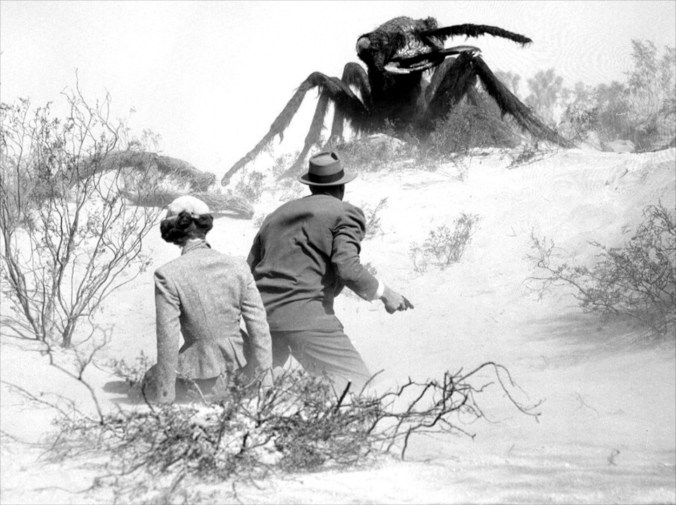
I tell ya, it’s getting so you can’t take a dame to an abandoned beach no more without some giant bug trying to crunch you between its mouth-hooks. There I was with my client, Ms. Harriet Flores, when this giant ant comes over the rise, and it looks red, mean, huge and hungry. I stand up lickety-split, pulling my bean-squirter. I look once at Flores, who’s looking right back at me, and then the ant is rushing us. But I didn’t spend six years in Uncle Sam’s shooting club for nothing, so I put a slug right in one of its ugly eyes, and down it goes, flailing its legs and stirring up a cloud of sand right in our faces.

When I’m done spitting grit, I grab Flores’s hand. “Come on, we gotta run.”

She stands, but none too quickly. “What for? It’s dead.”

“You ever see just one ant at a picnic? Come on!”

***

Seems like lately I been seeing ants everywhere. Must be how some hop-heads feel, always scratching imaginary bugs, only mine are real and oversized.

Last Wednesday this guy by the name of Selva comes into my office. He’s clean-cut and in a good suit, so I figure maybe he’s got some dough. Then he says he’s a civil-rights lawyer, so I reconsider. But I hear him out.

“People are dying in the fields,” he says. “Three so far. The others are terrified, but they don’t want to talk to the police.”

“What people?”

“Migrant workers. Fruit pickers.”

“I thought that was all done by ants these days.” You see ’em all the time, driving around California – little black knee-high buggers tending the crops. Helluva lot cheaper than paying any kind of human.

“Ants are best for low plants.” He puts his hand at his waist. “For orchards, not as good. So there are still humans. This is in the orange orchards in Riverside.”

Seems three workers are picking oranges in the sky now. He shows me pictures, and they aren’t pretty. Looks like someone went at ’em with a machete. “Hard to believe the police aren’t looking into it.”

“They think it’s maybe gangs from Mexico, drugs. But it’s not. And right next door to the orchards is a military base, and they don’t answer questions.”

I’m about to tell him if the Army’s involved, there isn’t much I can do – I’m a private dick, not a spy – but he pulls out three C-notes and I shut my yap. I promise no results, but for that many berries, I’ll give it the old college try.

***

The Riverside base has fences twelve feet high and electrified, miles of ’em, and some big warehouses in the distance. The guards at the gate eye me as I cruise past slow on the highway. No way am I getting in there.

But I have my own sources. Find out there’s a lot of animal feed getting shipped in there, and a lot of scientists going in and out. Word is it’s some kind of testing facility, but no one’ll say what they’re testing.

***

A week later Flores shows up. She’s real put together, like a Swiss watch, and about as complicated. “Are you Ray Denton?”

“What it says on the door. What can I do you for?”

She says she’s looking for her sister, who disappeared a few days prior. Probably her sis has just run off, but she insists otherwise. “We were staying at a beach house down by San Clemente. I went out for groceries, and when I came back she was gone.” I tell her my rates, and here again she pulls out two Benjamins and forks ’em over. My lucky month.

So we pile in her convertible and head south to look at the beach house. The Pacific’s blue and the breeze is fresh. Here and there are cars by the side of the road where people have pulled over to swim or to ride horses, which they do around here – just before we stop I notice two silver horse trailers.

When we’re parked, she takes a little perfume and dabs it on her wrists and neck. “Is this a date now?” I ask.

“Anything’s possible,” she says archly. And before we even get to the house, she asks if we can stop a minute. “Let’s just enjoy the view for a minute.”

I’m getting paid, so I’m perfectly amenable, and maybe she wants to tell me something. I’m about to ask her what the deal is when the ant shows up.

***

With the first ant dead, we run, and I swear she’s slowing me down the whole way back to the car. With twenty yards to go I spot three more of the big red suckers, and hoo boy can they move. I fire at one and hit it, judging from the squeal it makes, and tell Flores to give me the keys. “I can drive,” she protests. It is her car, after all.

I show her the business end of the revolver. “Keys now, lady!”

We burn rubber out of there, and damned if the bugs don’t keep pace for half a mile. Then we’re doing sixty-five and they’re out of sight. Fifteen minutes later I pull over. “You want to tell me what this is really about?”

She tightens her lips. “I think you’re going to have to tell me.”

“All right, I will. You don’t have a sister, never did, and there’s nothing much in that house. You drove me out here to take care of a problem, and maybe to give your damn bugs some practice. You brought the ants out here in those trailers, and put that scent on right before heading out. I’m betting it’s some kind of pheromone to let ’em know not to kill you. It stinks, by the way.

“Whoever you are, you work for someone at the base at Riverside, and you’re cooking up something nasty – for-real Army ants that will only attack the enemy. But one got out and decided to see how the locals taste. That about the size of it?”

She sneers. “What if it is? What are you going to do about it?”

“I’m going to kick you out of this car, is what.” So I do. Then I keep heading north, looking for someplace scenic, cold and giant-insect-free.

Marathon

Wrote this song and recorded this video a couple years back, but for some reason never shared it. Well, here it is now. Lyrics follow.

It’s not that I didn’t suspect, I just couldn’t say
With precision where the conflict lay
But here in this journal it’s so plain to see
The Gordian knot of our joint misery

I thought love was some kind of marathon
All I needed was to carry on
But you grew to hate my heart of stone
You just wanted to be left alone

Then you cut through our ties like a blade
A few swift strokes and all our lies were unmade

Maybe you forgot, but I never could
That day we walked beneath the cottonwoods
By the riverbank we made our tryst
You the very first I’d ever kissed

In the dusk your skin silvery shone
In the chill spring air I trembled like a fawn

I still see you in my dreams
Slipping so swiftly downstream
Your eyes fixed on the waxing moon
Your ears witched by some faerie tune

Mingus Rides North

mingus

Mingus rode north and Death rode with him. Mingus was, or had been, a canary. Death was this Swedish kid named Niclas he’d picked up hitchhiking outside Billings. Kind of a strange kid, truth be told. Did a lot of drugs.

“Stop here,” urged Niclas as they approached a Petro-Canada. “I need smokes.”

Mingus angled the Malibu toward a spot out front, but gave his passenger a dubious look. “You should let me go in.”

The skull looked at him intently. Mingus could see the back of its eye sockets, which wasn’t something you often saw when you looked at someone. “So what now, I never can talk to another human being?”

“That’s just it,” Mingus gently argued, “you don’t seem to be human exactly anymore.”

“I have a body, man. Look, it’s human.”

“It’s a human skeleton, yes. Walking and talking and smoking.”

“Yeah, like I say.” Niclas looked out the tinted window with dissatisfaction. “Fine, you go. But then we stop at a rest area or some place.”

“Okay.” Mingus got out. In Canada, it seemed, even the gas stations had beautiful views – mountains, a lake with a dock. Some boats down there. He felt refreshed, like maybe things would work out for the best after all. They’d find somewhere without any people, and spend their days chopping wood and carrying water and such. It was all admittedly a little vague, but it felt worth pursuing.

Inside the forty-something clerk was watching a television on the counter. Her gaze barely left the screen as she retrieved the cigarettes. Bizarre creatures were loping and flying and squirming down city streets, buildings burning, policemen in riot gear. “What do you think?” she said, jerking her chin absently at the TV.

He glanced at it nervously. “Oh, I don’t know. Probably good to stay away for now.”

“But what do you think it is? Look, this cop just turned into a walking refrigerator.”

“Well, if I had to guess… I’d say that probably a scientist was researching interdimensional phase changes using planar crystals in a lab in Denver. Then, probably, she found out she’d succeeded when her canary, which she kept around partly to warn of dangerous dimensional fluctuations, suddenly turned into a middle-aged man in a blue suit.

“Then, probably, she made the mistake of touching him, which initiated another phase change, turning her into an octopus. It’s like how very pure water won’t freeze until you introduce a little impurity, and then it freezes instantaneously.”

Her eyes narrowed. “But what about all this shit?”

“Oh, well, turns out it’s communicable. Just by touching. So… might want to stay at home for a little while. Or just not worry about it. It’s not so bad.”

She backed away. “I think you should go now.”

He nodded. “No worries.” He was hearing shouting anyway.

Outside a big red-bearded guy was backing away from his motorcycle, which Niclas had come out to admire. “You’re not taking me!” the biker was yelling, ducking around the pumps toward Mingus. “I’m not ready to go!”

“I’m not really Death, man,” said Niclas. “It’s just how I look. I can’t help that, you know?”

Mr. Redbeard seized a window-washer from a plastic well and waved it in front of him.

“Back off! I’ll use this!” Washing fluid sprayed the concrete.

“Excuse me,” Mingus said, and tapped the fellow on the neck. With his bare finger.

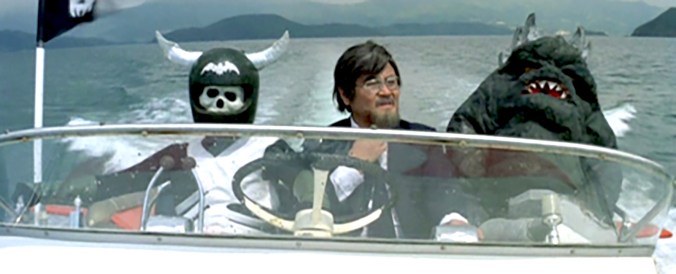
There was a crackling noise and a brilliant fragmented alteration of the space around the biker, as though he’d been suddenly encased in a sparkling glass mosaic. When it dissipated, there stood a short, exceptionally ugly gray-green demon thingie. Sharp, curving horns, flesh like rock, remarkably large triangular teeth, flaming orange eyes.

This squat devil looked down at itself, gasped, and made a rush for the motorcycle, deciding death was preferable to staying put, but unfortunately the keys had disappeared in the transformation along with his clothes. Also, his short legs couldn’t reach the chopper’s pegs. He raised his hideous visage to the sky and howled.

“Calm down, man,” said Niclas. “It’s okay, you’re just a little different now.”

The biker’s name was Fred. After a lot of reassurance, they all sat on the curb and contemplated their changed existences. “Listen,” Mingus said finally, “I’m sick of driving anyway. What say we walk down to that dock, steal a boat, and look around for a nice cabin on the lake?”

Fred shrugged in defeat. “Sure. I mean, I was going to meet my buddy in Prince George, but now he wouldn’t even recognize me.”

“Hey, everybody changes, man,” said Niclas breezily. “Can I take your helmet?”

Out on the water the air was crisp and fresh. As a canary, he’d been kept in a cage. This new life was confusing, but the mountains offered grand vistas of possibility.

Mingus rode north, and Death and the Devil rode with him.

A little flow

One of my not-so-secret secrets is that I like to dance. I find dancing an altogether remarkable activity, at once social celebration, artistic expression, and low-impact cardiovascular exercise. In some ways it seems to me also the mirror of zazen: where in zazen one forgets the self through stillness, in dancing one forgets the self through pure uninhibited motion.

Beyond the Worldwall, Chapter 4: A Guide to the Land of Devils

Once MacMillan was safely back at camp, Boleti turned back toward the site of the attack. He held his rifle at the ready, cradled in his arms. There had been quite a few of the creatures – a half-dozen or more – and the men had killed at least three. It passed through his mind that perhaps they could eat them, but then he saw again the creatures’ black blood, and dismissed the idea. Nothing that bled that color could be good for people to eat.

beads

When he neared the glade, he first stood a long time in the shadows, waiting. Perhaps the animals were likewise lying in wait. But after an hour he had seen and heard nothing, and he stepped forth from his hiding spot. There was plenty of that black blood visible, on the low ferns, the moss, the tree trunks; but the bodies of the beasts themselves were gone.

That was too bad, and a bit puzzling. He had hoped to have a closer look at their anatomy, having never seen anything like them, and he was sure the others would be interested as well. No doubt MacMillan would have wanted to dissect one, if the surgeon hadn’t been rendered insensible from his injuries. (Personally Boleti doubted he would live.) He especially wanted a look at that odd, bifurcated, tentacled proboscis… like two hands, almost.

Had some other scavenger dragged the bodies somewhere, perhaps up into the trees? It was possible. But somehow he thought that the creatures had returned to claim their dead. It was a strange thought; what animal cared for its dead? But perhaps they had taken the bodies merely to consume them.

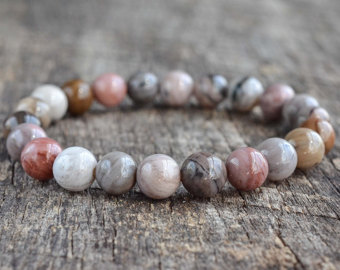
He squatted and picked up something that had caught his eye, handling it carefully: a variety of hard, multicolored seeds or nuts, each drilled through its center and run though by a cord of fibrous brown string. The cord had parted, and many of the crude beads were flung about the ground nearby, but still he could see a pattern to the arrangement: red nut, green nut, red nut, green nut. Continue reading

War is propaganda. Peace is truth.

Contrary to popular belief, the real point of war is not to destroy your enemies or raze their lands. It is, rather, to persuade them that you are in control, that one government’s rule is illegitimate and powerless while another’s is rightful and effective. It is only when a population acquiesces to one side or another that a war may be said to be over. Thus, war and propaganda are essentially inseparable. War itself is propaganda.

Seen in this light, the real purpose of “limited strikes” and “proportional response” becomes clear. The intent is not to end one government or even substantially hinder its military capability; rather, it is a means of persuading various parties of your authority. In the case of the recent missile strikes on targets in Syria, it seems likely that they will sway nearly no one within that country, and Assad’s jaunty walk to work the next day is perfectly in keeping. Who, then, are these strikes meant to persuade?

The answer is perfectly obvious: The real target is the American people. The strikes were done for the express purpose of convincing us that the current government, and especially the President, possess real power and the moral authority to wield it. It’s classic sleight-of-hand: The magician draws your attention to a bright handkerchief with one hand while relieving you of your valuables with the other. Don’t be deceived. Don’t look away.

Breaking Free from Gun Violence

The basic difficulty in ending gun violence is, I think, the immediate reflex toward self-defensive fear in the face of that violence. Where some of us, on hearing of another massacre, will advocate for stronger gun control laws and mental health care, many others see only possible danger to themselves as individuals, and cling to guns as means of self-defense (however uncertain that means is).

It’s a difficult spiral to break free from: violence to self-defensive fear to widespread gun ownership, which leads to more violence and more fear. It’s rooted very deep in our culture, which continues to worship warrior archetypes that invariably represent and advocate violence as the primary means of male power and redemption.

On a personal level, we have to break free of fear, first and foremost. We must recognize that all life is uncertain, and that the effects of our actions extend far beyond our individual selves. We are connected root and branch to the people around us, as the tree is to the soil, and our lives are, in the final analysis, just drops of rain in the torrent. Will we nourish life with kindness and self-sacrifice, or will we, in clinging to our fear and the desire for vengeance, allow our spirits to become poisoned?

On the societal level, we must turn to communities founded on principles of openness, compassion, and nonviolence, and provide them our energy, our material support, and our gratitude. We need also in particular to turn away from the destructive greed of capitalism and its feudal hierarchies, which perpetuate enormous inequality in our daily lives and workplaces. Really, it is when every person is loved and cared for, nurtured emotionally, spiritually and physically, that individual violence and its societal counterpart, war, will finally cease. On that day we will wake up at last to the world we have dreamed; and all we must do to accomplish it is give up our fears.

ancient-banyan-big-island-hawaii-james-brandon